


BRUNSWICK COUNTY — Two planned developments previously turned down by the Brunswick County Planning Board are moving forward after developers returned with revised proposals this week. The approvals will make way for 771 homes coming to Ash and Bolivia in Brunswick County.
READ MORE: 1,450-home Green Hill planned development rejected in Brunswick County
ALSO: Former lumber site to become 1,500-home development near Ash
Woodland Reserve and Willow Haven — projects denied in September and October — have been reduced by a combined 181 units. Both developments were turned down in part due to traffic safety concerns, but upon return have altered proposals to cut units and scale back uses.
Though the board determined the revised plans addressed previous issues, residents still turned out to voice their opposition to both projects, most concerned with traffic impacts.
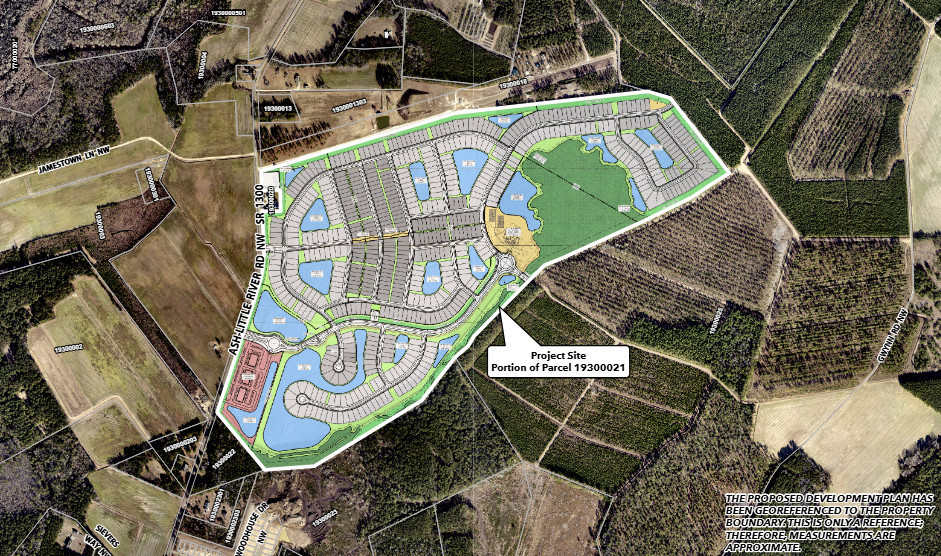
Woodland Reserve
The 232-acre Woodland Reserve planned development on Ash-Little River Road received unanimous approval after the board agreed it significantly reduced the impact on roadways
The project will consist of 620 single-family homes, as well as a pickleball court, recreation center, and pool. It also includes a 9.8 acre commercial component.
The board rejected in a 3-2 vote the former 650-unit project in September due to concerns of traffic congestion and overdevelopment in the area. About 900 people travel on Ash-Little River Road daily, although residents are worried other approved developments nearby — like the 2,750 unit Ashton Farms community near Ash — will overencumber the road.
Woodland Reserve’s previous plans also included 13.9 acres of commercial space, collectively generating an estimated 14,235 daily vehicle trips. Seeking to lower daily trips, applicant Lennar Carolinas, LLC, said the new plan will cut traffic by more than half — or 7,554 daily trips.
To do so, it amended the commercial uses, removing a supermarket, drive-through fast food, and gas station, and decreasing acreage to 9.8. The new plan also reduced the residential unit count by 30 and is also age-restricted to residents 55 and older, whereas before it was open for all.
Vice Chair Jason Gaver asked the applicant’s attorney, Matt Nichols, about the 30-unit cut, questioning the significance.
“I think a reduction in 30 units is a drop in the bucket,” he stated. “Suggesting that it’s reducing the footprint, I think, is a little misleading to the folks in the room.”
In response, Nichols emphasized the new unit count is not the biggest change, contending removal of commercial uses and the new age restrictions is the main driver bringing down daily vehicle travel.
The revised plan decreased the proposed commercial area by 4.1 acres and limited the types of businesses to only strip retail. The original commercial component was projected to generate 8,469 vehicle trips per day, but by removing uses, the updated projection dropped to only 1,496 trips per day — an 82% reduction.
“What we’ve done is eliminated the most intense commercial uses,” Nichols said, contending the remaining planned strip retail would not have peak hours coinciding with morning and evening commuter traffic.
Beyond traffic, Nichols said scaling back commercial elements allows more room for stormwater control. The space previously occupied by the supermarket was revised to extend a stormwater pond, as well as add an additional pond solely for commercial runoff.
Board member Richard Leary requested the explicit exclusion of gas stations, supermarkets, and drive-through restaurants be added as a fourth condition of approval, which Nichols agreed to.
The other major factor in traffic reduction was the commitment to making the residential component age-restricted. Nichols asserted 55-and-older communities minimize impacts during morning and evening rush hours and pointed to data prepared by project traffic engineer Scott Davenport. Nichols said senior adult detached housing would generate about 41% fewer trips over a 24-hour period than single-family detached market-rate housing.
“Oftentimes you don’t have folks going to work at the same time, you don’t have kids getting to school,” Nichols said. “The trips are more in the off-peak hours and that has a better trip distribution throughout the day.”
Gaver fully endorsed the approach for more senior housing. The median age for Brunswick County is 52.8, higher than the median age of 38.6 for North Carolina.
“I think there’s a great need for an age-restricted community, so I think that was very smart,” Gaver said.
However, some residents in attendance weren’t convinced. Shirley Sullivan refuted the claim seniors drive less than others.
“The seniors actually have more trips to the doctor, more trips to the hospital, more trips to labs than the families,” she said.
Her comments were echoed by resident Judy Andricak, who said medical facilities in the area for seniors who would live at Woodland Reserve are inadequate. While the immediate vicinity contains the Brunswick Health & Rehab Center, the nearest full-service hospitals with 24/7 emergency care are located approximately 13 to 14 miles away: Novant Health Brunswick Medical Center in Supply and McLeod Health Seacoast in Little River, South Carolina.
Despite questions from residents about health services, the board found the revised plan adequate for approval.
Willow Haven
The Willow Haven planned development on 81.8 acres off U.S. 17 near Bolivia returned to the board after the initial denial on Oct. 13. The original project, consisting of 209 units, was rejected due to concerns over traffic safety.
Applicant GE Engineering & Surveying, represented by Brady Gantt, revised the proposal by reducing the total single-family units by 58, bringing the new plan to 151 units. As a direct result of fewer units, the updated traffic impact analysis decreased about 500 trips from 1,970 to 1,422.
Gantt agreed to several safety improvements on Ocean Highway East, including an enhanced divided entrance and an additional stub-out access to the north of the property. A new left-turn lane and a new right-turn lane on Ocean Highway East will also be installed.
Despite the developer’s efforts, residents remained unconvinced Willow Haven would be safe for motorists. Resident Haley McFarland explained the already dangerous state of the local roads and intersections in proximity to the site.
“The location of this development is already in a known high traffic area. It sits right between two major intersections that do not have traffic lights and already pose a health and safety risk,” she said, pointing to an accident that happened earlier in the day when she drove on the road.
McFarland called the nearby intersection of Cherry Tree Road at U.S. 17 a “deadly place to pull out.”
Gaver also was concerned the project’s impact would further encumber an already overcrowded school system. Prospective students living in Willow Haven would be districted to attend Bolivia Elementary School, South Brunswick Middle, and South Brunswick High School.
The board heard from Larry Smith, executive director of operations for Brunswick County Schools, who provided a snapshot of county school capacity. Bolivia Elementary currently has room for 21 more students at the time of the hearing and is projected to hit 100% capacity as early as next school year.
By contrast, both South Brunswick Middle and South Brunswick High Schools will have adequate capacity for the foreseeable future, though South Brunswick High is expected to near capacity around 2030.
Gaver asked Smith if modular classrooms are included in the district’s projections. Smith explained modular classrooms have been used as a necessary stop-gap measure to manage the overflow, while the county works toward building new, permanent schools. The county is currently utilizing 20 modular units and is projected to increase by four to six per year until more schools are constructed.
“It doesn’t have the amenities of being in the school,” Smith said. “Access to the gym, cafeteria, the media center, and all those students have to come from outside in, and the weather. Honestly, we can’t secure it like we can the inside of the school, in the event of a lockdown or emergency. Those units are not as safe as brick and mortar.”
After hearing from Smith, Gaver called it “negligent to approve more rooftops” until school infrastructure catches up with growth, making the motion to deny.
“I think it would be extremely wrong of us to overload an already overburdened school system by approving developments,” Gaver said. “I have zero issues with this development, I have zero issues with the improvements. It is solely based on school capacity. Our kids are the future of this county — period, end of story.”
Gaver’s motion to deny failed to get a second. Leary then moved to approve the project based on the staff’s positive recommendation and the developer’s commitment to the conditions. The motion passed 4-1, with Gaver casting the lone dissenting vote.
Have tips or suggestions for Charlie Fossen? Email [email protected]
At Port City Daily, we aim to keep locals informed on top-of-mind news facing the tri-county region. To support our work and help us reach more people in 2026, please, consider helping one of two ways: Subscribe here or make a one-time contribution here.
We appreciate your ongoing support.
