


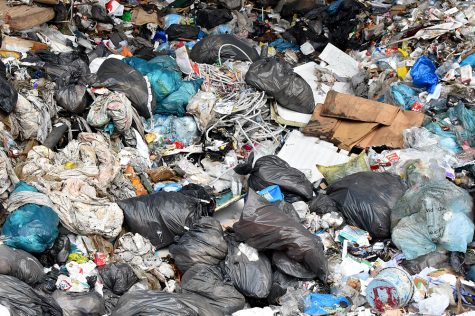
NEW HANOVER COUNTY — Two engineers appeared before the county commissioners last week with a proposal to turn landfill waste into a form of “clean energy.” County staff are hesitant, though the county will continue to explore the idea — and others — as the clock ticks on the county’s landfill lifespan.
“We agree that burying trash forever is not the perfect solution, but I’m often uncomfortable with unsolicited proposals that have no prior operating standard,” County Manager Chris Coudriet said at the commissioners’ Nov. 17 meeting. “I don’t believe that the county should be on the avant garde of how to deal with solid waste.”
READ MORE: Landfill solar farm project delayed, secondary rooftop solar plan underway
However, Neil Williams and Stuart Cooke, behind MEP/EnviRemed Environmental, claim their proposal — essentially turning waste into a gas that can be converted into fuel — is supported by several environmental agencies and working in several locales.
“It’s a chance for the county to lead again, proving that environmental protection and economic strength can go hand-in-hand,” Cooke said.
Cooke — a local who is the brother of Brunswick County Commissioner Marty Cooke — told commissioners he has located two potential sites off N.C. Highway 421 for the proposed gasification facility, as well as a property just over the border in Brunswick County.
The representatives are seeking a contract with the county to dispose of landfill’s trash through gasification. The process uses a combination of electricity and high heat to break down trash to its molecular level — no burning involved — and convert it into syngas. The gas can then be used for fuel, electricity, hydrogen and more.
The process does create a byproduct called “slag,” which looks like glass or rock. Theoretically, this can be used in road-paving or other construction materials.
“The system is fully self-contained — no wastewater, no runoff, no contamination … air emissions are about 100 times lower than the federal standards, making this one of the cleanest waste energy systems in existence,” Cooke said.
He claimed 95% of what would go through its facility — municipal solid waste, hazardous waste, agricultural waste, medical waste, plastics, construction debris and sewer sludge — will be turned into gas. The remaining 5% will be delivered to the landfill.
Conserving landfill space is a draw for New Hanover County, whose landfill has an estimated 23 years left in its lifespan. Both expanding the landfill, if that’s even possible with New Hanover County’s dwindling available acreage, and trucking waste to other sites would come with high costs.
“My initial reaction is that this sounds great; it sounds like a very interesting proposition that I would like to explore further,” Commissioner Dane Scalise said.
Cooke shared his team has been working with the county on a proposal for more than a year — “just so that they could vet us as far as from their foxhole,” he said. The county asked the company to seek guidance from the North Carolina Division of Environmental Quality, which recommended the proposal for New Hanover County.
Commissioner Rob Zapple questioned whether Cooke had that in writing.
“That may be strong terminology,” Cooke countered. “I appreciate the question — what they did was they started skeptical. They brought everybody from all facets of their organization to a meeting that took three months, and we all had a large room, and they took us through the soup to nuts about what we’re proposing for New Hanover County. Based on that meeting, they said: ‘This sounds great, especially for an application like New Hanover County.’”
However, without county staff’s endorsement, the commissioners weren’t comfortable accepting solicitation without further staff research and identification of other solutions. Coudriet and Joe Suleyman, director of the county’s recycling and solid waste department, advocated for a wider call for proposals; additionally, Suleyman said he was concerned about the engineers’ ability to follow through on the proposed plan.
“We have not identified any comparable gasification facilities that process the amount of municipal solid waste being proposed, so the likelihood of success remains uncertain,” he said.
Cooke claimed the facility would be able to process the 1,000 tons coming into the county’s landfill per day, though Suleyman said that number is more like 2,000 in an 2023 interview.
There doesn’t appear to be a facility in the U.S. processing that amount. There is a demonstration plant in Durham, North Carolina, though the facility only processes municipal solid waste.
Cooke pointed to a Dubai gasification plant, the largest in the world, converting 6,000 tons a day to synthetic fuel. Another facility exists in Spain, processing 1,270 tons per day.
The technology is more emergent in the United States. Williams attributed it to a rise in diesel costs 10 years ago, from which the country is still recovering.
Aries Clean Technologies is planning to open a gasification plant to treat municipal wastewater in Linden, New Jersey, while an InEnTec plant converting waste to hydrogen was just finished in Arlington, Oregon. Both will process less than 1,000 tons a day.
These facilities often require high initial investments — the New Jersey gasification facility cost $65 million, $55 million of which were financed with tax-exempt bonds through the Union County Improvement Authority. Operational costs also remain hard to find, as the technology is in the beginning stages in the U.S.
However, the MEP/EnviRemed Environmental representatives said they are not looking for county investment.
“If anything were to happen to us at any time for any reason that we can no longer perform, you still have full control of your landfill,” Cooke said. “Nothing changes. You still continue to be able to operate just exactly as you do today.”
The commissioners and county staff agreed to keep the gasification proposal on the table for potential landfill solutions, Coudriet saying the goal is to identify a plan in the next six months to a year.
Tips or comments? Reach out to journalist Brenna Flanagan here.
At Port City Daily, we aim to keep locals informed on top-of-mind news facing the tri-county region. To support our work and help us reach more people in 2026, please, consider helping one of two ways: Subscribe here or make a one-time contribution here.
We appreciate your ongoing support.
