


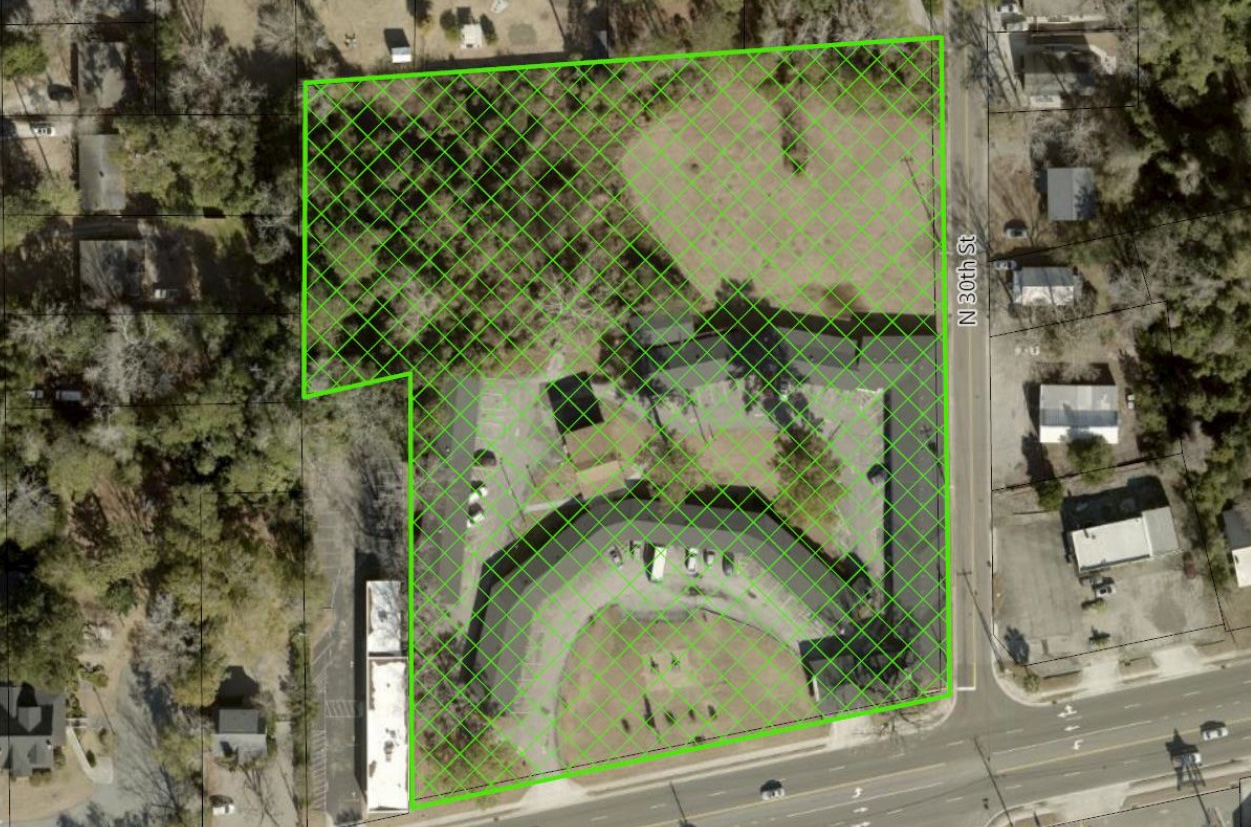
WILMINGTON — More workforce housing is coming to Wilmington, as city council approved a four-story project that would raze a one-story motel on Market Street to create 120 one-bedroom, two-bedroom and three-bedroom units.
READ MORE: Rezoning for 120 workforce housing units receive thumbs-up from planning commission
ALSO: 120 affordable apartments: Local developer seeks rezoning at Market and 30 streets
The vote came down to 6-1, council member Kevin Spears dissenting, to approve the rezoning of 4 acres at 2929 Market Street. The property moves from O&I (office & institutional) to MD-17CD (high-density multiple dwelling, conditional district) to make way for the Apex on Market. The complex will be for renters who meet the 30% to 80% area median income. According to developer Blue Ridge Atlantic’s proposal, monthly rents range from $500 for one-bedrooms to $1,700 for three-bedrooms.
Some residents at the public hearing at Tuesday’s council meeting were less convinced by the project’s promised affordability. Resident Ryan Beecham referred to it as a “scam” and “absolutely preposterous.”
Blue Ridge president Sam Weldon explained Apex was in compliance with state law defining workforce housing, adding the project is funded by the Low-Income Housing Tax Credit program. The North Carolina Housing Finance Agency gave the developer $1.8 million annually in tax credits, which are then sold to private investors for cash. The money received acts as a subsidy to help build the project and allows for lower rents. In addition to the tax credits, council also approved $1 million in gap financing for the development from the city’s General Fund Committed Affordable Housing Fund.
“This is not breaking new ground, this is not a scam,” council member Charlie Rivenbark stated. “This is a benefit. We should be out on the street cheering these people.”
Resident and former teacher Sarah Moxley questioned: “What teacher is going to be able to afford $1,700 a month?” cautioning against the overuse of the term “affordable housing.” The median rent in Wilmington is roughly $1,400 for a one-bedroom apartment and about $2,200 for a three-bedroom.
Part of LIHTC approval means strict criteria has to be followed and monitored by the developer annually. This includes ensuring renters’ salaries remain in the AMI brackets, and that rents charged do not exceed established caps, to comply with the federal program. The goal is to keep the development affordable for 30 years.
Speaking in support, council member Salette Andrews called the project a unique opportunity to build the type of housing the city needs.
“We have no way out of this housing crisis without building more housing and we get so many developments that come before us that have zero elements of affordable housing,” she stated. “We have so many units that have 10% so that they can get their density [cap] lifted. And when we get these that have 100% affordable housing, it’s just so rare and such a wonderful opportunity that it becomes really hard to pass up.”
Blue Ridge is also behind Canopy Pointe, a senior development project in the northern part of the county, also fully affordable for its 72 units, and is bringing Avenue Flats to Kerr Avenue, also a LITHC project. Starway Village, 278 units of affordable housing, is another set to open next month on Carolina Beach Road.
Mayor Bill Saffo called the proposed project a better option than what’s currently there. He referenced previous issues with the Azalea Inn being a frequent location for police calls. City attorney Meredith Everhart noted in her research of the hotel, service calls have decreased slightly in recent years but police still are drawn to the property.
The Azalea Inn was investigated in 2015 as part of a series of establishments targeted as part of the New Hanover County District Attorney’s office efforts to address businesses operating as a public nuisance. Along with five other hotels along Market Street, the Azalea Inn was identified with calls related to drug activity, prostitution, and violence. The district attorney’s office sent a letter to the hotel, demanding they remedy the criminal activity or face a civil lawsuit under public nuisance law. No action was taken against the hotel.
Spears, who lives in the neighborhood near the project, pushed back on the mayor’s reference to crime in the area.
“I’ll speak for my neighbors: We’re pretty safe right there,” he said. “If you’re for this project, be for it, but don’t try to use crime or fear mongering as a tactic to get this approved, I can’t be on board.”
Spears also expressed concern for the hotbed of congested traffic along the corridor of Market Street and what 120 more units could do to clog the area.
A traffic impact analysis for Apex was not required, as the development did not meet the minimum 100-peak trip threshold for a mandatory study. However, the developer decided to hire Davenport Engineers to run numbers preliminarily. They found the project would bring in 60 trips per day at peak times in both the morning and evening.
“You bring in 120 units, you bring in at least 100 cars,” he said. “That infrastructure is not made for that, that community is not made for that.”
However, the developers noted if rezoned by-right, it would allow a medical office, for instance, which could bring in the 175 daytime and 282 nighttime trips.
Area residents also worried over pedestrian foot traffic in the vicinity, as the project likely will attract families with plans including a playground and swimming pool area. The developers also touted the apartment complex being close to amenities, such as the Y, a bus stop across the street, and a grocery store roughly a mile or two away.
However, Beecham said there are no sidewalks in the vicinity to help safeguard the residents.
Shaefer noted the development team would explore, with the North Carolina Department of Transportation, the possibility of adding a crosswalk or HAWK light — a pedestrian activated traffic beacon — on Market Street. She added there will be two access points to the complex on both Market and 30th streets.
Resident Nancy Haddock and Lisa James were concerned about flooding. The latter, who lives directly behind the project, said water runs onto her property already. Azalea Inn was constructed in 1963 and therefore isn’t compliant with current city codes, including stormwater.
Developers plan to install a subsurface structure — like an underground stormwater pond — to temporarily store stormwater runoff before slowly releasing it. While the project would increase impervious surfaces by about 30%, Matt Lorna of McKim & Creed said the current property has no stormwater controls, so any new system would be an improvement.
“I’m going to put it in layman’s terms where you can really understand it,” Rivenbark stated. “Any storm water that’s going off of that property now after this project is built, cannot exceed that. In other words, this hotel was built in the late ‘50s. If it had ever been redeveloped, more than, say, 50% of what’s there now, the rules would have triggered it to put in stormwater [controls]. It never happened.”
The developers also are keeping all trees on the property, sans 12, and planting 85 more along the perimeter, while also having 100 feet between the units and the surrounding properties.
Natalie English, president and CEO of the Wilmington Chamber of Commerce, spoke in support, due to the need to retain teachers, firefighters and police officers, as well as university graduates, in Wilmington. She also criticized NIMBYism — or “not in my backyard” — that Wilmington residents often display in response to dense or multi-family developments.
“We, on the one hand, want to fight for more housing. We want to fight to provide places for people who are unhoused. And then we say, but not in my backyard,” English stated. “So I have committed myself to say: ‘Yes, in my backyard.’”
Spears questioned English, asking if she really would support the project in her own neighborhood. English confirmed she has: the Medici Townhomes development being built near her on Carolina Beach Road.
Theresa Shively, an unhoused individual, also spoke in favor of the development, calling the project a necessity.
“We need this project, we need more low income housing, especially for the disabled. Me and my sister are disabled. That’s what we need to look at right now, disability, especially for the ones that are homeless and have children,” she said.
The project will now go before the city’s technical review committee for final approval of its construction plans before permits are issued.
(Ed. note: This article was updated to reflect council’s approval of $1 million in gap financing for the development.)
Have tips or suggestions for Charlie Fossen? Email [email protected]
Want to read more from PCD? Subscribe now and then sign up for our morning newsletter, Wilmington Wire, and get the headlines delivered to your inbox every morning.
