


NEW HANOVER — A Castle Hayne forest has gained national recognition as a threatened old-growth area. Though the designation provides no direct legal protection against proposed development, it broadens the reach of local advocacy efforts.
READ MORE: Developer issued permit violations for unapproved structure in Sledge Forest
ALSO: Save Sledge Forest group lawyers up, as development increases phase one build-out
Sledge Forest, a 4,000-acre property in Castle Hayne, was added to the Old Growth Forest Network’s National Index of Threatened Forests on July 8. This comes as the property is slated for development into the Hilton Bluffs community, set to include up to 4,000 residential units.
The designation does not provide any legal protections for the property and the development will still proceed by-right. Kayne Darrell, founder of Save Sledge Forest — a local advocacy group seeking to protect the forest from development — told Port City Daily its addition to the list means their advocacy campaign could be bolstered by national coverage.
“When this national organization sees it as threatened, it’s further validation that this is a local natural treasure that belongs in conservation,” Darrell said. “Previous generations had the foresight and the fortitude to preserve land that are now National Parks and this is an opportunity to offer a pretty amazing gift to future generations of this community. It’s our turn to have that same foresight and fortitude as those previous generations did.”
Old-growth forests are rare, ecologically mature native forests that have developed over many generations, typically for at least 150 to 250 years, largely free from significant human disturbance. They are characterized by very old trees, abundant dead wood, and complex structures that provide unique habitats and critical ecosystem services.
According to Sarah Adloo, executive director of the Old Growth Forest Network, Sledge was added to the threatened list due to the presence of bald cypress trees, up to 500 years old, pines more than 300 years, its location along a river floodplain, and its designation as a Nationally Significant Natural Area by the NC Natural Heritage Program.
“One of the things that we’re amplifying from the local efforts is that these forests along rivers are incredibly important for biodiversity, but also for river flow through nursery habitats,” Adloo said. “With national flooding tragedies lately, these trees are of huge importance to flowing and managing our water.”
While national forest cover has increased by approximately 18 million acres between 1990 and 2020 due to regrowth, these new forests are young and lack the critical ecological benefits of ancient woodlands. North Carolina alone lost approximately 5.3-million acres of total tree cover between 2001 and 2024, according to Global Forest Watch — an independent monitor of global forests.
The Old Growth Forest Network supports threatened forests through education, advocacy, and empowerment. According to Adloo, they actively assist local groups like Save Sledge Forest with strategic guidance and national networking to amplify conservation efforts.
“We have a network of thousands of supporters around the country that are tuned in to what’s going on and while they may not be able to necessarily show up to council meetings and other efforts that are going on with local advocacy, there are sometimes opportunities for wider support, so we’re trying to enable that,” Adloo said. “We all benefit from places that are protected on the other side of the country and the other side of the world.”
Separate from the threatened index, Old Growth Forest Network has a list of 301 forests across the country with five in North Carolina in their main network, which receive legal protections from logging and are open for public use. Locally, Bald Head Island Woods Coastal Reserve was added to the list in January due to its old live oak trees and status as a maritime habitat.
Adloo explained it is difficult for a forest on their threatened list to make it into their main network because of the lack of public or governmental ownership. She said it’s rare for a threatened forest like Sledge to become protected unless it had a change in ownership — an outcome executive director of Cape Fear Alliance for Trees Isabelle Shepherd is hoping for.
“I am hopeful that this might draw the attention of someone who has an interest in preserving old growth forests in America, because one thing that would solve this problem real fast is an influx of money,” Shepherd said. “We’re looking for a hero and perhaps this will amplify the need nationally.”
In North Carolina, similar efforts have proved successful. Tim Sweeney, North Carolina native and founder of Epic Games — a video game company valued at $22.5 billion — has purchased more than 50,000 acres of land across the state for permanent conservation, including the 7,000-acre Box Creek Wilderness and 7,500 acres in the Roan Highlands on the Western side of the state.
Hilton Bluffs developer Copper Builders founder Wade Miller told PCD the company remains committed to “meaningful conservation outcomes” and Sledge’s addition to the threatened forests index might strengthen Unique Places to Save’s grant application.
Unique Places to Save, a nonprofit conservation land trust, reached an agreement with Copper Builders in March to purchase 1,160 acres in the northern portion of the Sledge Forest property. The proposed purchase cost for this portion is $10.2 million and is dependent on receiving a grant from the North Carolina Land and Water Fund. The NCLWF has an annual competitive grant cycle and decisions on grant awards are made in the fall.
“Preserving land at this scale is a complex process that requires time, coordination, and long-term resources for both acquisition and stewardship,” Miller said. “We welcome collaboration with anyone who shares our goal of making lasting conservation a reality in a way that benefits everyone.”
The Hilton Bluffs development continues to move through the county’s technical review process. A traffic impact analysis has not yet been completed, but preliminary project plans estimate an additional 30,000 to 40,000 vehicle trips per day on Castle Hayne Road once constructed.
As of the May 7 technical review committee meeting, the TRC is waiting for the developer to submit updated documentation including site plans, tree removal permits, and a conservation plan. This comes after Copper Builders updated the amount of homes planned to be built in phase one of the project from 230 to 647 units in March.
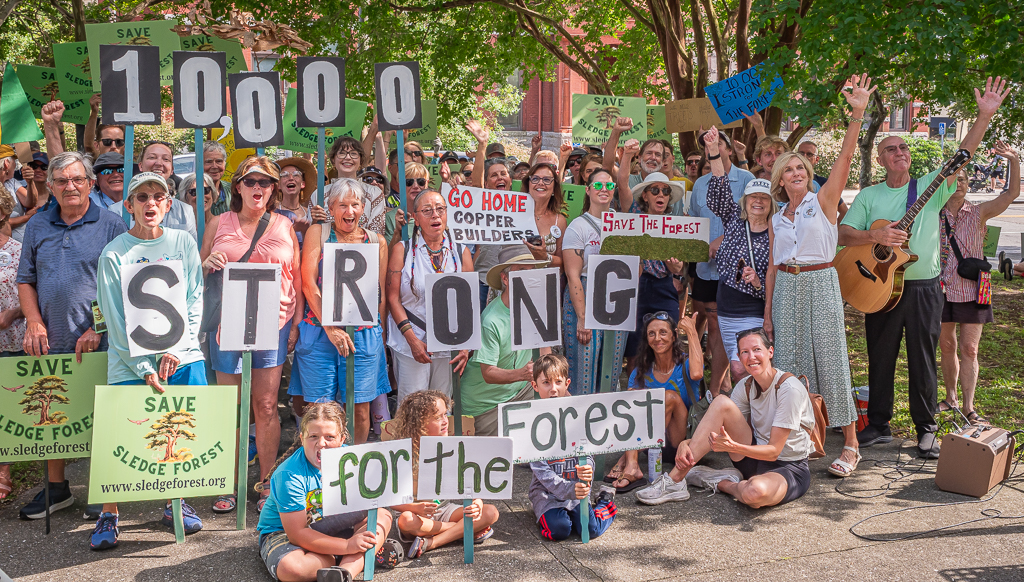
Save Sledge Forest hosted a rally on June 21 to celebrate reaching 10,000 signatures on a petition to protect the Sledge Forest from development. About 120 concerned citizens took to Innes Park and heard from Save Sledge Forest advocates like Darrell and biologist Andy Wood about their efforts.
“Having those people show up and their energy and their commitment and dedication to this is what keeps me going,” Darrell said.
Darrell and Save Sledge Forest plan on presenting their petition to New Hanover County Commissioners during a meeting on Aug. 4.
Have tips or suggestions for Charlie Fossen? Email [email protected]
Want to read more from PCD? Subscribe now and then sign up for our morning newsletter, Wilmington Wire, and get the headlines delivered to your inbox every morning.
