


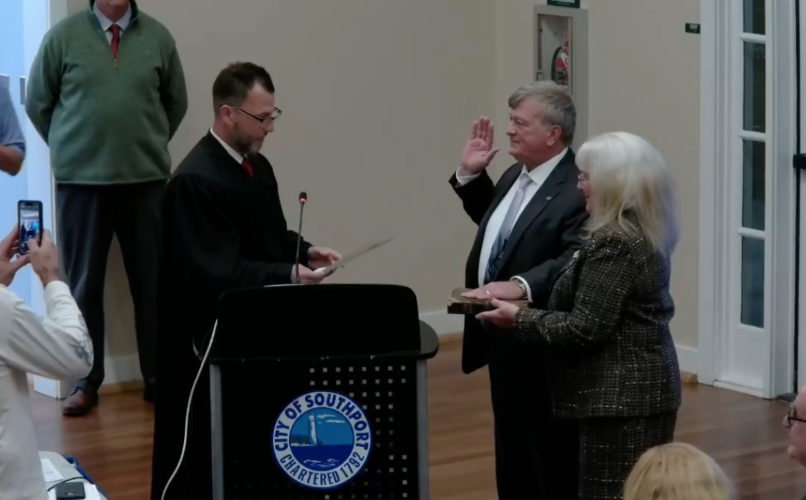
SOUTHPORT — ‘Tis the season of swearing in newly elected municipal officials, but the mood was far from merry during the Southport board of aldermen’s first meeting under new leadership.
READ MORE: Southport reports rise in complaints due to 5-person homeless population
On Thursday, Alderman Rich Alt was sworn in as the City of Southport’s mayor, two weeks after his win over incumbent Joe Pat Hatem was made official following a recount.
His oath was followed by the swearing in of incumbent Aldermen Lowe Davis and two fresh faces, Rebecca Kelley and Marc Spencer. Both chose to be sworn in by Rep. Charlie Miller, North Carolina House of Representatives member.
Kelley is a registered Republican and member of the No High Density Southport Group that mounted successful opposition to Project Indigo last year; Spencer, also a Republican, is a real estate broker. They are taking over the seats of Thomas Lombardi and John Allen after the two aldermen were voted out in November.
Several members of the public spoke on last month’s election during Thursday’s public comment.
“For me, there was no real win for Southport in this election,” voter Sue Hodgin, also a Southport planning board member, said Thursday. “In fact, a successful candidate posted something akin to the quote: ‘Whoever wins is going to have to make amends to half of Southport.’”
Hodgin was referring to a comment Alt made in prior Port City Daily coverage.
“Whoever comes out at the end is going to have to try to make amends with the other half of the city because we can’t have a divided city like that,” Alt said after Brunswick County’s election canvass on Nov. 17.
When he took the mayoral seat, Alt refuted making the remark, stating he said his mission was to “find common ground.”
The final election results, after Hatem submitted a recount request, came down to two votes, reflecting the identity crisis the city seems to be going through.
“I hope everyone can sense the change in Southport,” Hodgin said. “A change in the atmosphere, the very reason we all came here or grew up with, for the true locals. The charm, the friendliness of a coastal town with a protective sense over its history and care.”
A few residents expressed their approval of the new board makeup and pointed to the reason some members were making an exit.
“The candidates that were elected were very upfront about their position on conditional zoning in Southport that has the potential to change the complete makeup of our city, double the population, depending on who we have on this board,” Francesca Slaughter, another member of No High Density Southport, said at the meeting. “Just again want to remind people, the candidates that did not get elected either were for conditional zoning or didn’t share their position despite being repeatedly asked.”
Over the summer, the aldermen had tense debates over whether to expand conditional zoning to all properties or keep it reserved for commercial uses only.
Under conventional zoning, standards must be blanketed across all properties in the same zoning district. Conditional zoning allows for the aldermen to make certain adaptations to expand or constrict the development.
The amendment to expand conditional zoning ultimately failed; those for it argued it would give more flexibility, and thus, control over approved projects. The opposition feared it would be abused with excessive density or environmental leeway.
“If you think you can design an ordinance that’s going to prevent a future board from misbehaving somehow, you can’t,” Alderman Allen said at a July meeting. “We do not have the ability to tie the hands of future boards.”
Alderman Allen, who served as the city’s planning director before joining the board, was outspoken in favor of the amendment, calling conditional zoning a useful tool.
Rather than focus on their most divisive moments, however, the outgoing aldermen and mayor stressed the importance of continuing the board’s progress — 40 major projects and counting — and gratitude for those they served alongside.
“The board must set the tone and develop the roadmap and build the foundation for the best way forward, and should continue along this path of progress,” Hatem said in his farewell speech. “To the citizens of Southport, I have been your doctor at Dosher Hospital for almost 40 years. I will continue to serve there and I will support this vital institution for our city and for the surrounding community and for the many visitors that travel to our city.”
Hatem also made a point to thank each alderman individually — except for Alt.
“To my supporters, the 839 who voted for me and beyond, my deepest gratitude to you and those who contributed to the campaign,” Hatem said. “My apology and regret that this was such a close race not to our advantage.”
With the speeches over and the elected aldermen installed, the board still had another issue to deal with — Alt’s vacant alderman seat. The state does not outline specific rules for appointing a new member, aside from requiring the appointee be a registered voter and resident of the office they represent, in this case Ward 2 of Southport.
Earlier in the evening, several residents spoke in favor of appointing Bonnie Bray, who received the next-highest amount of votes on Election Day. Nearly 10 people spoke in Bray’s favor, emphasizing her work in the community, including with Up Your Arts and the Southport historic preservation committee.
However, when it came nominating time, the first name was raised by Alderman Davis. It wasn’t Bray.
“I have been bombarded for a number of days now from what can only be described as an intense lobbying effort on behalf of a number of people,” Davis said.
She decided on Frank Lai, president of Indigo Plantation’s board of directors. Davis said she aimed to pick someone outside of the political scene to prevent isolating groups of people advocating for certain candidates.
Davis’ move was a curveball for Bray, who told PCD she knew her appointment would hinge on the alderman’s vote.
“What I cannot fathom is why that vote, instead, was cast for a person who had not participated in the election, nor in any aspect of municipal life, prior to his appointment,” Bray said. “That action taken by a majority of the new board of aldermen precluded any other nomination being brought to the floor, precluded the stated wishes of city voters, and precluded common sense.”
Aldermen Robert Carroll and Karen Mosteller were equally dismayed.
“While I agree that it’s essential to consider the voice of the people, sometimes decisions can be more politically motivated than logically rooted in what’s best for the community,” Carroll said. “It’s crucial to ensure that the recommendations and choices made truly reflect the needs and values of Southport rather than being influenced by individual or political interest.”
Mosteller pointed out the board was straying from a common way of making appointments — even if not required — by not choosing Bray, who openly campaigned for the seat unlike Lai.
“Quite honestly, I would rather support the appointment of a new board member who had the support of 700 voters, almost 40% of all the ballots cast and only 6% less than the second highest vote getter in Ward 2, rather than picking someone that has not participated in the public process,” Mosteller said.
Mosteller and Carroll’s requests were ignored and Lai was appointed to the board in a 3-2 vote.
Tips or comments? Email [email protected].
Want to read more from PCD? Subscribe now and then sign up for our morning newsletter, Wilmington Wire, and get the headlines delivered to your inbox every morning.
