


WILMINGTON — Funding projected to emphasize intensive milling-and-resurfacing projects on some of Wilmington’s major streets was approved Tuesday night by city council.
READ MORE: Cape Fear region to receive $6.3M from NCDOT for street repairs, maintenance
The government body unanimously approved a second one-year extension on its annual needs street rehabilitation contract with Highland Paving Co. for $4.8 million.
This comes as it already spent $6.1 million with the company in 2022’s contract, with $500,000 in additional change orders tacked on. The city spent $5 million more in last year’s contract renewal. With 2024’s $4.8 million, the newly approved total calculates to a $16.3 million investment with Highland.
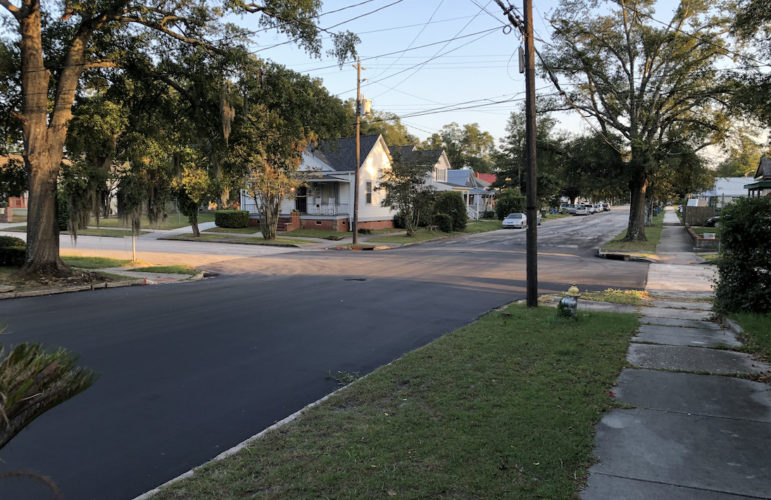
“We invested a lot in pavement preservation techniques over the past couple years,” public services director Dave Mayes told media Wednesday at Wright and Sixth streets on the southside of downtown Wilmington.
This area was chosen because it is part of the gridded street network downtown found to be in particularly poor condition and in need of renovation.
“Next year we’re probably going to focus much more heavily on milling and resurfacing,” he added.
Over the past two years, Highland worked on 177.26 miles – 22% of city-owned streets – utilizing at least one of four street management techniques:
· Pavement rejuvenation: a surface treatment of Reclamite – an asphalt rejuvenation agent – used to improve asphalt flexibility and slow the aging rate for recently resurfaced roads, used on asphalt less than five years old. Cost: $10,524 per lane mile
· Pavement preservation: Slurry seal used for roads in good condition of PCI 70 or greater. Cost: $28,752 per lane mile
· Microsurfacing: A thin overlay placed on top of existing pavement which may also include asphalt repair. It is also used on roads with a PCI of 70 or higher. Cost: $108,696 per lane mile
· Milling-and-resurfacing: Milling 2 to 3 inches” to 3” of the top layer of asphalt before repaving with new asphalt. Milling-and-resurfacing a block typically takes one full day. Cost: $232,725 per lane mile
The four techniques range in intensiveness of intrusion onto the street. Technique application is determined by traffic volume, accessibility, and pavement condition index (PCI), calculated by distress criteria, including potholes, cracking, and depression. PCI is measured between 0-100, with 100 representing the best possible condition and zero signifying the worst.
Mayes couldn’t detail the worst roads the city will focus on first. The complete 2024 paving plan will be presented by mid-November, though Mayes said he is aware of some roads already on the city’s radar.
Upcoming milling-and-resurfacing projects on Market Street and roads surrounding Greenfield Lake are top priorities for next year.
As well, a Market Street project will begin from the foot of Water Street and continue to Third street.
The Greenfield Lake project will focus on 2 miles of street surrounding the lake, focusing on half of Lakeshore Drive.
“That’s a little bit more than a 4-mile loop around the lake and we’re going to get about half of it,” Mayes said.
He anticipates the most challenging upcoming project will be a separate bid from the contract: milling-and-resurfacing a large section of Fifth Avenue. The public services director is working with the Cape Fear Public Utility Authority to replace 100% of the water and sewer infrastructure underneath the street before initiating street rehabilitation.
CATCH UP: City to overhaul 15 blocks of 5th Ave in 2-year project
The project will extend 15 blocks from Market Street and Fifth Avenue – where Kenan fountain is – to Greenfield. Beyond infrastructure and road reconstruction, it will include curb repair, sidewalk repair, and new ADA ramps.
The city has historically used milling-and-resurfacing as its primary street rehabilitation technique. In 2022, it changed strategies to focus on preservation, rejuvenation, and overlay methods to defer street maintenance and reduce costs.
“Once they deteriorate to a place where we have to mill and resurface, the expense goes way up,” Mayes said.
The cost for every lane mile of roadway milled and resurfaced is $232,725. Alternatively, pavement rejuvenation costs $10,254 per lane mile.
In the past two years, the contractor has used $3.2 million on preservation techniques compared to $9 million spent on milling and resurfacing.
The city will recruit a consultant next year to update its pavement management study, conducted every five years.
“They’ll come out, they’ll ride every single street, gather all the data, and produce a report for us,” Mayes said. “Probably close to the end of 2024.”
Wilmington City Council allocated $8 million for street rehabilitation in the 2023-2024 fiscal year. Outside of Highland’s contract, money is put toward maintenance projects and piecing together strategic intersections. According to the city’s budget, the street rehabilitation project received $2 million more in FY24 than last year.
“The more funding we have the more streets we can deal with,” Mayes told Port City Daily, stating the council deserves credit for prioritizing street rehabilitation in its budget.
A Wilmington streets management map details pavement conditions and work status of roads throughout the city.
Have comments or tips? Email info@portcitydaily.com.
Want to read more from PCD? Subscribe now and then sign up for our morning newsletter, Wilmington Wire, and get the headlines delivered to your inbox every morning.
