


Editor’s note: This is the second in a series of stories exploring the statewide implementation of Common Core standards in North Carolina, and what it means for teachers and students.
In Graham Elmore’s eighth-grade math class, rows of text books are neatly stacked on bookshelves in the back of the classroom.
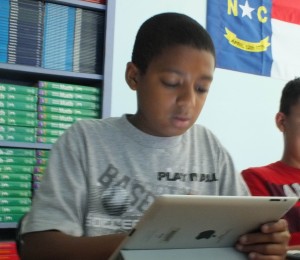
Geometry, algebra, math—they’re all there. But Elmore’s students are feverishly working away without the books. Instead, they have iPads.
Students are divided into groups, working together to solve problems displayed in the front of the classroom via Elmore’s iPad and Apple TV.
The math problems are the same—for example, two to the third power times two to the fifth power—it’s the way the students solve the problems that differs from years past.
This is The Common Core in practice—specifically at Roland-Grise Middle School.
For the first time in more than 30 years, a new statewide curriculum change has been implemented in North Carolina, but The Common Core was not designed by government bureaucrats. It was designed within the educational community, leading many educators to embrace the change.
Common Core was implemented in grades kindergarten through second last year, but this year marks the full statewide implementation in kindergarten through 12th grades.
Roland-Grise Middle School Principal William Hatch said the implementation of The Common Core has coincided seamlessly with other technology-based initiatives at the school.
“This is a really exciting year for our school and our county because things are going online. We’re going paperless. Twenty-first century technology and 21st century learning is enabling us to do lots of exciting and fun things. We’re working closely with the university on some instruction. We’re bringing in professors and, of course, our professional development center at the university,” Hatch said.
Roland-Grise Middle School is in its pilot year of a bring-your-own-mobile-device program at the school.
“We’re the only middle school piloting that this year. The kids will bring their mobiles and we’ll work with those in the classroom,” Hatch said.
Roland-Grise teachers are now more focused on research-based learning, Hatch said.
“The big thing for us with Common Core is a lot of what we’ve been doing before [with other math teachers] we’ve always kind of aligned to ramp our course to be a bit more than what the standard course is,” Elmore said.
Common Core implementation with math is different than with science or language arts, Elmore said.
“Now, with The Common Core, we’re seeing that we have to implement a lot of things from higher levels that are sliding back. Math is applying concepts and putting them in a real-world context and letting them work though it together.
“We’re here to guide them in the right direction. It’s not just me lecturing, lecturing, lecturing. I give them the information and let them work through it and see where they struggle. Then let them work together and let them figure it out. The last result is coming back [to the teachers] to ask the question. We want them to work through it on their own. We want them to make sure they understand the process,” Elmore said.
Stephanie Lilly, an eighth-grade science teacher, said The Common Core has “cleared up a lot of gray areas in the curriculum.”
Now, Lilly can “teach deeper” into each topic, rather than bouncing from one topic to another. She said it’s given her more freedom as teacher as well as given her students more freedom in the way they seek out information.
The scope of the curriculum with Common Core has “narrowed, but deepened,” Lilly explained.
Cell phones are allowed in Lilly’s classroom as a research tool. With only a handful of computers in her classroom, Lilly allows cell phones, iPhones, tablets and other electronic devices commonly banned in schools as a way for her students to seek out answers or research science-based presentations.
“I do want them to search through things to determine is this a credible source or not,” she said.
In language arts, Hatch said the eighth-grade curriculum focuses on a deeper understanding of concepts, including literature, informational text, writing, speaking, listening and language.
In addition to novels and plays, students are reading essay collections and other passages to view literature through a thematic lens.
Reach Caroline at (910) 772-6336 or [email protected] . On Twitter at @cgcurran.
