


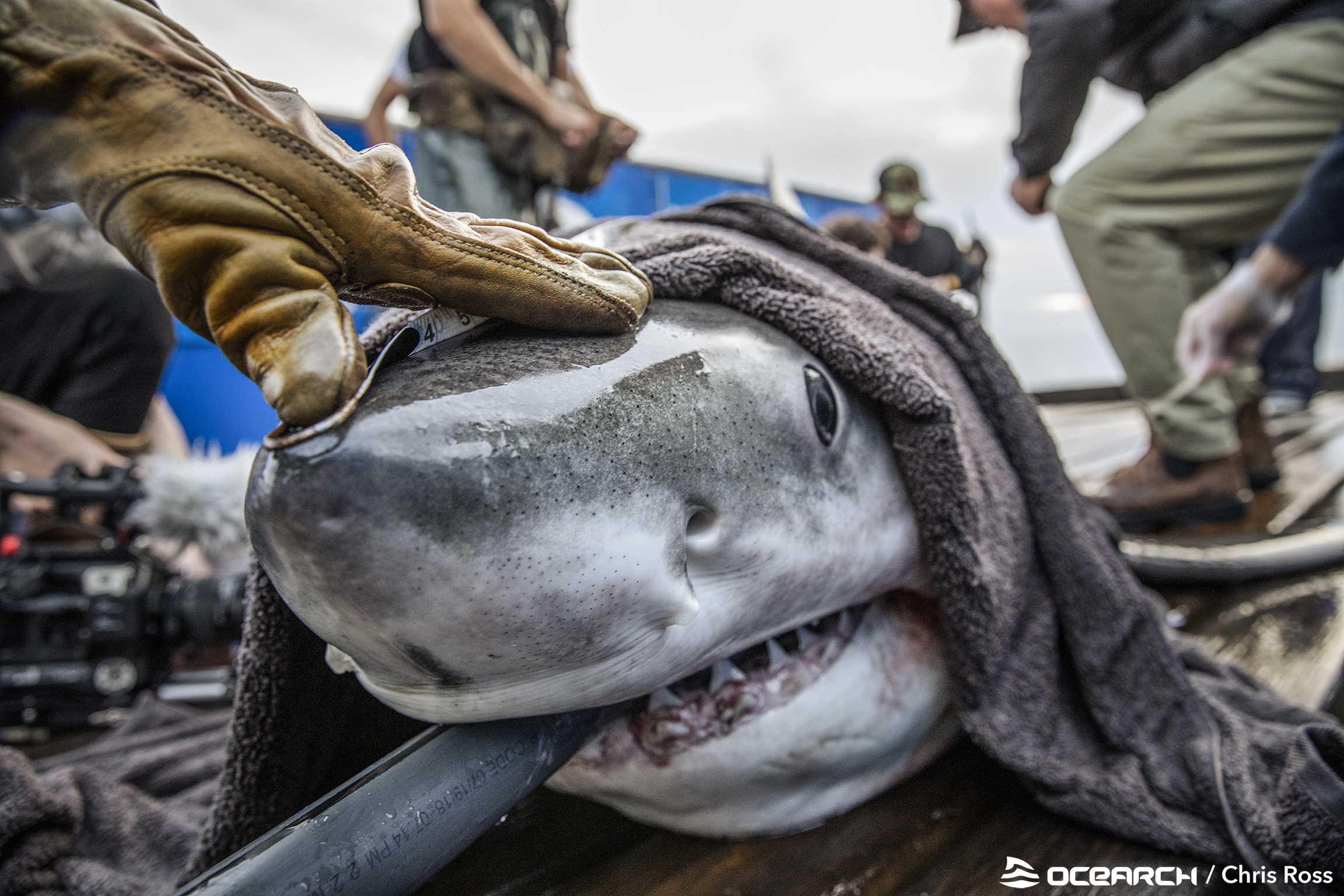
SOUTHEASTERN N.C. — The largest great white tagged by a nonprofit group of shark researchers was recently found hanging out off the coast of North Carolina. Mahone, a 1,700-pound male shark, pinged Apr. 5, roughly 30 miles from Onslow Bay, located just north of Sneads Ferry and North Topsail Beach.
The shark has since traveled 453 miles offshore from Wilmington into the Atlantic.
Established in 2007, OCEARCH has tagged more than 400 marine animals, including great white sharks, loggerhead sea turtles and tiger sharks. Most recently, its focus is on great whites in the western north Atlantic Ocean.
Named after Mahone Bay, where he was tagged in 2020 in Nova Scotia, Mahone was swimming closer to Wilmington back in January, tracking near Fort Fisher.
“We will likely have another shark within weeks or so in [that] region,” OCEARCH spokesperson Paige Finney said.
Mahone has traveled 9,241 miles in 335 days along the East Coast, as far south as Orlando and north to the Gulf of St Lawrence off Prince Edward Island.
He is not the only one spending time in the Atlantic off the southeastern North Carolina shorelines. As of Sunday, around 6 p.m., a 715-pound great white named Tancook pinged off the coast of Beaufort, 100 miles north of Wilmington.
The 990-pound male Ulysses last transmitted signals Apr. 6 off Portsmouth Island near the Outer Banks.
OCEARCH scientists place the tags on sharks’ dorsal fins. When the fin and tag breaks the surface of the water, it transmits a satellite signal. How often a shark pings depends on its “personality,” Finney said.
“Some sharks are total pingers and we hear from them every couple weeks,” she said. “Some we don’t hear from for months. They’re fish. They don’t need to come to the surface.”
OCEARCH launched its Global Shark Tracker in 2012 to provide real-time data on the species it monitors. When a shark’s tag pings its location, it can be seen on the map instantaneously with a flashing circle around a shark icon.
Finney explained trackers typically last about five years before the batteries die. Data on tagged sharks whose transmitters no longer work is still available for research purposes.
Over the last 10 years, OCEARCH has tagged 84 sharks off the East Coast of the U.S. and Canada to learn their life history.
“Really we’ve been able to understand where they’re moving, when they’re moving and, in a lot of cases, why they’re moving,” Finney said. “A lot of that wasn’t known until we started bringing expeditions to this region.”
OCEARCH researchers recently returned from a three-week expedition in the Carolinas in an attempt to learn more about where great white sharks mate. This was the organization’s 43rd expedition.
Made up of researchers and veterinarians, the group spent most of its time about 30 miles offshore of Morehead City. They were able to do some traveling off the coast of Wilmington for about half a day.
“It was a lot of dodging bad weather,” Finney said. “We had two or three fishable days, but in those two or three, we were able to tag Crystal.”
Named for the Carolina’s Crystal Coastline, the great white has traveled 225 miles over the last 17 days and pinged near Charleston, S.C., at noon Sunday. The 460-pound, 10-foot-long juvenile, with a life expectancy of up to 70 years, was the only one found during the 2022 Carolina Expedition near Lookout Shoals in Carteret County Mar. 14.
OCEARCH has a goal of sampling 100 sharks in the northern Atlantic region to assist with its mating hypothesis. Crystal is number 84.
During the expedition, scientists collected samples for 25 different projects, including blood samples and muscle biopsies. They also take measurements, semen samples, bacterial samples and parasite collections, as well as make additional tags.
According to OCEARCH, the research team collects 12 or more samples in 15 minutes to keep sharks out of the ocean for the shortest amount of time. Research is conducted on a 75,000-pound capacity hydraulic platform to safely lift marine animals out of the ocean.
Aside from the real-time locator, sharks receive acoustic tags emitting sound and accelerometers for tracking swimming behavior.
Finney explained many great whites are “over-wintering” in this area down through the Gulf of Mexico, and likened them to snowbirds who travel south for the winter.
“That’s why we see a lot of activity off the Carolinas,” she said. “As it begins to warm up here, late spring, early summer, they’ll start migrating north again, off New England, Nova Scotia, and that’s where they’re doing their feedings.”
During early spring — March and April — mature male and female great whites are spotted more frequently off the coast of the Carolinas. As a result, OCEARCH began studying the hypothesis that sharks use this region for mating.
“We believe there is evidence of reproductive activity of some sort happening in this region,” Finney said. “We look at the hormones in their blood.”
Finney said the fishing team hoped to tag a mature shark during its expedition last month but plans to embark on some day trips in the coming weeks to Georgia’s and the Carolinas’ waters. The goal is to gather data that will back up the theory that the Carolinas are possible mating locations.
Tips or comments? Email [email protected].
Want to read more from PCD? Subscribe now and then sign up for our morning newsletter, Wilmington Wire, and get the headlines delivered to your inbox every morning.
