


WILMINGTON — This Queen Anne style Victorian home nestled in historic downtown Wilmington is a living keepsake.
Stained glass windows, triple hung windows and nine fireplaces distinguish its historical and domestic significance. At 127 years old, the Durham-Davis house is being cared for by its modern owners.
Occupied by Robert and Sydney Powers, the owners of Jester’s Cafe on Castle Street, the 1890s Victorian is aging gracefully.
Living modern in a historic home
“I think about this old house every day because it’s alive,” Powers said. “Doors don’t fit the same two months in a row. It makes noises. It’s alive it continues to age.”
“It’s got stories I don’t even know about,” she said.
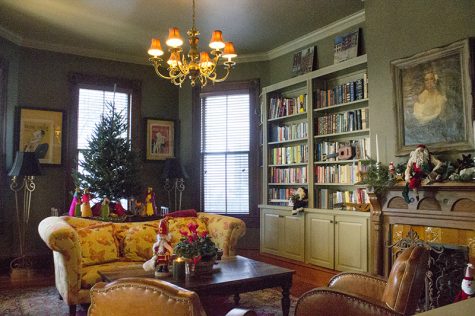
Eleven-foot ceilings and ornate woodworking decorate the interior, which Powers said can make a five foot-something person feel small in comparison.
“Living in a house like this, you feel like you’re completely dwarfed,” Powers said. “The scale of the furniture really has to be a lot bigger, otherwise it looks kind of strange.”
At 3,164 square feet, the two-story downtown home felt vacant without opulent details it was designed to host.
“We had to add a lot more. Paint just wasn’t enough in the formal rooms so then came the wallpaper, and the drapes because you just kind of need that to fill in the space, there’s just so much space because then it would feel empty,” she said.
Floor to ceiling windows frame the first floor, that at one point were practical.
The windows helped allow the home to naturally regulate temperature. Heat rises and a draft would flow through it, even in the August heat, that permitted cool air to drift below.
“It made sense in the days when you had no AC,” Powers said.
Throughout the years, the lofty windows have been sealed and painted over but still let in an ample amount of natural light.
Form follows decoration
Built in 1890, Powers says the home was constructed to aid in the lifestyle focus that came with the Victorian era and people.
The Victorian architecture on the South Fifth home is baroque in comparison to more contemporary homes Powers has resided in on the west coast.
“There’s a certain panache to it, a kind of drama,” Powers said.
For instance, brick was only employed as a structural material, never as a siding present in the finished product.
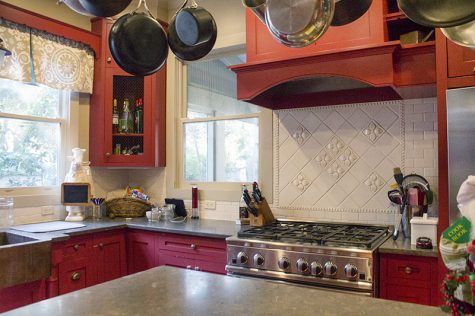
In the kitchen, with cabinets painted cherry-red, Powers chose to leave the stove with exposed brick, something the Victorians would have loathed.
“There’s definitely a better way of constructing a house than this, but how would you ever know that if a house like this wasn’t in existence?” she said.
Powers sees the house as a sort of prototype in architecture. In the grand evolution of housing design and construction, the Victorian model was ultimately tossed aside to pave room for a more utilitarian mindset.
“What the west coast had more of was the influence of Frank Lloyd Wright. His architecture was the exact polar opposite because it was all about form follows function.”
“If you don’t need that curly-cue on the fireplace, then it shouldn’t be there.”
“I like them both, strangely. As an actress, I’m an interpretive artist, I’m accustomed to being put in an environment and then making it work that’s what you do.”
Investing in the living past
Powers believes there’s a misconception that living in an older home is inevitably paired with costly repairs and upkeep. For her family, tending to a well-built Victorian home is a safe bet.
“In a lot of ways we have it easier than a lot of more contemporary, recently built homes because these houses were built of old growth wood and it’s over the years hardened and become almost like concrete so in some ways,” she said. “I think the house has been much more protected, the siding, the foundation surely.”
Contemporary built homes often utilize new-growth wood, inherently softer than aged, old-growth.
In the Power’s Victorian home, heart of pine was sourced for the hardwood floors and woodwork.
“Fortunately most of it hasn’t been painted over,” she said. “(It) would have started out as a bright color. Over the years it’s mellowed out to this really deep caramel color and it just has this wonderful age to it.”
Through the creaks and lingering, pleasant scent, the old-growth wood is a sturdy foundation to grow your roots.
The home is part of the Historic Wilmington Foundation‘s collection of designated historic homes, and recently appeared as a stop in the Lower Cape Fear Historical Society‘s Old Wilmington by Candle Light Tour.
“I don’t think we appreciate age anymore at all in our culture because we don’t let anything get old,” Powers said. “As soon as there’s another way of doing something it’s torn down I don’t know that that serves us very well as a society.”
“It’s just nice to be part of things that stick around for a while.”
Johanna Ferebee can be reached at [email protected] or @j__ferebee on Twitter
