


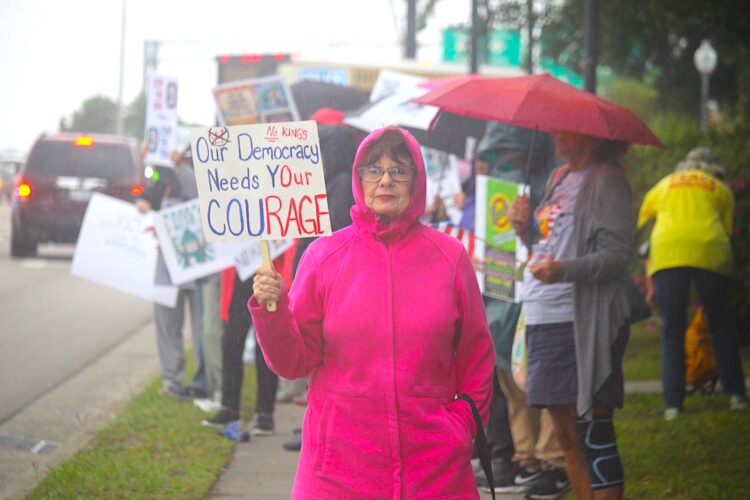
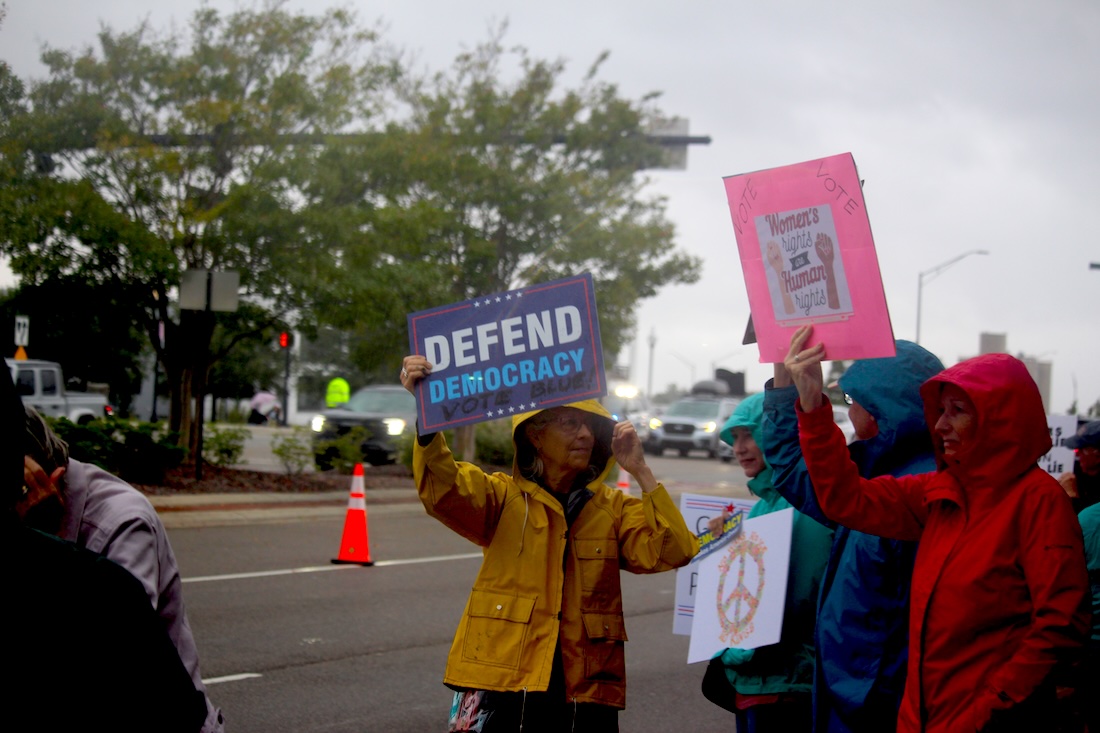
WILMINGTON — The No Kings protest on Saturday drew familiar faces as local groups and elected officials pushed for residents to vote — and vote early — in this year’s midterm election.
“I know all of you are going to vote,” Mayor Bill Saffo, who spoke at the protest for the first time, told attendees. “I know all of you are active. But it’s important to get your family members, your friends, those that care about this country, to get out, to vote.”
Early voting began Oct. 15, and state district 18 House of Representative candidate Deb Butler (D) praised turnout in New Hanover County so far.
READ MORE: ‘Devil’s in the implementation’: Scholars, candidates speak to ballot’s 3 constitutional amendments
“The numbers are incredible,” she said. “We are up 53%.”
As of Oct. 19, New Hanover County Board of Elections has more than 14,000 people turning out to the polls; the board of elections indicates it’s up 53.4% since 2022 and 43.2% since 2018.
Saturday featured the fourth No Kings protest held in Wilmington in the last two years; it was held along with more than 1,500 nationwide on Oct. 17. Wilmington’s protest drew the least amount of people of the four yet, yielding roughly 200 throughout the day according to Lynn Shoemaker from Women Organizing for Wilmington.
“We would have had a much bigger turnout if it hadn’t been cold and raining cats and dogs and parking had been easier and there wasn’t a triathlon overlapped,” Shoemaker said, about the Ironman event also happening across town.
The protest was held at 1898 Memorial Park — due to Thalian Hall’s Innes Park closed for construction — and was organized by WoW, Indivisible Southeastern North Carolina, the state AFL-CIO, the NAACP, Siembra, Speak Ya Peace, the National Black Leadership Caucus, the Climate Reality Project, the New Hanover County Association of Educators and Democratic Socialists of America in Wilmington. Speakers included elected city officials and folks from workers unions, including IATSE 491, the American Postal Workers Union and the newly minted American Federation of Professional Educators in North Carolina.
The protest was held in order to persuade people to cast a ballot early for this year’s midterm elections, with speakers emphasizing its importance to address concerns like affordability and the environment, clean drinking water and public school funding.
“Our schools are struggling. We are underfunded, understaffed and undervalued,” said Haley Miles, the local representative for the newly founded American Federation of Professional Educators in North Carolina and a Murrayville Elementary school teacher. “Our children are being directly affected by this. They’re missing out on critical instruction because there are vacancies in nearly every school. There are not enough subs to safely cover our classes.”
According to the state Department of Public Instruction, vacancies include positions being filled by substitutes temporarily and those without anyone to fill them. DPI has the vacancy rate from the 2024-2025 school year at 7.4%.
In New Hanover County, there are roughly 30 vacant teaching positions advertised online; while the county staffing levels meet state standards, the county has also been vocal about wanting to hire more educators. Port City Daily asked the district to confirm the 30 number but didn’t hear back by press.
Miles said the reason for the statewide vacancies was teacher pay. According to the National Education Association, North Carolina ranks 46 out of 50 in teacher pay. Personal finance company WalletHub also ranks the state as 46th in public school spending per student and 49th in teachers’ income growth potential.
In this year’s state budget, though, teachers received an 8% increase in pay on average.
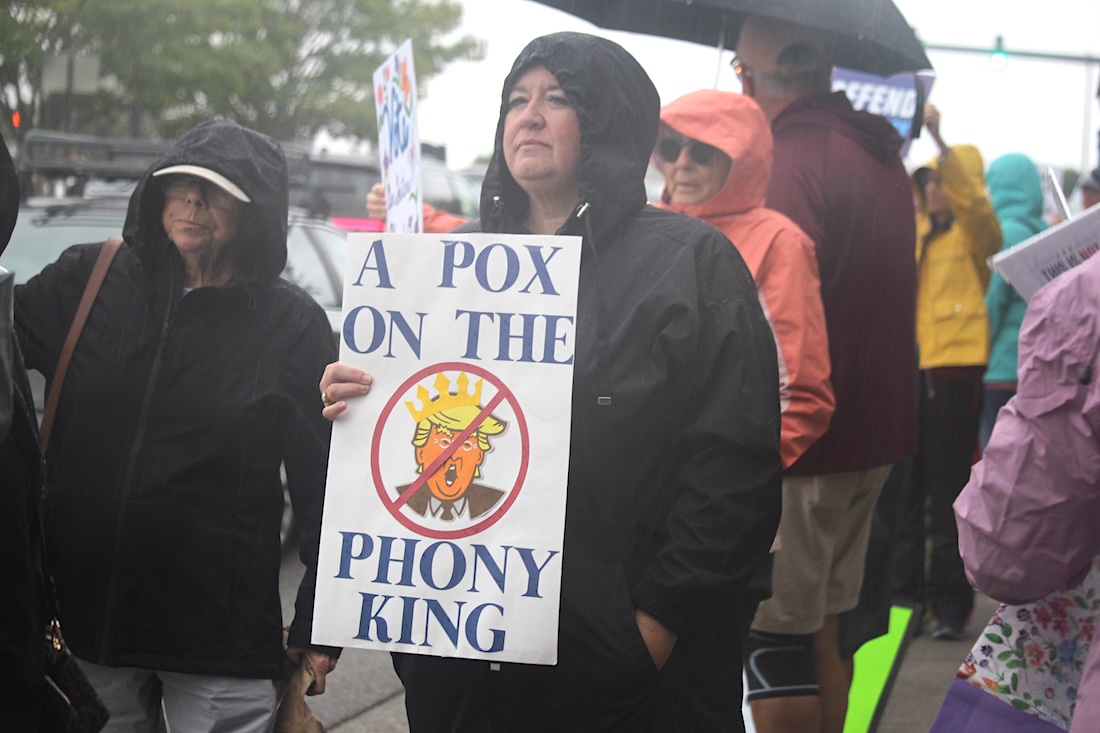
Aside from public school funding, attendees raised concerns about efforts the Trump administration has attempted enact to invalidate mail-in voting.
The administration ordered a voter-eligibility list approved by the federal government, which would determine who could receive mail-in ballots. Trump cited voting irregularities stating non-citizens were casting ballots and wanted the U.S. Postal Service to determine who may vote by mail and refuse ballot delivery by anyone not included on newly created federal mail voter lists. However, this was blocked by the Supreme Court via an injunction this summer because the courts thought it was too close to the election to issue changes.
President of the North Carolina Council of the American Postal Workers Union and the APWU Local 145 in Wilmington, Dan Matthews, addressed this directly.
“For some, voting by mail is a convenience. For others, it’s the only practical way to exercise their right to vote. And I want everyone here to understand something: When postal workers process election ballots, we don’t ask whether your ballot belongs to a Republican or Democrat,” Matthews said, adding later: “No ballot is left behind.”
Protesters in attendance, like Matt Guin and Bill Sewell, suggested the GOP was using “trumped up” voter fraud charges — or rather, rhetoric that voter fraud was rampant — as an excuse to disenfranchise voters. According to conservative thinktank the Heritage Foundation, there were only 123 voter fraud cases in the state of North Carolina since 1986 to present day and about 1,700 nationwide.
Guin further pointed to the voter identification constitutional amendment on the North Carolina ballot as an example of fear-mongering. As noted in Port City Daily’s previous reporting, scholars have said the amendment is just an effort to get Republican voters to the polls, since the law is already on the books that a voter ID is required; however, making it a Constitutional amendment means it’s not as easy to undo.
“A lot of people think it’s so easy to have an ID, but at the same time, it’s also really easy to have an ID that doesn’t have your updated address on it,” Guin said. “Which most affects people who rent, who tend to be of lower socioeconomic status, who tend to vote in a certain direction.”
Saffo urged protestors to the polls and to bring their neighbors, friends and family. His colleague, council member Sallette Andrews, who has spoken at previous No King rallies, pointed to the protest’s location as poignant to vote out “oppressors.”
The 1898 Memorial was erected to remember Black Wilmingtonians who were killed or run out of town by white supremacists. These same men then dismantled the local fusion government, including Black leadership, enacting the only coup in America.
“One of the lessons of 1898 is that the first weapon of the oppressors is not violence — it’s lies,” Andrews said, referring to the Republican Party arousing fear of immigrants and people of color. “They start with the lies, and then they take away freedom of the press. It isn’t an accident that they burned down the Wilmington [Daily Record].”
She pointed out that freedom isn’t always free — a sentiment echoed by local Richard Baylis, who lost his son in Iraq in 2007.
“It’s so important that we always remember that soldiers, over many, many years, have died for our freedom,” he said. “And I see our freedom slowly being eroded.”
Mayor Pro Tem Kevin Spears emphasized the importance of taking the same energy from protests and bringing it to the polls — and furthermore, for elected officials, to refine it into policy.
“It’s not just about raising hell,” Spears said. “Imagine going from raising hell to developing policy. Policy that understands that some have unfair advantages and have had unfair advantages.”
Butler pointed to policies passed that could negatively impact working families — such as the corporate tax declining to 0% by 2030. This passed in 2021 in the General Assembly.
“Republican leaders have prioritized corporate tax cuts while our public schools need resources, our teachers need support and families are struggling,” Butler said.
Chair of the Cape Fear branch of the Sierra Club and a soil and water conservation candidate, Kelly McConnell, was concerned about a lack of regulations protecting the environment and holding polluters accountable, such as when it comes to PFAS in the Cape Fear River.
“We need to change our representatives so we can set real regulations and protections for our environment,” she said. “We need to protect the people, protect our health and not have these fake regulations that protect the polluters and save them money.”
Most residents present for the protest that Port City Daily spoke to said the reason they felt inclined to attend was due to democracy failing or even being targeted. Marsha Winstead pointed to a multitude of factors, from immigration, the economy, and treatment of the military to Trump himself.
“It’s not just one thing, it’s everything. The economy’s horrible. We shouldn’t have been in the war,” she said. “But the meanness tops all of it.”
[Ed. note: This piece has been updated to clarify Kelly McConnell’s position as chair of the Cape Fear chapter of the Sierra Club, rather than president of the Sierra Club. Port City Daily regrets this error.]
Have tips or suggestions for Emily Sawaked? Email [email protected]
At Port City Daily, we aim to keep locals informed on top-of-mind news facing the tri-county region. To support our work and help us reach more people in 2026, please, consider helping one of two ways: Subscribe hereor make a one-time contribution here.
We appreciate your ongoing support.
