


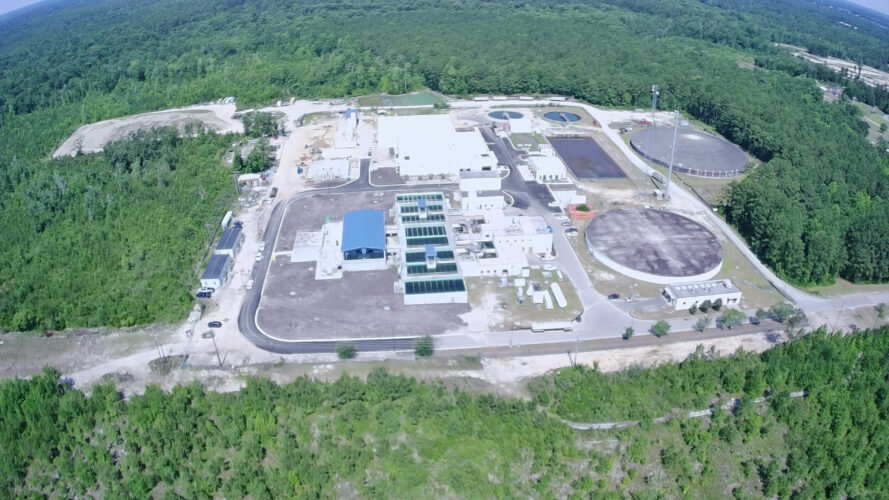
BRUNSWICK COUNTY — The Northwest Reverse Osmosis Treatment Facility in Brunswick County is nearing its completion, but its impending debut has drawn discussions of the costs and benefits of the plant’s filtration methods. While deemed most effective by academics, some commissioner candidates have voiced concerns over discharge and the price.
The reverse osmosis plant has been in the works since 2018, with two lawsuits filed due to construction delays — including a refiling in August this year — and over $160 million spent to bring it online. It’s scheduled to open by the end of 2026.
The Northwest plant was part of discussion at Port City Daily’s Oct. 14 forum, hosted with WECT and WHQR. Democratic candidates argued the RO facilities are often wasteful, costly and would repollute the Cape Fear River with PFAS.
READ MORE: CF River Watch says Chemours broke consent order; company disputes claim
ALSO: Chemours, DuPont, Corteva settle multi-million PFAS lawsuit with NC localities
“New Hanover’s got a system. They destroy the PFAS they take out of their system,” Democratic candidate for District 1 Gary Woods said. “Our filters that they’re building supposedly — if we ever see it — it collects [PFAS] and we put it back into the river.”
Reverse osmosis is a filtration process that forces pressurized water through a semi-permeable barrier. It removes anything that isn’t water, including minerals, PFAS and salt, and is more efficient than GAC filters in targeting short-chain PFAS, according to Duke University professor and environmental engineer Mark Wiesner. He added that RO treatment for drinking water involves a remineralization process to restore essential mineral balance, improve taste and stabilize pH.
The PFAS is flushed out immediately by a high-pressure water flow, which then disposes PFAS-concentrated water back into the Cape Fear River.
After it was revealed PFAS was in the river in 2017, Brunswick County hired consultants at CDM Smith in 2018, which determined reverse osmosis would be the most effective treatment option, based on a life-cycle cost analysis. The consultants — paid $25.5 million for their services — priced the RO facility at $99 million for construction and engineering and $59 million for operation and maintenance over a 25-year period.
The county issued revenue bonds to allocate funds to pay for the RO project.
However, since those determinations, the treatment plant has increased from to $167.3 million due to delays and lawsuits; this does not include the cost for operation and maintenance. The project is still covered by the bonds because the county upped the funds in the revenue bonds.
The county breaks it down to be $158.7 million for the expansion and low-pressure reverse osmosis treatment and $8.6 million for the concentrate pipeline, which transfers the discharge from the plant to the river.
“It’s gonna be a remarkable facility when it gets done,” Commissioner Randy Thompson, who currently serves district 1, said.
Thompson made the motion to approve the RO facility’s construction at the May 10, 2018, commissioner workshop wherein the plant was unanimously agreed upon. He answered in Port City Daily’s candidate questionnaire this year that the RO facility would be able to address the PFAS contamination issue in the county, though noted there could be additional options in the future to evaluate.
There are two county-owned water treatment plans in Brunswick. The Northwest Reverse Osmosis Treatment Facility will treat 36 million gallons of water per day to service the entire county, spokesperson Meagan Kascsak explained, since it is an open system with its Highway 211 water treatment plant. The 211 plant is not outfitted for PFAS treatment, and many localities receive blended water, or a combination of treated water from both plants. According to the county, 90% of the water entering the facility will be distributed to county residents; 10% of the water treated by the facility will be discharged back into the river through a pipeline.
The discharge will contain the PFAS it’s treating because the membrane in the RO filter catches all chemicals and substances in the water and washes them out. Then the higher concentrated chemicals return back to the river water, academics and research explain.
Brunswick County confirmed it does not have a filtration system for the discharge and the water does return to the Cape Fear River. In order to allow this, the county obtained a National Pollutant Discharge Elimination System permit from the state, which legally regulates and controls the discharge of pollutants in U.S. waters.
“But it is also important to note that the discharged water will not increase the PFAS already present in the Cape Fear River due to upstream contaminators,” Kascsak said, implying it’s putting back contaminated water that was already there. “The best way to reduce the amount of PFAS in the river is to stop it at its source and to hold the contaminators responsible for reducing and removing these compounds from the river in the first place.”
Chemours has been dumping PFAS into the river for decades, dating back to 1980 when its predecessor DuPont operated the Fayetteville Works facility. Chemours built a mile-long barrier wall in 2023 to stop groundwater contamination, a treatment system for Outfall 003 and other projects and plans to stop the contamination. But Chemours has also allegedly broken its consent order with the North Carolina Department of Environmental Quality and Cape Fear River Watch — even recently, for not meeting groundwater remediation and air emission control requirements as well as failing to prevent chemical discharge in groundwater moving around the site and PFAS discharge at outfalls leading to the Cape Fear River.
The company is allowed to continue operating as long as it is keeping contamination levels under the permitted limit, which is less than 10 parts per trillion of GenX, less than 10 parts per trillion of PMPA and less than 20 parts per trillion of PFMOAA.
Clean Cape Fear co-founder Emily Donovan said it was important to address the public health crisis and provide people with clean drinking water. She also thought objections to the RO plant, due to the discharge, were misdirected.
“If we really, truly are concerned about discharges of PFAS, a drinking facility is the last place we need to be concerned. We need to be concerned way upstream,” she said, pointing to Chemours.
However, the county could also buy and implement machinery to treat the discharge; there are several mechanisms that allow electrochemical treatment plasma and advanced oxidation, with varying costs depending on the scale, according to Wiesner.
Electrochemical treatment plasma breaks down toxic chemical compounds in wastewater, and advanced oxidation processes destroys pollutants and turns them into harmless end-products like salt. The processes could be added in conjunction with the existing RO system.
“But these are all gonna be more expensive than RO,” Wiesner explained. “Those would be the kinds of things you would want to put in to treat a much smaller volume of water in the form of the concentrate coming out of RO.”
For example, in El Paso, Texas, the Advanced Water Purification Facility, which cost $295 million, uses ultraviolet light and hydrogen peroxide advanced oxidation processes to degrade the concentrated organic matter and chemicals in the discharge. The majority of the cost was shouldered by taxpayers, who, most recently, had their rates increase by 12%.
Donovan suggested the $95 million from the North Carolina Attorney General’s settlement with Chemours, DuPont and Corteva coming to Brunswick County over the next eight years could be put toward funding this type of filtration.
Port City Daily reached out to county commissioners to ask if these discharge filtration methods were discussed at all and if they would be interested in implementing them at the Northwest RO facility. A response was not received by press.
Lawsuits and RO vs. GAC
Since the Northwest plant RO construction was first decided upon in a unanimous vote eight years ago, costs have increased for construction and engineering. This was attributed to delays in construction, errors in work completed and supply-chain backlogs for materials.
In 2020, Oscar Renda Contracting was awarded the bid to build the Northwest facility. At first, the company was given more than $117 million, but commissioners awarded an additional $5.6 million to expand the project further by adding three additional RO packaged systems.
While engineering and design was completed in late 2019, construction began in 2020 and was originally slated to be completed in 2023.
It was first delayed in November 2023, a month before the original deadline, attributed to pandemic-related setbacks by the contractor. However, the county pointed out there were personnel shortages on the job site and the crew needed to correct work already finished. The project deadline then was extended to May 2024, which the contractor also missed.
When the plant was not completed a year after the new deadline, the county sued Oscar Renda Contracting, and its sureties Zurich American Insurance Co. and Federal Insurance Co., for the delays, poor workmanship, and a breach of contract. That was July 2025.
The lawsuit was voluntarily dismissed by the county the next month, with the promise the two insurance companies would oversee and manage the remainder of the project, but the county refiled in August 2026.
According to Commissioner Thompson, that was always the plan, in order to prevent “blowback” from the contractor, such as the company asking for additional money because the deadline was pushed to 2026.
“The longer you work on something, the more it costs personnel-wise,” Thompson said. “So they could certainly come back and say: ‘We think you owe us this.’ In reality, you were contracted to have the job done for this amount on this timeline.”
County spokesperson Kascak clarified the county is “not planning on any additional steps at this time.”
Brunswick County leaned into RO treatment as the best option fiscally and practically. It was considering both RO treatment and the granular activated carbon filtration system — the latter used by Cape Fear Public Utility Authority in New Hanover County.
Much like Woods, Democratic candidate for district 2, Sara Singer, pointed to the current RO plant’s high cost as problematic, especially when compared to GAC filtration systems. CFPUA paid $43 million for its system and approved the bonds for it in 2019.
However, GAC systems require less hardware and are also easier to dispose of waste because they do not require pipeline connections and discharge permits, according to the EPA.
“[GAC systems] won’t filter out natural minerals and things. It focuses on the PFAS, but it is ultimately a cheaper filtration system to create,” Singer claimed on Oct. 14.
Port City Daily reached out to Singer’s opponent, Republican Patti Hewett, for her thoughts on the RO treatment coming to Brunswick County but did not receive a response by press.
“I’m not convinced that RO systems are the best option,” Singer also said at the forum. “They waste a lot of water in their ability to filter out.”
Generally speaking, reverse osmosis filters used at a municipal-level can waste 15% to 20% of the water they intake, according to research published by the American Chemical Society. Because the RO treatment process doesn’t involve trapping the chemicals but rather actively flushes them out, a portion of the intake water is siphoned off to carry the discharge from the filter back to the Cape Fear River to prevent clogging the system.
Heather Stapleton, an environmental chemist and professor at Duke University, told Port City Daily she thought reverse osmosis is the better option, even over the granular-activated carbon filtration used to treat PFAS. RO captures a wider range of contaminants, including ultrashort-chain PFAS.
“I know everyone is so focused on PFAS, but there are likely other things in there we’re not paying attention to that we’ll discover in the future,” Stapleton said. “The technology and the way the reverse osmosis works is just more comprehensive for a wider range of chemicals, and that’s why I prefer it personally. I’ve seen granular activated carbon filters where the small PFAS go right through. They’re not retained very well.”
Stapleton conducted a study alongside N.C. State professor and engineer Detlef Knappe — best known in the Cape Fear region for being one of the lead researchers who discovered PFAS in the river. Port City Daily reached out to Knappe, but was told he was traveling abroad.
Published in 2020, the study captured data from 89 residential reverse osmosis systems. They tested samples from across different types of household water filters to see how much PFAS remained in the water after treatment. Outcomes indicated reverse osmosis filters were the ideal way to filter PFAS chemicals, including GenX.
“The granular activated carbon filters had some problems and breakthroughs,” Stapleton explained to Port City Daily. “We had a couple homes where their filtered water was higher in PFAS than the incoming water because the filter had gotten so clogged with PFAS.”
GAC filters have carbon molecules chemicals stick to; however, the filter cannot catch minerals like salt, fluoride, iron or heavy metals, and it won’t stop microscopic bacteria or viruses. This means chemicals like ultrashort-chain PFAS are able to slip through.
RO filtration captures it by capturing the PFAS on a semi-permeable membrane and immediately flushing it out and discharging it through a pipe. It is a continuous flow of water which prevents buildup in the filter.
The Sweeney Water Treatment Plant servicing Wilmington from Cape Fear Public Utility Authority’s GAC system has eight thick filters, 14 biological filters containing granular activated carbon and normal water treatment processes like clarification and disinfection. As of Sept. 29, the Sweeney plant found 1.16 parts per trillion of GenX in the treated water, up from June but lower than levels found in July. PFOA, PFOS, PFNA and PFHxS levels have all consistently been 0 since September 2025.
GAC gets rid of PFAS by capturing and containing the chemicals in a filter that is then moved off-site for thermal regeneration. This process burns the PFAS particles off the carbon molecules to allow the filter to be reused later.
Donovan pointed out this process really just redistributes back into the air. This has been conferred by environmental scientists and engineers in a 2016 study conducted in Japan that found ultrashort-chain PFAS in emissions from the thermal regeneration process.
“My understanding is that incineration is still a problem,” Donovan said. “And so whatever poor community that’s living near the facility that’s getting CFPUA’s GAC filters to recharge, no one’s written a story about what’s happening in those communities.”
CFPUA area utilizes RO treatments for the Richardson Water Treatment Plant, to service the groundwater coming from the Castle Hayne and Peedee aquifers. The CFPUA’s treated water contaminant level tracker indicates no PFAS chemicals have been found in the treated water as of September.
“Each technology was chosen for its respective water treatment plant due to numerous factors, including the size of the plants and the treatment technologies already in use at those facilities,” CFPUA spokesperson Cammie Bellamy explained.
She said because RO is better at removing short-chain PFAS, CFPUA utilized it at the Richardson plant, and installed reverse osmosis membranes, or filters.
Meanwhile, Bellamy explained GAC was selected as the best treatment technology option for the Sweeney Plant because, in addition to its effectiveness of treating PFAS, it could better integrate with other advanced treatment processes already in use at the Sweeney Plant.
Once Brunswick County’s Northwest Treatment Plant is live with the RO treatment, reports with testing results for PFAS and 1,4-dioxane in treated water will be available through the county website here.
[Ed. note: This article was updated to amend $143 million to $43 million for the cost of the Sweeney plant construction. Port City Daily regrets this error.]
Have tips or suggestions for Emily Sawaked? Email [email protected]
At Port City Daily, we aim to keep locals informed on top-of-mind news facing the tri-county region. To support our work and help us reach more people in 2026, please, consider helping one of two ways: Subscribe here or make a one-time contribution here.
We appreciate your ongoing support.
