


WILMINGTON — This week saw another round of restrictions — this time limiting capacity at ‘essential’ stores — and increased tensions over when, and how, to ‘reopen’ the state (including local protests to reopen Carolina Beach and New Hanover County).
What follows is a snapshot that, at least for the time being, covers some of the major moving parts of the Covid-19 situation: testing and results, restrictions and resistance to those restrictions, and the rollout of government aid (which came with some serious hiccups).
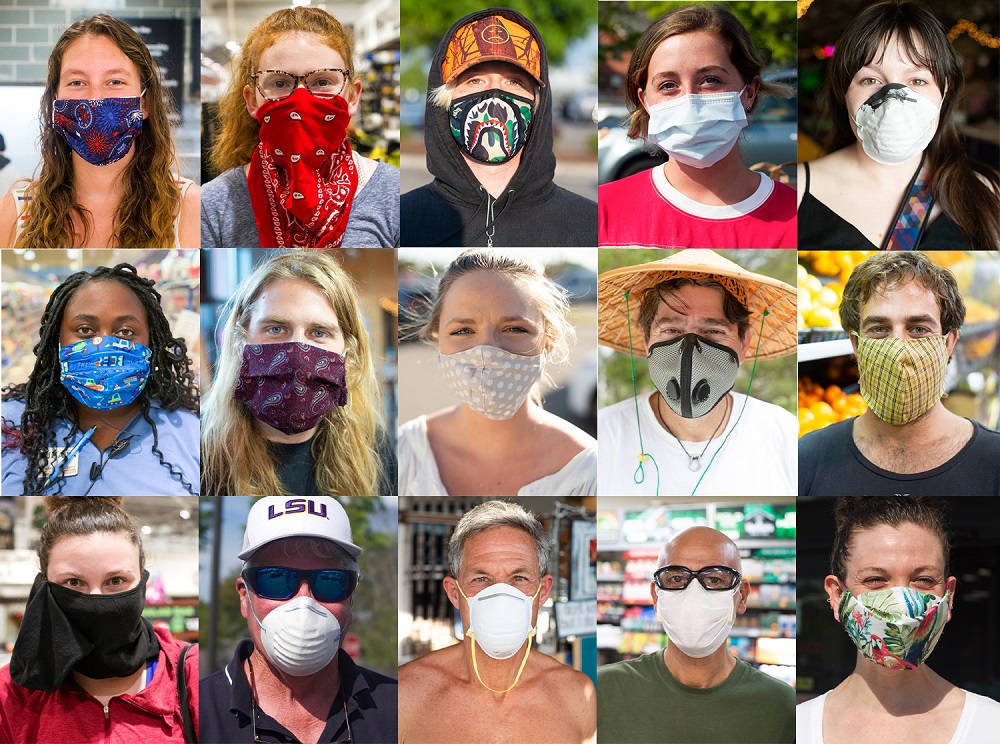
Speaking of snapshots, check out this photo essay, which includes photos featured on NBC’s weekly Pandemic Nightly News special — Faces of Wilmington: Portraits of residents masking up for the Covid-19 crisis [Free read]
Resources, reporting
If you’re looking for resources, you can find some useful ones here: Covid-19 resource roundup: Wilmington-area small businesses, childcare, health, info [Free read]. If you’re looking for what’s still open, you can find a directory of local businesses here.
Of course, it’s hard to recap the whole week, so you can find all of Port City Daily’s free reporting on Covid-19 here. We also encourage you to send comments, questions, and concerns to info@portcitydaily.com.
Cases, casualties, recoveries, hospitalizations, and the ‘curve’
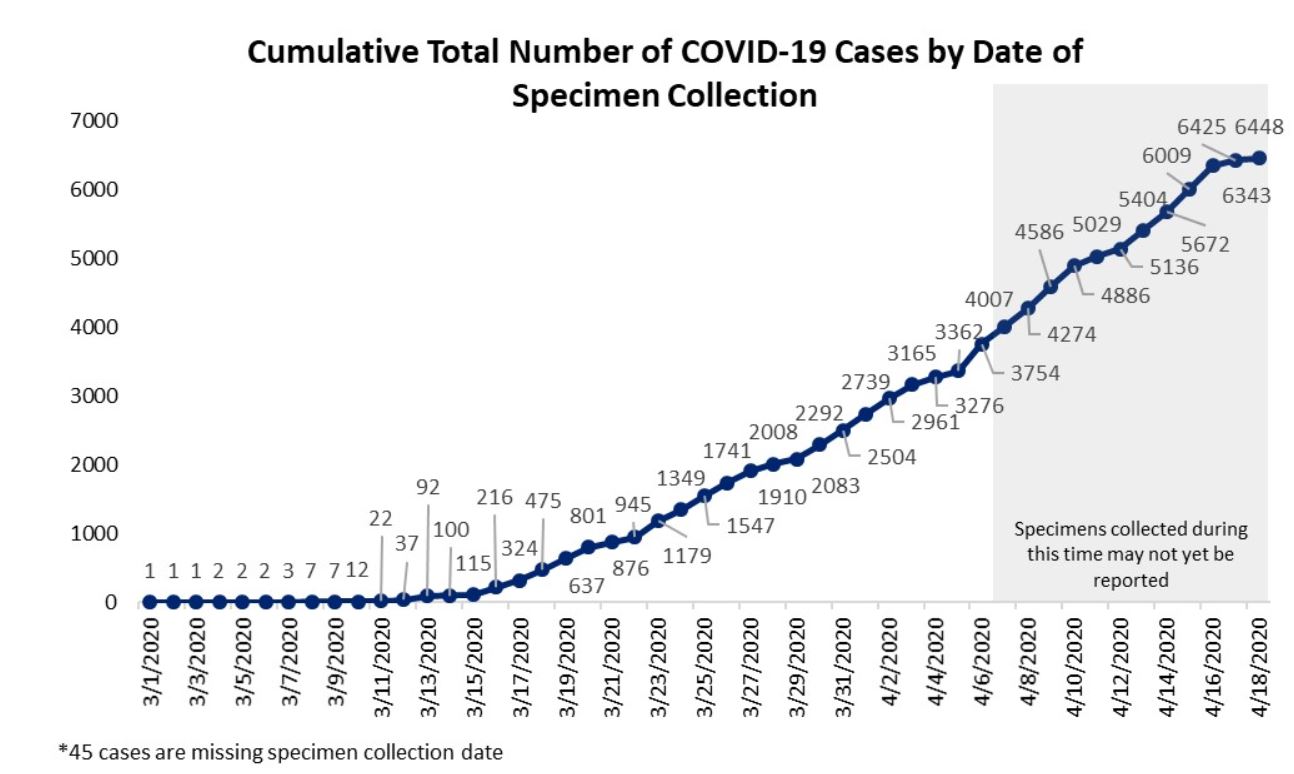
As of Sunday around 11 a.m. North Carolina Department of Health and Human Services (DHHS) was reporting 6,493 positive Covid-19 cases out of 78,772 private and public tests; there have been at least 172 deaths. DHHS is not currently reporting ‘recoveries,’ although local county public health offices are.
These numbers include at least 68 cases in New Hanover County with at least 40 recoveries, 36 cases in Brunswick County with 29 recoveries, and at least 7 cases in Pender County. Two deaths have been associated with Covid-19 in Brunswick County, although no information about the patients’ other potential medical conditions has been released; one death in New Hanover County has been reported, also with limited additional information.
Last week, North Carolina had 4,312 cases out of 60,393 tests. The week prior, North Carolina had 2,402 positive cases out of 38,733. Nationwide, there have been about 743,000 cases and 39,200 deaths with around 67,000 recoveries. Last week there were roughly 500,000 cases and 29,100 deaths. Two weeks before that, there were about 300,000 cases and over 8,000 deaths
While other hospitals around the state have made similar data public, New Hanover Regional Medical Center has continued to decline to release the number of hospitalizations. However, that data is being released to county commissioners through the public health department. Commissioner Woody White stated that as of Wednesday, there were 13 Covid-19 patients at NHRMC, with about half on ventilators. White noted that this was roughly 10% of what NRHMC officials predicted several weeks ago, an estimate that did factor in social distancing.
There’s a nationwide debate about the importance of reporting ‘recoveries’ alongside infections and deaths. Some have accused the media of ‘fear-mongering’ by not reporting data showing the estimated 98% recovery rate — making more than ten times as deadly as the seasonal flu, but less dangerous than other outbreaks like MERS or Ebola. Others have pointed out that, at that rate, 6 million Americans would die if everyone in the country eventually became infected. Based on the current data, the mortality rate of Covid-19 in North Carolina has been between 2% and 2.5% over the last few weeks.
It’s worth noting that many with Covid-19 deal with symptoms for a considerable amount of time, so there is a delay in recoveries to report. While New Hanover and Brunswick counties have started reporting recoveries, North Carolina isn’t including that data in its daily recap. Google’s Covid-19 database is tracking nationwide recoveries.
It’s also important to note that the daily increase in cases doesn’t track the spread of the virus in realtime. Public and private tests have different lag times. Add that to an incubation period that can stretch up to two weeks, and it’s still probably too early to say, based on the current data, if efforts to ‘flatten the curve’ have been successful. The efficacy of ‘social distancing’ measures are likely to be hotly debated as state and local officials consider whether to extend the current stay-at-home order and other restrictions.
It’s also important to consider that many cases are likely not being reported or tracked. Many patients with Covid-19-like symptoms don’t require hospitalization; those who contact their healthcare providers with more mild cases are being told to stay home and manage the symptoms with over-the-counter medications — it’s not clear if these ‘presumptive diagnoses’ are being reported, but anecdotally it seems many cases aren’t.
In terms of the ‘curve’ — that is, the rate at which case numbers are increasing — it’s still difficult to extrapolate from the data. Early in the week the rate slowed to under 100 new cases a day — but then jumped by over 600 cases in a single day.
Open and shut (or, rights vs. rules)

Currently, statewide restrictions are set to expire at the end of April. Governor Cooper has said that removing all restrictions would be ‘catastrophic’ — although his phrasing implied he might relax some restrictions. For now, many expect at least some form of continued stay-at-home order to be extended into May.
That’s provoked a growing chorus of opposition, in the form of the #OpenNC movement — which has its own local chapter in New Hanover County. The movement spawned protests in Carolina Beach on Friday, and near Oleander and College in Wilmington on Saturday.
Part of the debate is about whether or not social distancing regulations have already done their job — and whether the government needs to impose them or whether people can self-police. Another part of the debate has to do with how much governments should be able to infringe on civil liberties in the name of public health.
Despite the heated rhetoric — and occasional willingness to both data and real-world examples like New York — the OpenNC groups are tapping into a widespread uneasiness that stems largely from the lack of an endgame.
Governor Cooper, like leaders of other states, has pointed to three key things that will factor into reopening the state: testing, tracing, and trends. In other words, the ability to test to see who has Covid-19 (and antibody tests to see who has already had it), tracing those people who still have the virus to make sure they and their potential contacts are isolated, and trends — like new cases, and hospital capacity — going in the ‘right direction.’
There’s still a lot of ambiguity about how and when those things will come into play. There’s also still a lot of questions about how immunity to Covid-19 will work (for a good overview, check out Scientific American’s article on the issue). Immunity is a spectrum, after all. With some viruses — like Chickenpox — humans develop lifelong immunity. With others — like HIV — there’s nearly no protection at all. It remains unclear where SARS-CoV-2 lies on the spectrum. And, of course, there’s a lot of political weight being carried by faith in immunity.
Government aid
After several disastrous weeks, North Carolina’s Division of Employment Security (DES) has made progress filing claims and answering questions — although there are still plenty of people caught in bureaucratic snags and waiting for aid.
DES has started dispersing not only state funding but also the additional $600 per week from the federal $2 trillion aid package.
Next week, the state plans to begin distributing the Pandemic Unemployment Assistance (PUA). “This program provides unemployment compensation for individuals not eligible for regular unemployment insurance, such as independent contractors and self-employed workers, and those who have exhausted any extensions to unemployment insurance,” according to the North Carolina Division of Employment Security, which plans to begin accepting these claims on Saturday, April 25.
There’s also the federal $1,200 stimulus checks — technically an advanced tax refund for the 2020 year, although finance experts note that the way in which the congressional legislation is written, the checks will not be taxable or count against returns in 2020 (i.e. the funding won’t trigger a financial booby trap down the line).
The IRS hit a number of snafus in its rollout, including the ‘Get My Payment‘ website which returned million of error messages, and payments that got lost in financial limbo because the IRS wired money to temporary accounts used by tax-preparation companies instead of permanent checking accounts. In spite of considerable evidence to the contrary, IRS officials claimed the website was ‘working fine,’ but did acknowledge the temporary account error.
If you’re one of the millions who haven’t been able to access the IRS information page, despite having filed a 2018 or 2019 refund, you can catch up on why you’re getting error messages in this article from Forbes.
Send comments and tips to Benjamin Schachtman at ben@localvoicemedia.com, @pcdben on Twitter, and (910) 538-2001
