


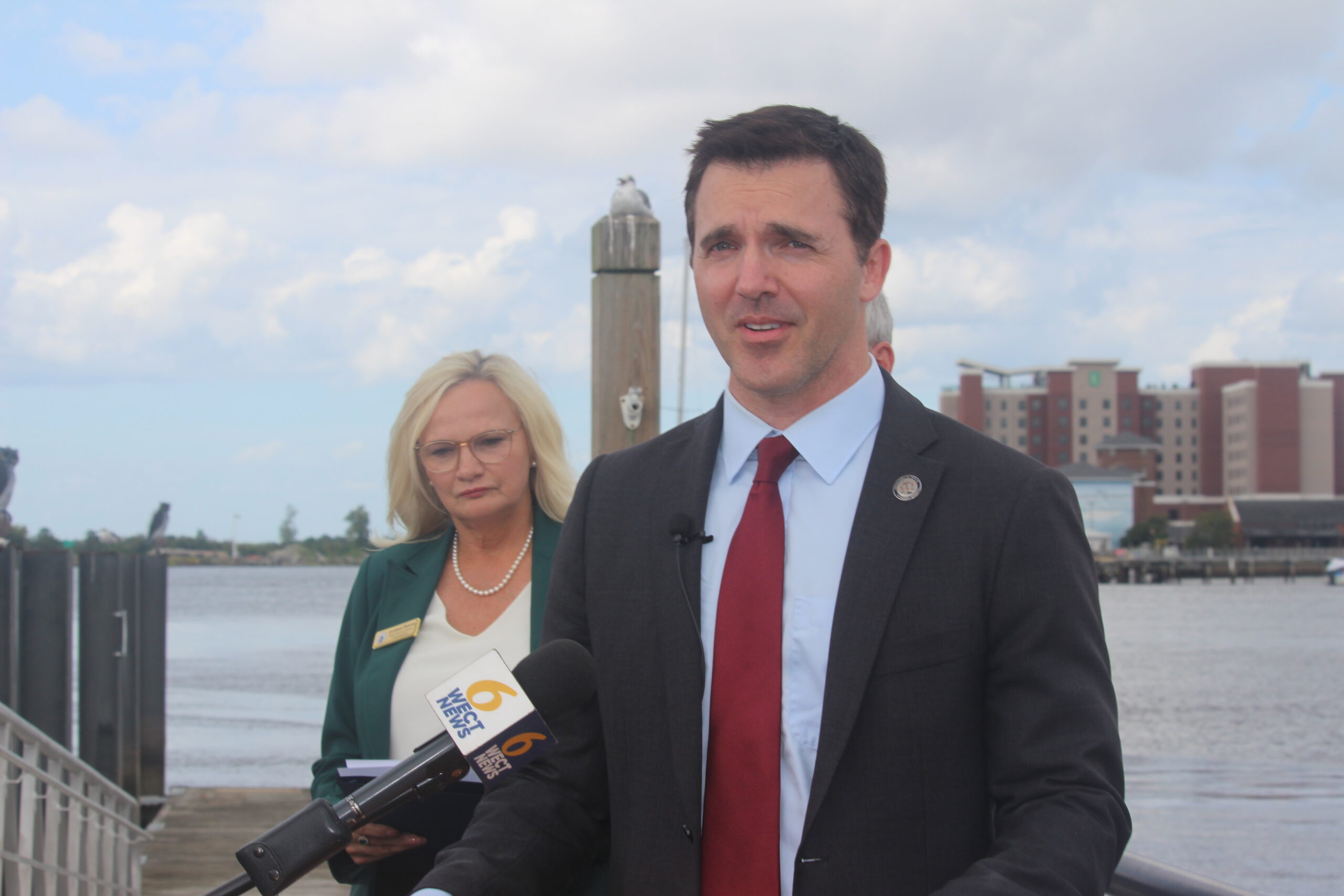
SOUTHEASTERN N.C. — Attorney General Jeff Jackson made a stop in Wilmington Thursday to announce a multi-million settlement between localities in southeastern North Carolina and chemical manufacturing companies Chemours, DuPont and Corteva. The yearslong lawsuit is over environmental PFAS contamination across the state.
$455 million will be paid out, with $75 million allocated to the state and roughly $55 million going to an Emerging Contaminant Mitigation Fund recently created by the North Carolina General Assembly. According to the announcement, the 11 local municipalities will receive $380 million over the next 15 years. Chemours’ will contribute $180 million, to make up 50% of the payment with DuPont and Corteva picking up the other 50%.
Local governments and entities included in the settlement include: New Hanover, Brunswick, Bladen, Columbus, Cumberland, Robeson, and Sampson counties, as well as Wrightsville Beach, Lumberton, Bald Head Island and the Lower Cape Fear Water and Sewer Authority.
READ MORE: Class action suit against Chemours goes to jury trial next spring
ALSO: ‘Industry is winning’: State budget funds PFAS research, but some balk at lack of regulatory teeth
CATCH UP: ‘EPA has abandoned NC’: Local stakeholders dismayed by Chemours, feds’ settlement
It also establishes a $135-million reserve fund from DuPont and sister company Corteva to guarantee work that Chemours must continue to complete, decades into the future under the NC Department of Environmental Quality’s (NCDEQ) 2019 consent order. A feature is to provide clean drinking water to families with polluted well water.
“Bottom line here, people deserve to have clean drinking water, and these companies deserve to be held accountable for the damage that they’ve done to our state,” Jackson said, noting the settlement, worth almost $600 million, is the largest environmental payout in the state’s history. “This settlement is a historic step … 20 times what the EPA got for the state.”
Jackson was referring to litigation filed by the Environmental Protection Agency on behalf of North Carolina, West Virginia and New Jersey in June. Only the EPA and West Virginia received direct funding. North Carolina is set to receive a $90-million mitigation program from the EPA settlement, to prevent future discharge of chemicals in the air or water.
The attorney general hosted a press conference from the Battleship N.C. to announce the news, along the bank of the Cape Fear River — the site where decades of chemical discharge of PFAS, GenX and other forever chemicals were dumped from Chemours’ Fayetteville Works facility.
The settlement also addresses damages caused by the distribution of aqueous film-forming foam containing PFAS to firefighters without proper protection. According to Chemours, $18 million goes towards PFAS discharges unrelated to the Fayetteville Works plant, including the fire suppressants containing PFAS.
PFAS, known as “forever chemicals,” doesn’t break down in the body or environment and has been linked to kidney and testicular cancer, liver damage, and birth defects.
“This settlement is an important step, but it is not the end,” New Hanover County Chair LeAnn Pierce said.
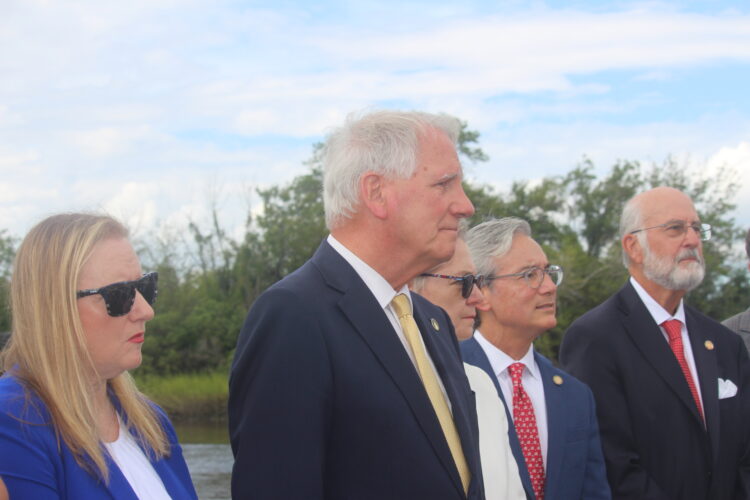
She joined Jackson, along with N.C. Department of Environment Quality Secretary Reid Wilson. State representatives Sen. Michael Lee (R-New Hanover), Rep. Ted Davis (R-New Hanover), Rep. Deb Butler (D-New Hanover) and New Hanover County commissioners also attended.
Pierce called the work to hold Chemours accountable in the county a bipartisan effort.
“We will keep working to protect our water, support affected residents, and hold polluters accountable,” she said.
Locally, lawsuits were filed against the companies in 2017 from the Town of Wrightsville Beach, Brunswick County, and Lower Cape Fear Water and Sewer Authority. In 2020, then-Attorney General Josh Stein also filed a suit on behalf of the state, with Bald Head Island following in 2023, and a year later, New Hanover County did the same.
To help pay the lawsuits, Chemours and DuPont created an escrow account in 2021, with the goal of saving up to $1 billion for future litigation. A memorandum of understanding was signed between Chemours and DuPont in 2021; the companies separated in 2015 as part of a reorganization effort by DuPont, which then separated from Corteva in 2019, also in an effort to restructure.
Chemours sued DuPont for essentially leaving it with the chemical discharge liability, though the company had been dumping PFAS into the Cape Fear River since 1980.
It’s common for industrial companies to set up escrow accounts due to litigation. According to the MOU, Chemours was supposed to pay $50 million into the account every year from 2021 to 2028, while Corteva and DuPont paid the other $50 million. Based on the agreement, Chemours would have three more installments to make into the account for a total of $150 million. However, the settlement exceeds that amount, thus satisfying the terms of the MOU.
Chemours provided Port City Daily a statement about the lawsuit’s conclusion:
“We are proud to have reached this resolution with the State of North Carolina and other parties. Over the past several years, Chemours has invested about $1.2 billion to significantly reduce PFAS emissions from Fayetteville Works, mitigate off-site impacts, and address community concerns, and today’s agreement recognizes that progress. It also provides a clear path forward for addressing the remaining off-site obligations under the 2019 Consent Order while supporting the continued operation of Fayetteville Works. We remain committed to responsibly manufacturing the chemistries our world relies on and continuing to earn the trust of our neighbors and community.”
What the settlement will do locally
According to Pierce, New Hanover County will receive $22.8 million over the next 10 years. The money would go toward further de-contamination efforts and private wells would be the first to be addressed. Commissioner Dane Scalise, who is also seeking District 20 seat with the N.C. House of Representatives this year, told Port City Daily the county hasn’t yet formulated a plan for how it would spend the money and what it would look like.
The money, however, will not go to reduce rates at the Cape Fear Public Utility Authority.
“We want to emphasize that this settlement does not impact CFPUA’s separate and ongoing lawsuit against Chemours and DuPont,” Cape Fear Public Utility Authority announced in a statement earlier Thursday. “Perhaps today’s events will motivate Chemours to take responsibility for its continued burden on CFPUA.”
To combat PFAS in New Hanover County, the Cape Fear Public Utility Authority installed a $43-million granular-activated carbon filtration system in 2022. Since then, rates have gone up by 8.46% in 2023, 4.6% in both 2024 and 2025, and 6.85% in the fiscal year 2026 budget, according to previous Port City Daily reporting.
But Scalise, a member of the CFPUA board, told Port City Daily the county will still push for further accountability and financial compensation. He vowed to continue to fight for CFPUA, as well to get reimbursed for money spent toward the water treatment facility.
“We’re going to make sure that we make our citizens whole, and we’re going to make sure that we have some recognition by Chemours that they have acted improperly to the citizens of New Hanover County and the ratepayers of CFPUA,” Scalise said.
Brunswick County commissioner Randy Thompson told Port City Daily the county will receive $95 million from the settlement, to be paid over the next eight years. However, the county is still exploring its options.
Some initial conversations, he assured, would be about finding ways to lower the cost of water utilities for residents. Brunswick County is installing its own treatment, including a reverse osmosis system, in the Northwest Water Treatment Plant. He said the county has spent over $100 million on addressing PFAS contamination.
At the state level, NCDEQ Secretary Wilson explained Thursday that $55 million out of the $75 million allotted to the state would be put into the Emerging Contaminant Mitigation Fund, which provides financial assistance for local governments to detect, test, and reduce chemical contaminants like PFAS. He told Port City Daily it would function similarly to a grant application process, wherein local municipalities could request money from the state to help address PFAS concerns. He explained the remaining $20 million would be used for expenses like the cost of the litigation.
However, Wilson also pointed out the next step is to create numeric standards for PFAS compounds, which could either be done by the Environmental Management Commission or the North Carolina General Assembly. Creating numeric standards would give the state authority to monitor and receive reporting on PFAS discharge from companies producing the compounds.
Port City Daily asked Sen. Lee if he would reintroduce numeric levels in the legislature. He said he hoped to use the PFAS research funded through the Water Safety Act from the budget bill to bring numeric limits to the floor. The original version of the bill included numeric standards, but it did not pass. When asked why, Lee said he was given many different answers from many different people, with many concerned about the feasibility of enforcing such a rule.
“Once we can get this data — speaking with the scientists, the different academic institutions — once we can get this comprehensive data, not on the drinking water side, but on the wastewater side, hopefully we’ll be able to utilize that in moving something forward and working with the secretary, and hopefully on the regulatory front,” Lee said.
Rep. Ted Davis (R-New Hanover) told Port City Daily, while he’s happy about the settlement, he also hoped to see his bill, H.B. 569 — or the Pollution and Polluter Liability Act — passed in the Senate. The bill passed the House of Representatives in May 2025 but has been stalled since.
“So far, they’re not hearing it,” Davis said.
The bill would make it mandatory for polluters to shoulder the cost of cleaning up contaminated water and would give the state the authority to order specific polluters to do so.
Rep. Deb Butler (D-New Hanover) was of the same mind about wanting to hold polluters accountable.
“It took too long in my mind, but I’m happy we’re here at least,” she said about the settlement. “In my mind, it’s just the beginning because we have to prevent this from happening ever again, and we need legislation in order to do that.”
Other responses
Despite the win, Southern Environmental Law Center released a statement Thursday following the announcement. While the agency applauded municipalities and area governments receiving funds to tackle the pollution, senior attorney at SELC Jean Zhuang said “it is not the end of the story,”
“Chemours’ planned expansion, extensive groundwater contamination, and ongoing releases of ultra short-chain PFAS into drinking water supplies all remain unresolved,” she added.
Ultrashort-chain PFAS is a smaller molecular form of the forever chemical, which is highly water-soluble and moves quickly through the environment. They are even more difficult to filter out using traditional treatment methods.
As for its planned expansion, Chemours announced in 2022 its goal to grow production at the Fayetteville Works facility by increasing production of vinyl ethers, which contain PFAS. The company is still in the process of seeking this permit, according to the NCDEQ.
Clean Cape Fear co-founder Emily Donovan told Port City Daily she was not trying to take away from the win, but remained skeptical. Beyond the concerns noted by the SELC, Donovan believes the $590-million figure is “low-balling” and thought damage incurred in the Cape Fear River and surrounding areas deserves a billion-dollar-or-more settlement.
“The people are expecting justice, and justice should have been in the B’s not M’s,” she said. “North Carolina has some of the highest levels of PFAS in public drinking waters. There’s PFAS in our seafoam. North Carolina also has some of the highest levels of PFAS in blood per the GenX exposure study.”
Donovan’s worries were two-fold: First, she expected the state was bending to Chemours because of a bankruptcy concern the attorney general noted during the press conference.
Jackson explained there was a “real risk of bankruptcy” with Chemours. The company has been hit with litigation across several states, including New York, New Jersey and West Virginia. One of the state’s priorities, he said, with the settlement was ensuring that North Carolina would still get financial compensation even if Chemours couldn’t pay anymore. DuPont’s net worth is almost nine times Chemours’, so even if Chemours does close, DuPont is on the hook to pay the remaining amount.
Donovan’s second concern came with the choice to settle. She referred to Senate Bill 382, dubbed as a Hurricane Helene Relief Bill, which also had hundreds of provisions buried in it. Included was stripping the attorney general’s right to initiate or intervene in court proceedings on behalf of the state in all matters affecting the public interest. Jackson assured this was not the case and had no relation to the settlement.
“We wanted to set a record for largest environmental damage payment ever,” Jackson told Port City Daily. “We thought that it was important to send a message to them, and to the entire industry, that you’re gonna face serious accountability.”
Have tips or suggestions for Emily Sawaked? Email [email protected]
At Port City Daily, we aim to keep locals informed on top-of-mind news facing the tri-county region. To support our work and help us reach more people in 2026, please, consider helping one of two ways: Subscribe here or make a one-time contribution here.
We appreciate your ongoing support.
