


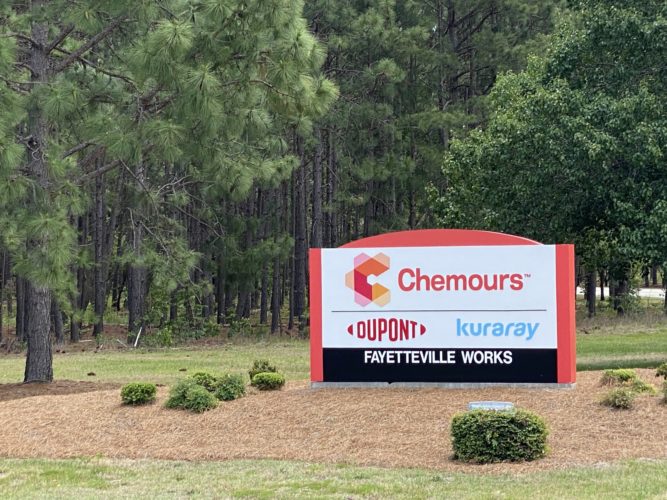
SOUTHEASTERN N.C. — A class action lawsuit nine years in the making will finally go before a jury in March 2027. The lawsuit represents more than 180,000 North Carolinians impacted by the Chemours Fayetteville Works plant.
The case is being litigated by co-lead counsel, Cohen Milstein, a law firm with an office in Raleigh which typically represents plaintiffs in class action suits, among other civil actions. The suit was first filed against DuPont and its subsidiary, Chemours, in October 2017, a few months after the public was made aware of the presence of PFAS — in particular, GenX — in the Cape Fear River, which supplies drinking water. The lawsuit received class action status in October 2023 and, recently, Judge James C. Dever III, of the United States District Court for the Eastern District of North Carolina, granted the plaintiffs’ motion for partial summary judgment for trespass liability.
Partial summary judgment is when a judge resolves some claims in a lawsuit before trial. Trespass liability, in this case, is when a company like Chemours is held responsible legally and financially for its byproducts and discharge crossing physical boundaries and intruding onto another person’s or company’s property without permission.
READ MORE: Two PFAS strains remain hazardous substances after court rejects industry challenge
ALSO: ‘Industry is winning’: State budget funds PFAS research, but some balk at lack of regulatory teeth
CATCH UP: ‘EPA has abandoned NC’: Local stakeholders dismayed by Chemours, feds’ settlement
The judge’s ruling indicates: “Plaintiffs did not authorize defendants to discharge PFAS from Fayetteville Works onto their properties.”
However, this is just one moving part in the case.
“We’re still waiting for the court to rule on defendants’ motion for partial summary judgment on damages (that GenX and PFAS damaged residents’ water filtration systems) and to decertify the class,” Cohen Milstein partner Ted Leopold told Port City Daily, referring to the twice-certified class action status. “So, stay tuned.”
Chemours and DuPont attempted to have the class action status removed after it was first certified in October 2023; this was denied November 2023. Chemours argued the plaintiffs’ claims didn’t have enough legal precedent and thus shouldn’t be viable for a large group of people to bring forth similar claims.
The class-action status was reconfirmed in the Fourth Circuit court in November 2023. The court did not explain its reasoning, but it was not required since the appeal Chemours filed was under Federal Rule of Civil Procedure 23(f). The rule grants judges discretionary authority and does not include language requiring an explanation on the decision.
About three-quarters of the 180,000 people in the class-action lawsuit are located in New Hanover, Pender and Brunswick counties.
Though, the plaintiffs representing the class action are Brent Nix from Wilmington, Victoria Carey from Leland, and Dr. Marie Burris, who owns a home in Fayetteville and lives in Harnett County north of the facility. They’re seeking relief for property damage resulting from the pollution and compensation for the costs of filtering or replacing contaminated water systems.
Burris did not respond to Port City Daily’s inquiry by press. Nix and Carey did, but their attorneys fielded questions for them.
According to spokesperson Kate Fitzgerald from Cohen Milstein, the firm representing Nix and Carey, both residents suffered damages from PFAS contamination, both healthwise and financially.
“In terms of the property damage, we’re talking about damaged plumbing systems, hot water heaters, and a new need for reverse osmosis filtration systems,” Fitzgerald wrote.
She said they were seeking compensation for money spent on bottled water over the last decade and in replacing their hot water heaters and installing reverse osmosis filtration systems, which filter PFAS.
While the case has been developing throughout the years, Fitzgerald said damages have only compounded.
“PFAS-contaminated sediment and sludge have built up in the water systems in class members’ homes, contaminating their drinking water and causing damage to their plumbing and hot water heaters,” she wrote. “After 10 years, residents are still buying bottled water to use in their homes.”
According to attorney Leopold, the size of the case and the fact that it covers decades of contamination has resulted in nine years of back and forth appeals and dismissals.
“There is no typical timeline for litigation of this scale,” he said. “Complex environmental class actions can take many years before reaching trial, particularly when class certification and highly technical scientific issues are contested.”
The case has evolved due to ongoing litigation and changing EPA regulations over the last nine years. For example, in earlier filings, plaintiffs’ claims about harm did not actually have the regulatory framework to back it. The plaintiffs’ argument cited the Clean Water Act, which did not address PFAS nor drinking water standards; both are addressed as part of the Safe Drinking Water Act, though. It would have given the plaintiffs an actual statute and regulation to rely on for claims made earlier on.
It wasn’t until spring 2024 that PFAS drinking water standards were established for six strains. Some of those standards are still up in the air, though, since the EPA proposed eliminating thresholds for four forever chemicals due to alleged procedural mistakes. If the proposal passes, only PFOS and PFOA will be regulated.
Leopold said these changes “have helped establish the broader context surrounding the contamination.” They provide plaintiffs regulatory gravitas to base claims on, and the related research surrounding PFAS standards provides evidence for the claims.
The need for scientific and environmental research to serve as evidence, however, also added to the slow pace of the lawsuit. It took six years to receive class action status — which makes litigation against companies like Chemours and DuPont more financially accessible, among other benefits — and another three years to be pushed forward to jury trial.
Though building the case has been a long process, Leopold estimated the trial “will take no more than five days.” He said the short trial date is because the judge’s August decision about trespass liability got rid of one of the issues the jury will need to hear in spring.
The date of trial is March 4, 2027. Pre-trial motions and other preliminary proceedings will take place prior.
Chemours did not respond to a request for comment by press.
However, the case is one of many against the company and comes on the heels of a June 2026 settlement between Chemours and the Environmental Protection Agency. The lawsuit covers drinking water supply contamination in West Virginia, New Jersey and North Carolina, providing monetary compensation for the former two. North Carolina was snubbed from receiving financial compensation for filtering or replacing the contaminated drinking water.
In North Carolina, Chemours also faces a lawsuit against the Cape Fear Public Utility Authority for decades of polluting the Cape Fear River resulting in millions of dollars in treatment and the North Carolina Attorney General Jeff Jackson for the decades of pollution and financial compensation. Both are still ongoing.
Have tips or suggestions for Emily Sawaked? Email [email protected]
At Port City Daily, we aim to keep locals informed on top-of-mind news facing the tri-county region. To support our work and help us reach more people in 2026, please, consider helping one of two ways: Subscribe here or make a one-time contribution here.
We appreciate your ongoing support.
