


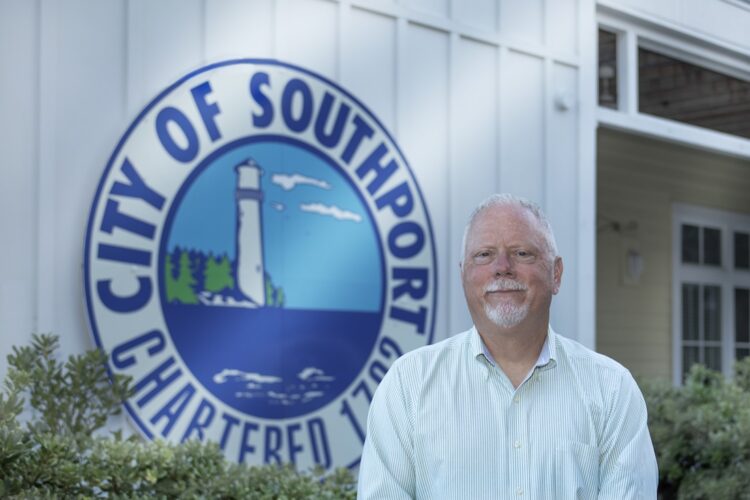
SOUTHPORT — The election in Southport includes three seats up for grabs on the board of alderman: two in ward 1 and one in ward 2. Mike Crosbie, formerly in law enforcement, is hoping to be elected to ward 1.
Though the council is a nonpartisan race, Crosbie is unaffiliated. He has never served in an elected position and will face off against incumbents Robert Carroll (U) and Karen Mosteller (U), as well as David Miller (R). Ted Blackburn filed to run but since has dropped from the race.
While Crosbie does not consider himself a politician, as a police officer at the command level for 34 years he said he is prepared for the role. Crosbie retired from the force as an assistant chief in a large metropolitan area department of 700 sworn officers and oversaw criminal investigations and school resource officers, and was in command of 200-plus personnel in support services such as records management, animal control, the 911 center, and more.
“I consider myself trustworthy, honest, capable, and fair. My career in law enforcement has allowed me to cultivate many skillsets including both long- and short-term planning, crisis management, risk mitigation, personnel matters, rational decision making and commonsense,” Crosbie said. “I believe in listening to all sides of an issue before making an informed and rational decision and always considering the” good of the order.” I believe in empowering and supporting good employees and letting them do the job they were hired to do, rather than usurping and undermining their authority. I am a forward thinker and though I am very much concerned about the current health of the city, I also want to preserve and protect it for the many generations to come.”
A few things to consider this election season:
- A valid ID is required to cast a ballot in North Carolina
- Election Day is Nov. 4, 2025, with voters required to go to their assigned precinct locations
- Early voting opens Oct. 16 and closes Nov. 1, and voters can cast a ballot at the Cooperative Extension Training Room, 25 Referendum Drive, Building N, Bolivia. See the hours here.
Anyone who wants to register to vote can do so here through Oct. 10 or register and vote in one stop during early voting
Port City Daily asked all candidates a slate of questions about topics that are tracking high with voters and residents of Southport currently. Crosbie’s answers have been edited below for clarity; candidate opinions and statements are not a reflection of Port City Daily. The paywall has been dropped on candidate profiles to help voters make informed decisions ahead of the election.
Port City Daily: Why run for office now?
Mike Crosbie: After many years of living in Southport, and watching from the sidelines, I felt compelled to run for office to do my part to protect and preserve our beloved city. The reasons are many — some are: a 33.8% tax increase in one year which was approved by two of my opponents; a constant turnover at the City Manager position; the misappropriation of city property, attempted or otherwise, for individual gain or for uses other than those of the taxpayers; the failure to properly maintain and protect city infrastructure; moving the Police Department further out from the downtown area and into a rented space. Also, I am beholden to no one other than the citizens and taxpayers in Southport.
PCD: There have been concerns about the long-term fiscal health of the city, as seen earlier in the year when a potential $1.4 million budget deficit was discussed — this was after a 12.7% tax rate increase in FY 2024-2025. Though Southport avoided a tax hike this year and managed the budget, how do you envision the city being more financially stable in the future and what would you like to implement to make this happen?
MC: I do not believe in taxing our way out of fiscal problems. Southport’s two largest revenue sources are real estate taxes and ABC sales; we do not have a commercial tax base that contributes heavily to the city coffers.
My approach would be multi-pronged: First, I would like to ensure that the city government is as efficient as possible by doing a top-down approach. Do we have right number of employees? Do our contracting and procurement policies make sense and are they economical? Can we partner with other local municipalities to bring down costs? Are we being good stewards of the taxpayers’ dollars?
Secondly, we need to seek alternative sources of income, such as grants. I would like to see the city hire a full-time grant writer or contract with a grant writer to be paid on a commission basis.
Third, we need to lobby our state legislators in Raleigh and seek a more equitable distribution of sales tax revenues. Southport generates far more sales tax than it receives in return.
PCD: Southport aldermen broached discussions this year about a paid parking program, though eventually tabled it. Where do you stand on paid parking in the city — for or against? Explain.
MC: I am against paid parking. I feel that it would be a bigger benefit to the contractor than it would be to the city. The financial benefit to the city would not even come close to the negatives of paid parking. The residents do not want it, and the businesses do not want it; that is who should decide.
PCD: The Southport Historic District Overlay has received backlash from some, while others have expressed it’s long overdue; do you support the design standards that the Historic Preservation Commission has been working on this year and would you be in favor of adopting them — why or why not?
MC: The final version from the HPC has yet to be presented, so it would be premature or speculative of me to take a hard stand, one way or another, at this time; however, I am opposed to the standards as originally presented.
In my opinion, if there are to be any design standards they should come from the residents who live in the Historic Overlay and not from those who live outside it. To me, it is similar to imposing an HOA on residents who did not move into an HOA neighborhood, and they had little to say in the matter. Most of the folks living in the overlay do not support it and neither do I.
PCD: Many are concerned about rapid development taking place in the area and disrupting the small-town feel and values of the community, as well as straining public services. What are some actions you would support to ensure future development is strategically managed to protect the community character and serve the public’s best interests? Also, how do you envision balancing green space and development?
MC: I, too, am concerned about over development. Unfortunately, when the City of Southport lost the ETJ (Extra-Territorial Jurisdiction), they lost virtually any control over whatever development takes place just outside the city limits. Brunswick County now controls development in what would have been the ETJ.
I believe it is incumbent upon the board of aldermen and the mayor to foment positive relationships with county commissioners to work with them to minimize development that could directly affect the city. Inside the city limits, there is less and less land available for major development projects. Between the UDO and state law, there are restrictions as to what extent the city can control individual property rights. The city cannot prevent landowners from using their property, but it also does not have to allow special accommodations that increase density or approve roads or drainage plans that negatively impact the city or adjoining property owners.
The city should work hard to preserve, protect, and maintain the property that belongs to the taxpayers.
PCD: What are the top three infrastructure projects you want to address immediately for Southport, why and how?
MC: Refurbish and renovate the old City Hall/courthouse. This building is historic and should be a showpiece for the city. It would provide a home for the police department thus saving the city $60,000 a year in rent and putting the police in the downtown area.
In addition, it will provide meeting space for the board of aldermen as well as the planning board, the board of adjustments, and various other committees. The city recently completed mold mitigation of the property, and I feel that the project should move forward as fast as possible before it once again is allowed to deteriorate. The city should seek grants first and then possibly loans for the project.
Stormwater mitigation: The city needs to continue its stormwater mitigation projects by seeking additional monies. Stormwater is one of the biggest infrastructure issues facing the city and its residents and the city must continue to move forward towards rectifying the many issues to prevent further damage to homes, businesses, and streets whenever the city is inundated with rainfall.
Shorefront restoration: The city has received a $5 million grant for shorefront restoration that, if not encumbered by next June, will likely be lost. This should be one of the city’s highest priorities due to the potential loss of the grant. The restoration will, hopefully, prevent the further erosion of water-front land along E. Bay Street, and should work towards making the beach area much larger.
PCD: Transparency has been a hot topic in Southport, not only raised among constituents but also by members of some aldermen-appointed boards, with assertions of back-door dealings and lack of accountability when it comes to elected members. Do you find this to be an issue; explain? What will you do to facilitate and build trust with those who have elected you?
MC: Transparency, or the alleged lack thereof, has become the buzzword among those who do not agree with decisions made by the current board or the mayor. There have been allegations of a 300% increase in closed board sessions, a dubious number, but even if it is accurate there are some discussions that, by law, must be done in closed sessions. If there has in fact been a marked increase in closed sessions, that to me would indicate the board and the mayor were actually doing the work for the city that needed to be done.
The allegations by some alderman-appointed board members or their followers, are clearly smokescreens to cover up their misdeeds or potentially illegal behaviors.
I completely agree with the need for closed sessions when the law requires it, otherwise, all other discussions should be done in public, and in full view. What I do not agree with is a board member releasing information discussed in close session as that is illegal and unethical. As an alderman, I would do my job as I have lived my life: as an open book. I have no hidden agendas; I am beholden to no one, except the citizens and the taxpayers.
PCD: What is one other issue not discussed above that you have a plan to address if elected and how would you do so?
MC: The city manager needs to be supported and have the full backing of the board of alderman and the mayor. There have been countless city managers over the last 10 years, which has been a great disservice to the city employees, the city government, and the city taxpayers.
The lack of strong, long-term leadership leads to a lack of continuity and employee direction and a decline in city services, not to mention affecting fiscal responsibility. The city manager must be free to do his lawful and appointed duties and do so without fear of termination should a mayor or alderman disagree with him. I am not privy to personnel matters but I venture to say that the turnover rate for city managers does not lie solely with those individuals who have left.
Want to read more from PCD? Subscribe now and then sign up for our morning newsletter, Wilmington Wire, and get the headlines delivered to your inbox every morning.
