


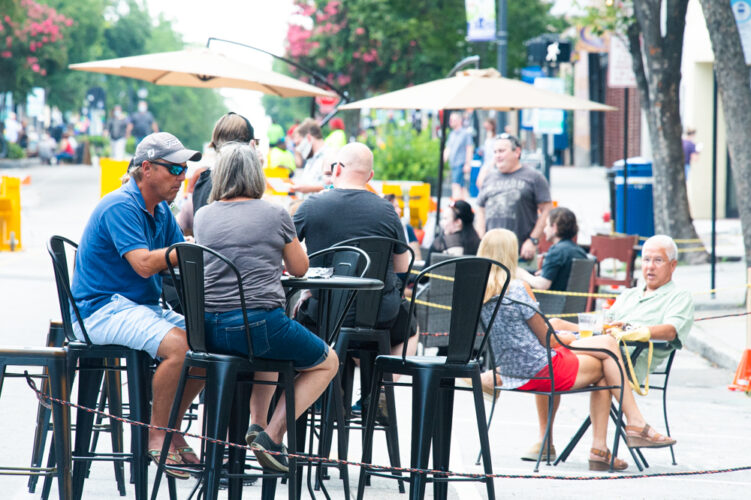
WILMINGTON — To entice more customers to downtown, Wilmington Downtown Inc. is putting together a proposal for city council to consider expanding an outdoor dining, shopping and entertainment footprint on a popular downtown roadway.
READ MORE: Social district coming 2 Saturdays a month to Brooklyn Arts District
“We are in the very early stages,” Christina Haley, president of WDI, told a group of business owners at a community meeting hosted Wednesday at Front Street Brewery. “This could strengthen our downtown economy, support businesses, increase our tax revenues, and bring a bit of vibrancy to our downtown.”
The plan is much like DBA’s Downtown Alive program, which took place during the summer of 2020 when businesses faced declining clientele amid Covid-19 pandemic restrictions and social-distancing measures. WDI — which helps boost downtown businesses and economic development — wants to extend the business footprint into onstreet parking spaces or utilize a fully closed roadway along the north and south sections of Front Street’s 00 block — that would be from Market to Princess streets and Market to Dock streets — to create more of a pedestrian plaza on weekends.
This means dining establishments could set up tables and chairs further outdoors to serve patrons and retail stores could move products outside for people to shop through.
“We allow the closure of Front Street for outdoor vendors to come in and take over the street for a day or a weekend during festivals and my perspective is: Why can’t we do the same thing for businesses?” Haley asked.
The program would take place only during the area’s shoulder season — for example, October and November or April and May — from 4 p.m. on Friday until Sunday evening, with the parking spaces or roadway remaining closed overnight. Though dates and times haven’t been finalized.
The program’s impetus is multi-faceted. Haley said this area of Front Street has faced perception hardships in recent months — even years — with downtown shootings that have taken place in the vicinity. As well, Wilmington’s overall growth and varied districts have begun to draw in crowds elsewhere with more entertainment and dining options that were once centered only in downtown or beach areas. This includes the Cargo, Brooklyn Arts, Soda Pop and South Front districts — all just on the outskirts of downtown’s central business district.
“We are the dinosaur,” Chap Wallace, owner of Port City Cheesesteak at 21 N. Front St., said about the CBD.
Having seen many iterations of the historic district after living in Wilmington for 27 years, he pointed to the early 2000s and 2010s as having a more bustling scene due to little competition.
“But dinner time on Fridays at 6 o’clock, it looks like a ghost town,” Wallace said. “Something needs to be done to make people want to come down here.”
Haley told Port City Daily she has heard from some business owners in the area that their revenues are down 20% to 30% compared to this time last year.
WDI sent out a survey about its idea and so far around 170 people in the community have completed it — 39% are downtown residents and 36% are downtown visitors. The majority — 152 — are supportive of an outdoor expanded business footprint on weekends.
However, not everyone in attendance Wednesday were fully in favor. Jason Henderson, co-owner of Tarantelli’s, was concerned about shutting down Front Street in any capacity. He said anytime roadways or parking spaces are closed off, it becomes problematic for his business at Second and Dock streets because the parking must go somewhere. Thus, it feeds more into a chief complaint he already receives from diners: There’s nowhere to park.
“So the benefit goes to two blocks on Front Street and the rest of us pay for it. That’s the way this works — boots on the ground, real world, that’s how it works,” he said.
Barbary Coast owner Eli Ellsworth agreed. His business won’t be in the footprint of the pilot either, however, he is prepared for a negative impact if there is a street closed.
“I can tell you from 18 years being on South Front, whenever Front Street is blocked off between Market and Dock, Barbary Coast — excuse my French — eats s**t,” he said. “They also use our spots as a parking lot and we get no action.”
Ellsworth said it happens every Azalea Festival and Riverfest. Henderson also confirmed Tarantelli’s numbers decrease during festivals when streets are blocked.
“I’m not against the parklet idea, if you will,” Ellsworth clarified. “I know it takes up parking, but if you block off Front Street, it impacts us.”
Wallace indicated the area they’re considering closing off only contains around 40 parking spaces, much of which also envelops a loading zone. Haley pointed to nearby parking decks available for motorists — on Market Street, Second Street and paid lots in the vicinity. She also pressed that, unlike larger events and festivals, Market Street will still be open, as will Water, Dock, and Princess streets.
Haley chose the two 00 Front Street blocks due to it being close to the parking decks, as well as having multiple crosswalks in place for pedestrian safety. At least 15 restaurants also are in that area, she said, though WDI could amend the proposal to start out smaller with only one block.
Resident Paul Pascarosa attended the meeting and expressed excitement for it. He and his family frequent downtown and always utilize parking decks upon visiting, he offered.
Ellsworth mentioned a closed roadway could be a logistical nightmare for people in short-term rentals and a deterrent to safely access rideshares as well. He thought making someone go an extra step to pinpoint a location a block or two away from where they would normally be picked up would cause confusion.
“And what happens is the Uber drivers catch wind and they stop coming downtown,” Ellsworth said. “They talk just like we all talk.”
Resident Michael Havens attended the meeting and said he “didn’t have a dog in the fight,” but thought the logistics could be figured out and the program could be a success with proper marketing. More so, he wanted to see it extend down Front, from Walnut to Orange streets.
Haley desired to test it in a small area first, to show the city council its benefit and success before growing further. Costs also have to be considered. The program would include renting furniture for businesses to utilize, which Haley received a $1,400-per-weekend quote for 400 tables and chairs, to include set up and breakdown (she said the furniture could stay out overnight or they have been offered a storage space nearby to break it down nightly).
There would be costs associated with insurance, signage and barricades as well. If the program were only blocking off the parking spaces instead of a full roadway, more barricades and bollards would be needed to wrap individual businesses. Those who participate would have to cover the price, though Haley indicated WDI could help with funding from its project budget and potentially even secure a sponsor to help mitigate it.
Haley added she also would like to bring in local musicians, even utilizing its relationship with the Wilmington Symphony Orchestra, if they choose to block off the whole street. Similar initiatives she studied, such as in New York and New Jersey, had a saxophonist, trumpeter or guitarists traversing through crowds and serenading tables.
While some thought bringing in music would add a “sparkle” and persuade people more to attend, Henderson questioned the kind of atmosphere WDI wanted to create and whether it would be a French Quarter vibe. He pointed out during larger festivals, he has had fountains smashed in and tents torn down at his restaurant.
The program would not be tied to a social district, Haley clarified. A social district means customers 21 and older can open-carry alcoholic beverages purchased from businesses freely in approved public right-of-ways. City council passed its first one earlier this week in the Brooklyn Arts District, which WDI also helped the BAD Collective with its test pilot in February. Haley was clear a pedestrian plaza or closed parking spaces would require a server to bring drinks to customers at their tables, where they would be required to stay and finish them before being retrieved by a server.
Wallace chimed in that it would be unfair to compare this program to the public who attends a larger festival, as they normally attract a lot of out-of-towners as well.
“This is for brick-and-mortar businesses, locals,” Wallace said. “And it’s never been done before. This can be adaptable.”
Justin Wilson of The Ivey agreed: “We have to create another option that’s new and exciting that makes people want to come back downtown.”
Josh Cranford of Front Street Brewery added it’s important downtown businesses work together. He was grateful to have an opportunity to “talk it out” with others “instead of doing nothing.”
Haley admitted there were a lot of challenges to work out, such as traffic flow, safety and neighborhood impacts, including noise. The program would come with strict enforcement and guidelines for businesses.
She was more inclined to support a pedestrian plaza, wherein the full street is blocked off, as it would be more appealing to more people. When asked who would make that ultimate decision, Haley told Port City Daily she may present both ideas for the city council to decide.
“And they will have public safety in mind first,” she added.
Haley is devising a proposal packet, with a full marketing plan and all details hammered out. She wanted to have it ready by the end of October or early November, to see a pilot executed before the end of autumn but isn’t sure that can happen. She wants to gauge more feedback and possibly host another community meeting.
Want to read more from PCD? Subscribe now and then sign up for our morning newsletter, Wilmington Wire, and get the headlines delivered to your inbox every morning.
