


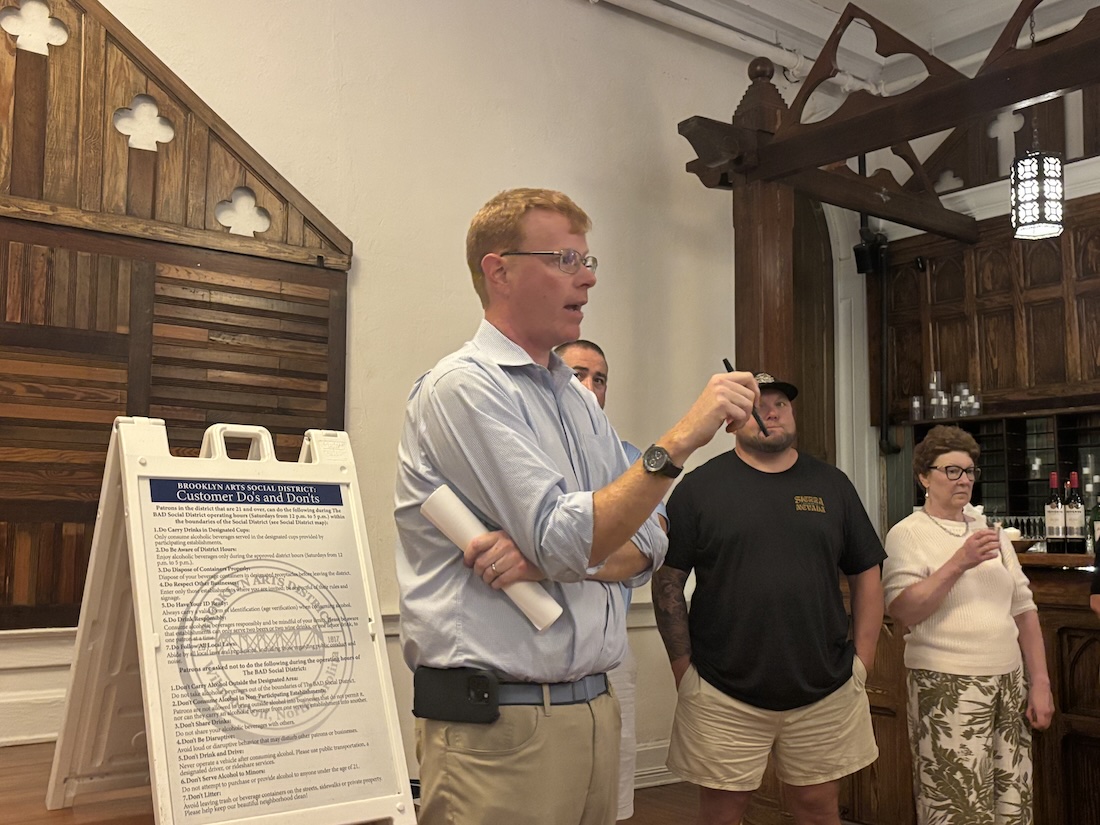
WILMINGTON — Roughly two dozen people attended a community meeting this week ahead of businesses from the Brooklyn Arts District pitching a permanent social district for the area.
READ MORE: Council sets framework for citywide social district considerations
ALSO: ‘Butterfly effect’: BAD Social District a success, permanency addressed by city staff
CATCH UP: Wilmington’s pilot social district set, public speaks out
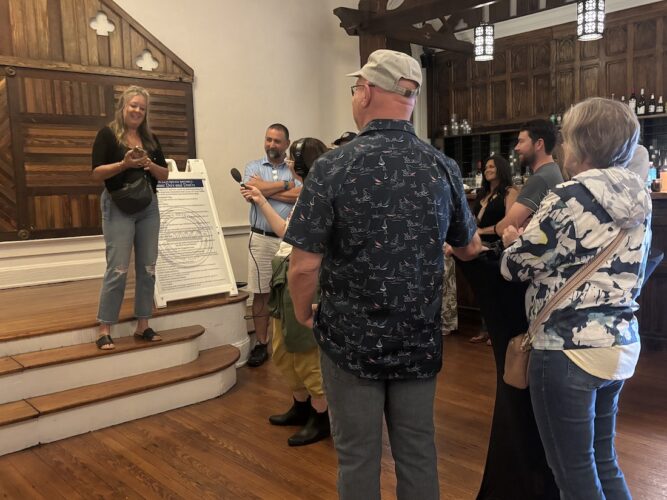
“I would like to preface that this meeting is a Q&A, we are not here to debate. That can be saved for your time with the city council. If you have a respectful question, we are happy to answer it,” Tara English, owner of Brooklyn Cafe and Skyline Cafe, said. “We know we may have some opposition but we support being good stewards of the community.”
English is one of a handful of business owners in the BAD Coalition putting forth an application to council for approval of a permanent social district to take place every Saturday, noon to 5 p.m. The district allows patrons to open-carry alcoholic beverages purchased from the businesses in a 10-block boundary.
Council is supposed to take it up at its Sept. 9 meeting.
The community meeting was hosted in the Brooklyn Arts Center Annex, with concerns mainly centered on parking. This was the bulk of complaints the city received as well after a pilot social district launched in February in the BAD.
N. Fourth Street is the target footprint of the permanent district, encompassing 20 or so business participants. Yet, also surrounding the 10-block boundary are numerous residences, including area condos and historic homes peppered throughout the Northside.
“I know you all put a lot of planning into this,” BAD resident Ty Greene said at the meeting. “I lived in New Orleans for eight years. I’m not at all opposed to the social district, but when we have $30-plus million in residential value in condominiums that are contingent on having curb space to retain value, I want to know, what planning have you decided to do to protect our value with our parking?”
English said the goal is to send as much traffic as possible to nearby parking decks. Skyline Center and Hanover Street parking decks are both located roughly a block-and-a-half from the district. She added the group began advertising the Skyline deck, with signs placed throughout the district as a potential parking option, last winter upon the launch of its pilot program. Each of the three Saturdays in February led to increased usage in the deck.
However, onstreet parking on Fourth Street and down side streets, like Brunswick, Hanover and Bladen, also were utilized as the pilot brought in several thousand people during those three Saturdays.
Deputy manager Chad McEwen told Port City Daily the city is considering utilizing digital signage as well along Third Street to direct people to the Skyline deck in the event the permanent district passes.
“We are going to get more aggressive with that if this is proposed,” he said. “We have a 1,100 space parking deck a block away so parking should not be an issue.”
One resident asked if the city would consider opening the decks for free, to much laughter.
“When have you ever known the city to give something for free,” Scott Wagner, owner of Goat and Compass, quipped.
While Greene appreciated the suggestions and efforts, he remained concerned the deck wouldn’t be enough of a deterrent to protect the free parking spaces available on N. Fourth Street often utilized by residents. The Skyline deck is $2 an hour, but BAD is one of the few sections continuing to offer free parking in the greater downtown area.
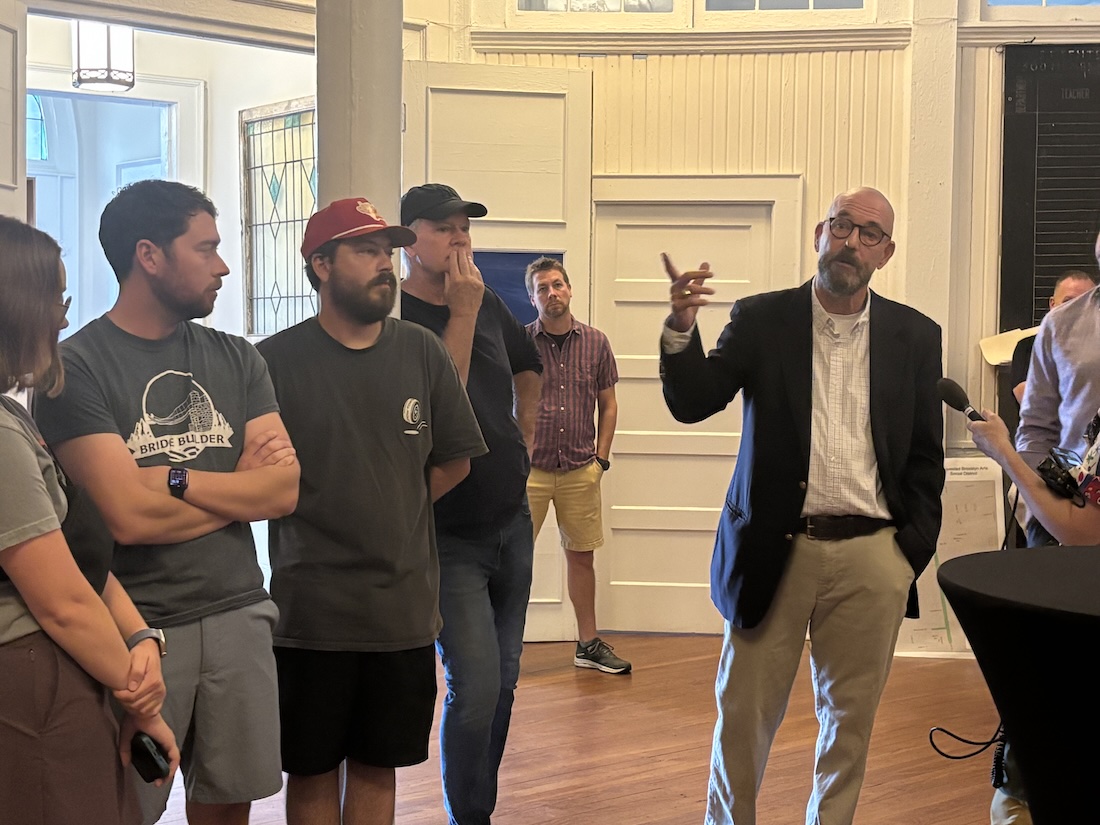
McEwen said they have toyed with allowing the first hour or two to be free in the deck, to help area businesses, but the proposal would have to be vetted through the Downtown Parking Advisory Committee.
Other ideas to address parking were floated. Greene suggested a residential tag system be taken up by the city, which Mayor Saffo also mentioned in January, as originally reported by PCD.
Saffo suggested neighbors act in the same vein as those in the historic residential district did a few years ago as tourists and downtown employees were parking in their spots. Now an historic district pass is required for residents only on a portion of S. Front Street. A historic residential parking program also is in place for the historic district near Orange and Second streets, primarily fronting historic homes.
McEwen told PCD after the meeting an application process is open through the city to consider a residential parking program. None have been submitted for the Brooklyn Arts District, according to city spokesperson Amy Willis (full disclosure: Willis used to be assistant editor for Port City Daily), though McEwen said he anticipates that could change in the near future.
To be considered, a petition from the applicant must include signatures from two-thirds of property owners on the block, verified by the city staff. The Downtown Parking Advisory Committee considers the applications and completes a six or seven-day occupancy survey.
“For an application to be recommended to City Council, it must meet council’s approved guidelines, which is a two-pronged test,” Willis wrote in an email. “During the survey, the area must be 70% occupied and 25% of the parked vehicles must belong to individuals who do not live in the immediate area. The application must then be voted on by property owners with a two-thirds majority in favor to pass.”
Petitions are accepted to survey parking occupancy from residents twice per calendar year, on Nov. 1 and May 1.
McEwen said the N. Fourth Street area is tricky because it has so many businesses mixed in with residential. He noted discussions have taken place among city staff about long-term plans to potentially install meters as well, though nothing is set in stone currently.
At the meeting, Greene indicated that anything the planners can do to protect residential parking would be “fantastic,” pointing to available parking nearby on Third Street and empty lots as well.
“Metering any residential street sends a message there is no longer continued interest in supporting residential,” Greene wrote in a handout he passed around to meeting attendees.
By his estimates, there are 100 residential units between the railway and Bladen Street that depend on curb parking.
BAD resident Patrick O’Leary, who spoke to council against the social district back in March, said he had a change of heart and was supportive of one now. However, walking a mile to his apartment during social district days was “untenable,” he said, and also questioned the idea of metered spaces coming to N. Fourth Street.
“Where in the world do residents go?” O’Leary asked.
“Any meter plan to be added in a residential or mixed-use type environment is also going to be counter measured with a residential parking program offset,” McEwen clarified.
Greene would like to see a residential pass implemented seven days a week to secure spaces for those who live in the BAD. When asked by PCD if he planned to apply to the city’s residential parking program, he put the onus on the city to develop the plan.
“My thoughts are, since the estimated 35-plus million in residential assessed value pays an extra tax of over 15k a year for economic development; and with that payment, and a need to preserve and grow that residential tax base, the city should develop the plan themselves,” he wrote in an email post-meeting.
He also was disappointed no clear path was put forth for parking, other than “we’re asking patrons to park in certain areas,” Greene said.
Businesses all reported the pilot program as highly successful — tripling revenue or more for everyone. Boosting business was the main driving force behind its pitch, with those in attendance Tuesday calling the pilot successful.
“We had zero EMS calls, we had zero police calls, we had zero ALE incidents, we had zero calls for fire,” English explained, adding the daytime hours are intentional so as to not require extra police presence or take away from current first responder resources. She added there are no plans to extend hours into late-night, a time when bars already are packed.
Wes Westlye of Commodore Kitchen and Public House said aside from benefiting the brick-and-mortars, the district also helped artists who set up during the pilot to vend at various establishments and musicians who performed live to keep people entertained.
“It wasn’t what some city council members are saying was ‘turning into New Orleans,’” he said. “There is a real shortage of things to do in Wilmington for young families especially in the downtown area. … It was a family-friendly event.”
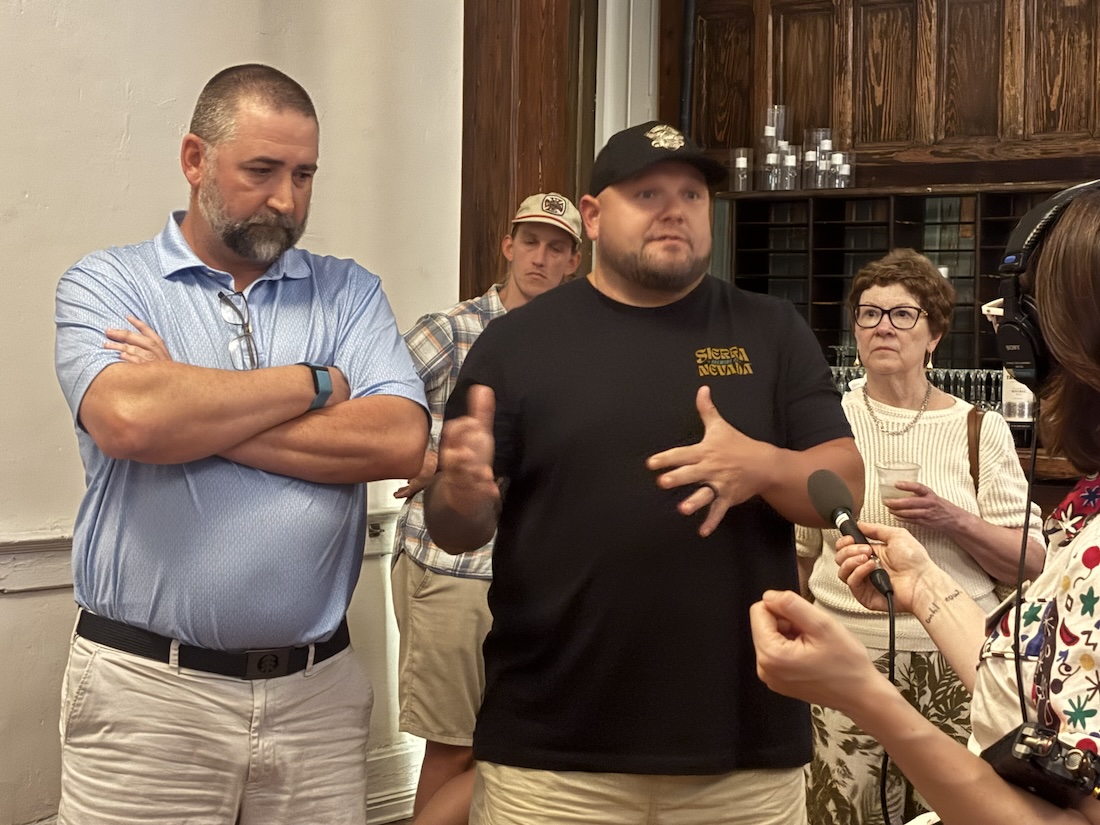
The owners of Boombalattis Ice Cream, located near Davis and N. Fourth streets, agreed. With a large part of their clientele centered on families, they noted serving not just 30-something-year-olds and their kids, but grandparents and grandkids as well.
“Everyone who came through was completely respectful,” owner Kristen Betchel said.
Her husband, Wes, also pushed back on any notion a social district would bring in more riff-raff, trash or crime.
“If you see 1,000 people having a great time walking down the streets, you might not want to [commit a crime] there,” he said. “We’ve had some issues in the last few years and calls to EMS to wake people up. I just think the more people walking in the BAD, the less of that we are going to see.”
Alex White, owner of Don Luca Pizzeria, said everyone in the room, residents, businesses and otherwise, loved the neighborhood and wanted to be cognizant of concerns. But, in the end, he said parking would not be solved overnight.
“It isn’t going to get any better in the future immediately,” he said. “There’s more people moving here and there’s eventually going to have be another deck or more street parking — whatever it is. Parking is an issue and we all agree we need to address it.”
McEwen concurred, calling it a larger issue than what can be tackled for the social district.
Someone suggested utilizing a shuttle or trolley from the parking deck during social district days to alleviate walking for those who may need help. McEwen confirmed it’s also being discussed.
Westlye and Wagner said after the first few districts launch, should the permanent district pass muster, they expect the newness and novelty will wear off some after a month of two. Thus, participation — and parking concerns — may plateau.
The coalition’s original goal was to have a permanent social district in place this month or next. They hoped for their application to go before council next week, but the process — as codified by council last month — isn’t quick. It includes mailing notices to all property owners impacted by the district within 500 feet of its boundary, hosting a community meeting, paying a $1,000 nonrefundable fee and gathering recommendation by a new 11-board member community advisory committee to turn over to council.
“I hand-stamped 450 mailers to send out,” Wagner told Port City Daily after Tuesday’s meeting.
Though the group was only required to have one community meeting, the coalition is hosting two. Wagner said they took feedback from previous council meetings to heart. Some residents and at least one council member, Sallette Andrews, decried notices not properly being sent to those who were affected ahead of the pilot.
“We wanted to make sure we gave plenty of opportunity for input,” Wagner said, adding the next community meeting planned is for Tuesday, Aug. 19, also at the Brooklyn Arts Center Annex.
If approved Sept. 9, the coalition will begin immediately planning to get the district up and running, hopefully sometime by mid-fall. The goal was to have the Saturday district’s operational for ongoing events, the next planned for Nov. 1 — BAD’s annual Day of the Dead celebration.
Want to read more from PCD? Subscribe now and then sign up for our morning newsletter, Wilmington Wire, and get the headlines delivered to your inbox every morning.
