


WILMINGTON — A government land development code will be changed after the Wilmington City Council signed off on doing away with special use permits in all but a couple of instances.
CATCH UP: Wilmington planning board, city attorney debate public’s place in development decisions
ALSO: City considers banishing special use permits after Holly Tree rec facility ‘disaster’
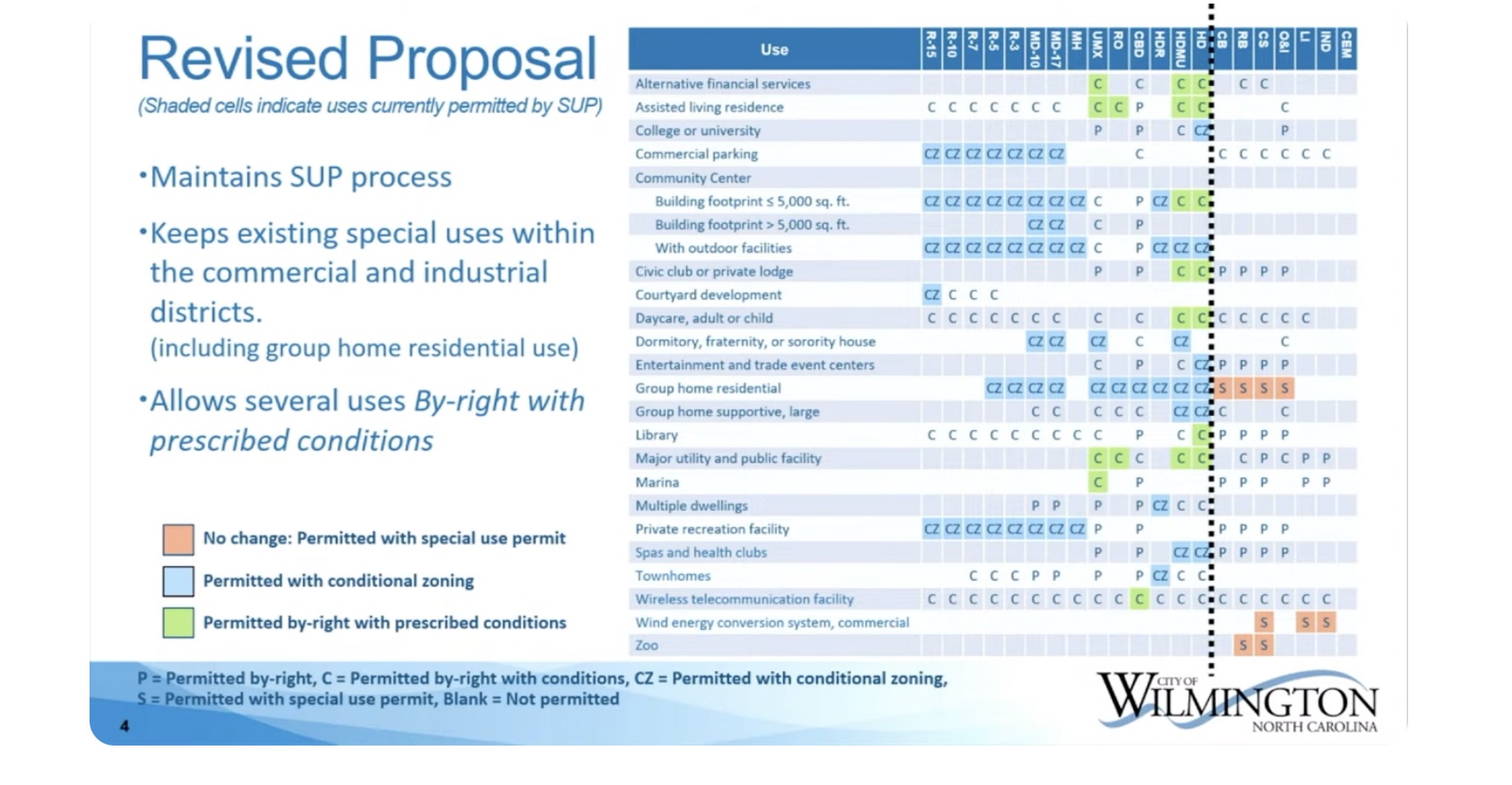
Among a packed agenda on Monday night, the council voted unanimously to pare down SUP uses from 22 to three.
Brian Chambers, assistant planning director, said they decided SUPs moving forward would continue only in commercial and industrial districts, including for residential group homes, wind energy conservation system/commercial and zoos.
The change was prompted by a tedious hearing held this year for the Holly Tree Racquet Club expansion, which lasted four hours.
A special use permit is allocated through a quasi-judicial hearing and doesn’t allow just anyone from the public to speak. Only people with standing — those who prove they’ll be affected by a project and provide expert evidence and testimony — can be heard when weighing in on a developer’s plan.
The development team often comes with an attorney and experts to speak to traffic, home value increases and decreases, stormwater issues, and other areas that draw pushback from the public.
A governing body approves the projects based on four points that developers must prove, including their plan:
- Will not materially endanger public health or safety
- Meets all required conditions and specifications
- Will not substantially injure the value of adjoining or abutting property, or that the use is a public necessity
- If developed according to the plan as submitted and approved will be in harmony with the area in which it is to be located and in general conformity with the city’s comprehensive plan, the CAMA plan, and adopted special area plans
Many have decried the process unfavorable to public concerns and slanted to help developers, oftentimes with the various rules of the hearing causing confusion. The goal was for the city to change SUPs to conditional zonings, however, some planning commission members took issue with it.
There were concerns it would go against Senate Bill 382 and could be considered a downzoning. However, attorney Meredith Everhart, after discussing the change with UNC School of Governments, said it would be a process amendment only and maintained conditional zoning expert testimony from city staff and developers would remain.
“The argument that the development community has got to pay all the money for the experts and the public doesn’t have to pay anything, they can get up there and say whatever they want — that’s not good government,” commissioner John Lennon said back at the planning commission’s May meeting.
At the same meeting. his colleague Livian Jones thought sticking to evidentiary facts was a better way to go, while fellow member Jack Pollock “bristled” at the idea that the public’s concerns were not being taken seriously due to not paying for professional expertise.
The planning commission voted 4-3 to pass the suggestion to council, who took it up June 3 but instead city leaders asked for a working group meeting among stakeholders. That took place June 30 with three planning commission members, planning staff, residents and representatives from the development community.
“We believe these changes reduce a barrier to public participation, allow for greater communication with council and simplify the public hearing process,” Chambers told council Monday.
Conditional zoning makes up the bulk of what was once SUPS. For example, it’s now required for private recreation facilities, townhomes, and community centers in some placetypes. As well, conditional zoning would be in place for the applicant in perpetuity, whereas the SUP had to be acted upon within two years.
Changes also were made for some uses, like marinas in urban mixed use and libraries, to become permitted by-right with prescribed conditions. The conditions are the same as before under SUPs and were pre-written; they didn’t come from the ad-hoc committee meetings.
Chambers appeared before the planning commission on July 16 as well and clarified to them that “no conditions changed and no definitions changed.”
Planning commissioner Ace Coffer asked Chambers if he thought the conditions were adequate considering they were written for specific SUPs; Chambers did.
Cofer also took issue with courtyard development being R-15 and permitted by-right rather than going through a conditional zoning process.
“To go straight to staff level, administratively approving by-right in R-15, that’s a pretty significant change,” Cofer said, later calling it “a horse of a different color.” “That’s no longer a process change, whether an SUP or conditional zoning — now, we do it at the administrative level. … It seems to me we are injecting more density without going through the SUP or CZ process if they meet the conditions.”
Commissioner Richard Collier — who is running for city council this year and has worked as a civil engineer on projects including Mayfaire and Riverlights — said during the stakeholder meeting he particularly asked for staff to address the courtyard development. Collier was part of the small group, along with Jones and Pollock.
Collier noted that courtyard development has its own classification and restrictions in the code already: “So I didn’t see it as an issue in R-15 — that’s my opinion.”
However, he conceded to Cofer’s concerns that if it were altered back to conditional zoning, he would not object.
“It is a different development pattern that may be more disruptive in a low-density, homogenous kind of zoning area,” Chambers said. “Adding this to it may not be appropriate in some R-15 areas and may be appropriate in others.”
Lennon noted leaving it as is would be consistent with the city’s push for density increases and providing more housing options.
By the time the code changes reached council on Monday, courtyard development was back to conditional zoning rather than by-right.
Other adjustments from the stakeholder group meeting that stuck included major utility and public facilities also being permitted with conditions by right in the historic district, historic district mixed use, residential office district and urban mixed use.
Collier explained to the planning commissioners he saw utility and public facilities as “necessary” and already would have prescribed conditions on where and how one places them. The extra step of conditional zoning approval felt unnecessary to Collier.
“They’re only limited in a few places,” he added.
Cofer, who supported conditional zoning over SUPs, had hoped for more discussion and even input on the draft changes. Chambers iterated council didn’t mandate another public hearing about the amendments before the planning commission, only for them to have a working meeting with stakeholders, with changes from there presented only before city council took it up in August.
Jones wasn’t keen with not having another vote of recommendation or otherwise: “I object to a lot of the uses that are on this table and it doesn’t matter.”
Pollock challenged her and said the ad-hoc meeting was the platform to be heard, adding they met two hours to suss out the changes.
Jones stood by the SUP process and called it a viable “tool in the toolbox.”
“It doesn’t mean we cut the community out of it, we find a way to let them speak,” she said. “A lot of people handle it differently. I don’t think we strike something that’s a process and not really used that much.”
It’s been used five times since 2022. Pollock countered the argument saying because it’s infrequent, it’s better to consider its plausibility, noting staff already cut SUP use in 2021 from 59 to 22.
“I look at this as a continuation of that discussion,” he said.
Lennon circled back to community feedback, questioning if this change fulfilled that mission.
“This gives the opportunity for each side to talk for 10 minutes during a conditional zoning hearing,” he said and thought the county’s planning board accomplished a better way to handle SUPs that allowed the public input.
New Hanover County’s board does a dry-run of quasi-judicial hearings, to provide and guide the public so they understand how it works — and to hear out their concerns and address it with the developer. However, the planning board doesn’t offer a recommended vote or review to give commissioners.
Pollock said NHC commissioners also have to disclose if they tune into that review, which creates “ex-parte potential.” The governments who approve SUPs aren’t supposed to have communication about the hearing ahead of time.
Lennon said he thought that argument was loose, in that true “testimony” isn’t necessarily provided during the dry-run.
While Collier — who also wanted to keep SUPs — said he respected Lennon’s opinion, he thought direct community input would be the same if not more. Collier explained a public hearing will be held at the planning commission and in front of council when a conditional zoning is sought.
No one spoke out at Monday’s public hearing in front of city council and only one person wrote in agreement to the changes, according to the city clerk.
Want to read more from PCD? Subscribe now and then sign up for our morning newsletter, Wilmington Wire, and get the headlines delivered to your inbox every morning.
