


WILMINGTON — The New Hanover County School district employs thousands of teachers and staff, so both turnover and disciplinary action are an expected part of its operation. Still, it’s worth taking a look at a particular pattern of how disciplinary suspensions line up with resignations — and why it matters when employees could be fired, but aren’t.
Between July 1, 2019, and February 12, 2020, New Hanover County Schools (NHCS) has seen 255 retirements and resignations, as well as 36 suspensions — 25 of them without pay. In at least six cases, suspension without pay was immediately followed by a resignation — it’s a pattern that, in the worst-case scenarios, can allow problematic employees to end up at other educational positions despite past misconduct.
Former Superintendent Dr. Tim Markley is also part of this pattern, although the district did not include him in the list of recent suspensions. Markley was suspended without pay in October for attempting to intimidate a parent. In addition, the board was considering another incident of alleged harassment and intimidation of a parent by Markley when he resigned as part of a separation agreement.
These numbers don’t include two recent incidents from Williston Middle School: the substitute teacher fired after he was arrested for urinating in front of a classroom and a teacher suspended with pay after a criminal investigation was launched following a parent complaint. They also don’t include some of the recent resignations and retirements of top administrators, including Assistant Superintendent for Human Resources Dr. John Whelmers.
Since 2013, NHCS has averaged around 289 resignations and retirements annually. But, while the numbers between July and February appear to put the district on track for higher-than-average turnover in the 2019-2020 school year, officials don’t consider the numbers exceptionally high.
According to NHCS, “In the past several years the district has seen a significant decrease in turnover rates amongst our educators. Local stipends and opportunities for advancement allow NHCS to attract and retain phenomenal educators. We hope to continue that trend in the future. When reviewing the numbers on retirements and resignations you see that July 1, 2019, and January 1, 2020, are our biggest spikes of retirements and resignations, and account for 27% of the total numbers on just those two dates. New Hanover County Schools does not anticipate another spike in retirements or resignations until July 1, 2020, and that data will be reflective in the 2020-2021 school numbers. NHCS employees over 4,000 teachers and staff, though there can always be room for improvement the district does not believe that 25 suspensions without pay are exceptionally high.”
Resignation and retirement
Retirements at NHCS come in large groups, with dozens of employees leaving effective January 1 or July 1 every year. As NHCS has pointed out, in the last seven months those retirements have made up over a quarter of the employees leaving the district.
While there was one high-profile retirement that raised eyebrows — the departure of then-Deputy Superintendent Dr. Rick Holliday, less than a week after an investigation into the administration was announced — the majority of retirements aren’t made public, except in letters to school communities, like one several weeks ago announcing the retirement of Holliday’s wife, Holly Tree Elementary School Principal Laura Holliday. Since July 1, 2019, it appears that no retirements have followed disciplinary suspensions.
Compared to ‘retirement,’ the word ‘resignation’ sometimes carries a negative connotation in public employment, but it’s worth noting that there are normal reasons for employees to resign. Like many other districts, NHCS competes with other public and private schools, as well as the private sector, to retain employees. Resignation often only means an employee is leaving the district for another job or is ending their career but is not yet of retirement age.
Often, but not always.
Suspension, resignation
Since July 1, there have been at least six NHCS employees who were first suspended without pay — almost always a sign of disciplinary action or pre-termination — and then resigned.
However, unless there was law enforcement involved, it’s not possible to know what led to these suspensions and resignations. NHCS routinely cites state personnel law in declining to answer questions about suspensions, although in rare cases it has provided limited information; for example, in the case of Peter Michael Frank, the district indicated that a prior suspension without pay was due to an incident that had not involved students, possibly a pre-emptive defense against claims that district had failed to report sexual misconduct to law enforcement.
In only one of the five cases since July is there an arrest record that sheds light on a suspension.
In that case, Williston teachers assistant Angela Clark was suspended without pay on November 27, 2018. This was one day after Clark was arrested by the Wilmington Police Department for attempting to conceal a firearm from officers who responded to a shooting. Clark pled guilty to a misdemeanor charge of resisting an officer and was issued a 30-day suspended sentence and paid $300 in fines and court fees. Three weeks later she resigned. While NHCS has not publicly commented on Clark’s suspension or resignation, it’s difficult to imagine the timeline is coincidental.
In other cases, there’s some evidence of repeated or evolving incidents. This includes a custodian at Blair Elementary who was suspended without pay for three days in August of 2019. A month later, the custodian was suspended without pay again; this time he resigned on the same day.
There’s also evidence for moving problematic teachers around. This was most recently the case with substitute teacher Darvin Greene, who — two months prior to being fired for urinating in front of a classroom — was investigated and removed from a school where a complaint had been filed against him.
This may be the case of a teachers assistant at Mary C. Williams Elementary School; in January, an employee was suspended without pay and five days later given a lateral transfer. The employee resigned the same day as the transfer.
Two other incidents include a former JROTC instructor at New Hanover High School who separated from NHCS after his teaching license expired and then returned as a custodian at Noble Middle School. The custodian was suspended without pay in early November, 2019 and remained suspended until he resigned at the end of the month. They also include a teacher who had worked in Pender, Duplin, and New Hanover counties schools over the last two decades, moving between positions but without any suspensions or demotions. Then, at the end of January, the employee — at the time the ISIS coordinator for Laney High School — was suspended without pay and resigned several days later.
The sixth case was former Superintendent Dr. Tim Markley.
Why does it matter?

When a teacher is fired, like former Roland Grise Middle School band teacher Peter Michael Frank, a termination letter often spells out the district’s grounds for firing them — this is information that can be made public. But when a teacher resigns without being fired, the details of any apparent misconduct remain sealed in a personnel record.
While suspensions without pay are public records, they don’t appear to carry the same weight as terminations — perhaps because they don’t come with details. Further, resignations apparently don’t prevent school coworkers or administrators from writing letters of recommendation.
NHCS requires three supervisory recommendations and inquires with prior employers if there were any disciplinary concerns. The district also asks applicants themselves “to state if they have ever been asked to resign, been subject to disciplinary action, as well as if they have been suspended, dismissed, fired or discharged.” But in some cases, it seems employees slip through the cracks and, for other schools, the background checks may not be vigorous enough to catch prior misconduct that didn’t result in termination.
The most recent high-profile case in point is Nicholas Lavon Oates, the former Myrtle Grove Middle School special education teachers assistant. Oates was investigated by both the administration and the New Hanover County Sheriff’s Office and, despite evidence that he had sent sexually explicit text messages to a child, was neither arrested or fired.
Oates was suspended without pay — twice — but then resigned. It was only much later that he was arrested and charged with the crime of sexually assaulting a former student.
While there are still serious questions about why action was not taken earlier against Oates by both the district and law enforcement, it’s also worth noting that in the year and a half between Oates’ resignation from NHCS and his arrest, he was employed by another educational facility — something that likely would have been prevented had Oates been fired.
While Oates is the most glaring example, there are others, dating all the way back to the 1990s, when Laney High School band director Richard Priode was the subject of complaints. He eventually resigned and moved to several other school systems before he was arrested in Charlotte-Mecklenberg for having a sexual relationship with a student.
An uneasy balance
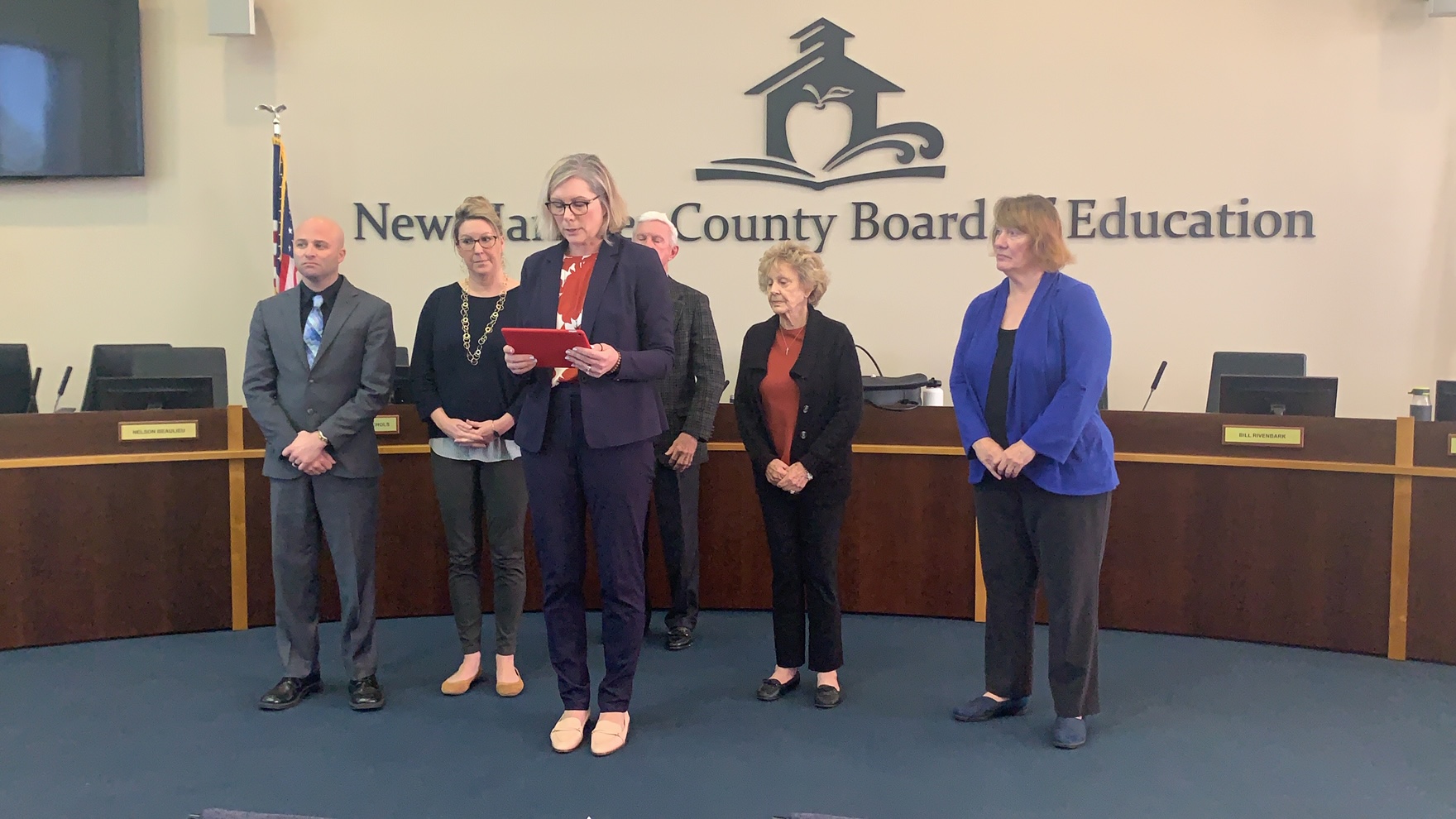
The Board of Education has repeatedly pointed to rigorous procedures required for firing a ‘tenured’ or career teacher. Failure to follow these procedures, the Board has said, could expose the district to a civil suit; likewise, inappropriately disclosing personnel information about employees could also result in litigation.
By law, the district must give career employees an opportunity to have a superintendent’s decision to terminate them or suspend them without pay reviewed by the board. This process is designed to make sure employees have access to due process.
It’s worth noting that tenure status does complicate potential termination proceedings — however, the state eliminated “career status,” also known as tenure, in 2013, but in 2016 the North Carolina Supreme Court struck down the move, preserving tenure for those teachers who already had it. Tenure would not have applied to Oates, or most of the five employees who resigned following suspensions in the last half-year.
In the end, however, state statute lays out a number of reasons for which a district can fire an employee, even a tenured one. These include specific convictions of felony crime and misdemeanor crimes of ‘moral turpitude‘ (usually involving deceit or fraud, but also including violent crimes, drug possession with intent to sell, and theft), but also much broader categories including immorality, insubordination, neglect of duty, and in general failing to live up to the standards imposed by the state and the local board of education.
In other words, the district has broad authority to fire teachers. But, quite often, it hasn’t. Without access to the closed session discussions of the Board of Education, the reason for this remain unknown. However, the discussion around Markley’s contentious exit from the district provides some insight.
Related: Why didn’t the New Hanover County Board of Education fire Superintendent Markley?
In Markley’s time at NHCS, he appears to have presented the district with repeated reasons to investigate and potentially fire him, including an affair with a subordinate employee who received a promotion and raise without clear explanation, retaliation and intimidation of parents, a criminal investigation and a civil lawsuit both looking into allegations that his administration covered up sexual misconduct, a litany of Title IX and other civil rights claims, and other issues, including Markley’s murky role in the racial discrimination in the Forest Hills Spanish Immersion program.
Still, the board chose a separation agreement.
It’s clear that the Board of Education had the backing of county commissioners, approving the separation agreement — a $226,000 buyout for Markley — before the county approved providing the funds to the district. In discussing that funding, Board of Commissioners Chairwoman Julia Olson-Boseman was more direct than the board had been, telling WECT, “I think that we would all just like to say ‘you’re fired,’ but with that we, the school system chose, to [ask] ‘How can we end this quickest and get us out easiest without a lot of lawsuits, without a lot of dragging people through this anymore?’”
While the sizeable buyout for Markley may have not sat well with many, commissioners and school board members both said — with varying degrees of directness — that they believed the agreement would ultimately save taxpayers from an even more expensive legal battle with Markley.
It’s possible that, as with Markley, the district and board have been hesitant to fire employees — even when they wanted to, even when there was cause — because of concerns over litigation. Given the recent history of employees who have been arrested months, years, or decades after complaints were filed about them — Michael Earl Kelly, Nicholas Lavon Oates, Peter Michael Frank, Darvin Greene — it’s clear that while this policy might have fiscal concerns at heart, it’s striking an uneasy balance with the public trust.
Send comments and tips to Benjamin Schachtman at [email protected], @pcdben on Twitter, and (910) 538-2001
