


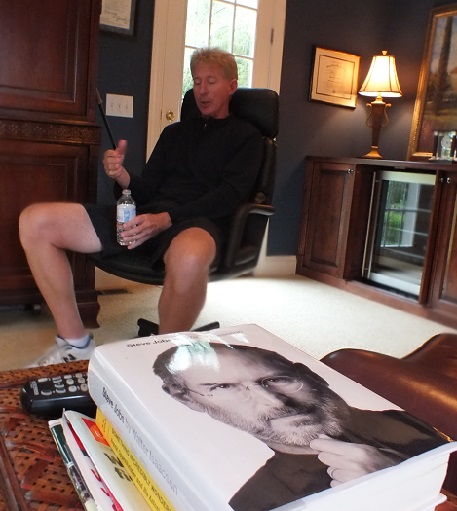
What Michael J. Fox is to Parkinson’s disease, and what the Ice Bucket Challenge has done for ALS, Wilmington’s Tom Looney wants to do for MSA—a terminal disease he’s lived with six years.
Never heard of him?
He’s not a beloved celebrity, and he’s not this year’s YouTube sensation. But his resume is impressive, having worked a number of high-profile gigs at several high-tech companies, including Oracle, Microsoft and Steve Jobs’ NeXT, where he worked with the Apple co-founder six years.
Never heard of MSA?
That’s what Looney wants to change.
Similar to both ALS and Parkinson’s, Looney describes MSA—multiple system atrophy—as something in between: a rare, degenerative neurological disease that affects the body’s automatic functions (digestion, heart function) and ultimately leads to death. The average survival rate, Looney said, is seven to eight years.
Looney has made it six years and counting. And while he’s aiming to break records—he said some patients have survived as many as 18 years—he’s also trying to educate and help others with the disease, through advocacy, awareness and his own struggles and successes.
Like Jobs, who battled pancreatic cancer the last eight years of his life, Looney says he has access to doctors and resources that most MSA patients do not. “And to me, that’s wrong,” he said this week.
“One of my goals is to make my regimen, my daily routine—including hyperbaric oxygen therapy; things that aren’t covered by insurance that are accessible to me—accessible to every person who suffers from the same disease,” Looney said.

Appointed earlier this year to the board of directors of advocacy group MSA Coalition—the first-ever patient to serve on the board—Looney is striving to share what he knows and continues to learn through his treatments and experiences. While raising awareness and funds for research, he’s also attempting new approaches and techniques that he said are getting notice within the medical field.
Today is World MSA Day, an annual observance, and Looney is marking the occasion by reaching out to others in hopes of helping them learn more about the disease, and to help those who have it learn how to live with it.
“As long as I can, I want to help the organization raise awareness and raise funds, not just for researching on a cure,” Looney said, “but researching on quality treatments and accessibility for everyone with the disease to those treatments.
“And that’s a pretty neat thing to follow up on a life previously that was focused on trying to grow these businesses or to win a state championship or a national championship in college,” he said, referring to his days on the basketball court.
“Now it’s just: try to figure out what you do with the rest of your time.”
Physical fight
At six-foot-five, Looney is imposing but welcoming when he answers the door to his Landfall home. He moves slowly, using a walking stick at times, but otherwise gets around his spacious house with ease.
His speech is slightly slurred, another effect of his MSA, but he speaks with a wealth of knowledge that reflects his decades of experience in the technology field—experience he’s continued to put to use in Wilmington, involving himself with several business startups, consulting with UNCW on its Center for Innovation and Entrepreneurship, and co-founding the university’s Seahawk Innovation venture fund program.
The 55-year-old looks physically fit, despite his condition and decades’ remove from his days as a small forward and shooting guard at Maryland’s Mount St. Mary’s University. He said he walks 4 or more miles per day and has a personal trainer who works with him regularly on coordination exercises and maintaining core strength—approaches to living with the degenerative disease that he says go against traditional doctor’s orders.
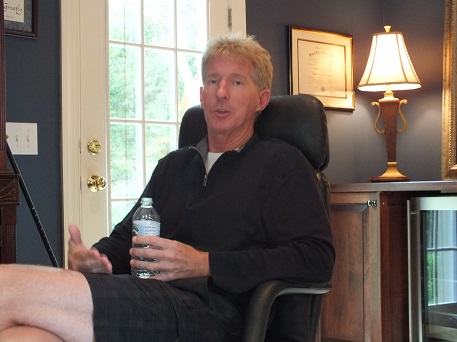
“I felt like, if you’re going to tell a guy who’s in his late 40s that he has a terminal illness, they should hand out a copy of the movie ‘Rocky,’ instead of saying that we need to childproof your house now,” he said.
“Instead of ‘No, you can’t go upstairs; you can’t do this, you can’t do that,’ really you should be urging people to be as active as is safe for them to be, and then to work on things like understanding the proper way to breathe and understand the proper way to develop 360-degree core strength,” he said, “because that’s so essential as the disease progresses that you can rely on those simple things. It suddenly comes to be extremely valuable.
“That’s some of the stuff that we want to make part of the medicine, if you will, for MSA,” Looney said. “It’s not just the meds. It’s got to be this lifestyle of commitment to physical conditioning, strength, agility drills, and then some of the other life skills like talking and even swallowing food.”
Such skills are what Looney has had to relearn, seeing a speech therapist not only for speech but also to learn a new swallowing technique. He said he’s kept a fairly normal diet but has cut out gluten and alcohol, and he supplements his meds with calorie-rich shakes.
Most times, like today, he feels pretty good. But sometimes, like last winter, he gets really sick. The first three years of his diagnosis, he said, Looney suffered from pneumonia—a high risk with MSA—three times.
The past three years? Zero, he said.
‘Game on’
Diagnosed in 2008, Looney retired from his job with Microsoft, where he served as industry director for its homeland security and public safety unit. His wife and two kids, both college-aged now, had moved with him to Wilmington eight years earlier, drawn by family and the area’s amenities.
At a symposium he attended in late 2007, Looney said he experienced vertigo that led him to seek out medical treatment. A local neurologist diagnosed him as having MSA—one of “a handful of people” she’s diagnosed since, according to Looney, who emphasized its rarity.
“Parkinson’s disease is far better known,” he said, adding that he’s heard about 20 percent of Parkinson’s patients who donate their brain to science are found to have actually had MSA.
“Some people refer to it as Parkinson’s on steroids. Others say it’s between Parkinson’s and ALS,” he said. “It’s a tough disease, because it affects your autonomic nervous system, it affects the cerebellar system (coordination, timing), and it affects you the same way that Parkinson’s affects people. So it’s like the triple-threat disease.
“That’s why every person with MSA suffers it a little differently than the next person,” he said, “because it involves this clumping (from cell degeneration) that takes place in three different parts of the brain.”
Rather than taking his diagnosis as a death sentence, Looney decided to commit himself to learning about the disease and seeing what treatment from the world’s best doctors could do to make the most of the time he has left.
“Once it was confirmed, then it just was like: ‘Okay. It’s game on.’ This is the next great challenge. It used to be sports; then it was business. Now, it’s MSA,” he said.

His retirement affords him time to commit to treatment and research—a luxury he’s aware most patients might not have—and he said his background in basketball and sports made him open to committing to regular training and exercise schedules.
“I just kind of took this attitude of, ‘this is like everything else,’ which is you don’t overnight become an all-county basketball player. You work really hard on these different individual skills, you try to merge them together and eventually you’ve got game,” he said. “What I realized is, I’m going to decompose this complex, neurological thing going on and figure out the best possible treatments, the best things I can do and have control over—from my fitness, to my diet, to being cooperative with the meds that were being prescribed, finding doctors that think outside the box while still respecting western medicine.
“I found some benefit from learning things like yoga and tai chi and adopting a gluten-free diet, and of course giving up alcohol and any other kinds of things that generally aren’t good for you. And they’ve all contributed to my progression being now an area of interest by some of the leading doctors in the world,” he said.
Looney also notes emerging technologies, such as a smart phone app called TremWatch—announced last month by Wilmington-based Human Innovations—that detects and tracks human hand tremors brought on by Parkinson’s disease or other conditions. Ten percent of profits generated from TremWatch will be donated to the MSA Coalition, the company said in a release.
Good company
Looney’s efforts have also seen him involved in events that have raised substantial funds for research. In February, he was part of a MSA fundraiser inspired by celebrity chef and musician Kerry Simon, a competitor and winner on “Iron Chef America.” The event, held in Las Vegas, raised a half million dollars with support from celebrities and musicians including Bill Murray, Alice Cooper, Sammy Hagar and Slash.
While tackling MSA has produced new relationships, Looney said his journey has made him appreciate most friends and family here at home, as he said is often the case for people who are facing a fatal illness.
“I’ve really admired what I’ve learned about people through this,” Looney said. “It seems to me that the impression of people in general is that they run away from the flame and they run away from the hard things, but I’ve found that the majority of people in my life have run to the flame—meaning me with MSA—and are accepting that the guy that used to be able to maybe run faster and jump higher, and do okay in business too, is suddenly slurring his words or a little bit off.
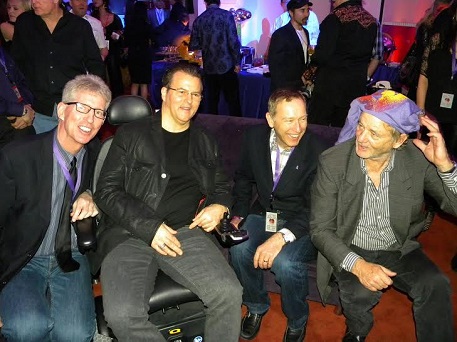
“I think that’s wonderful, and I think that’s true of countless other people who are fighting terminal illnesses and dealing with their friends, their family, their caretakers and so forth. So much of what I have come out of this with is a positive feeling for what people are capable of.
“And seeing these people just desperate to try to get the right diagnosis for their loved ones, the right care for them…” That, Looney said, is what motivates him to keep helping with research—and to keep living his life.
“The average age of onset for MSA is earlier than Parkinson’s. It’s late 40s, early 50s, on average,” Looney said. “And the prognosis is single digits in years, although they now know that some cases have lasted 15-18 years.
“At the very least, I want to be trying to push that one, because I’m always motivated by records,” he said, pointing to plaques on the wall from his hoop-shooting days.
“That’s the current thing that I’m shooting for,” he said.
To learn more about MSA and how to donate toward research, visit the MSA Coalition website, multiplesystematrophy.org.
Looney appeared on Port City Radio on World MSA Day to discuss his diagnosis. CLICK HERE to listen to his Community Connections interview with host Aimee Bowen.
Jonathan Spiers is a reporter for Port City Daily. He can be reached at (910) 772-6313 or [email protected]. On Twitter: @jrspiers
