


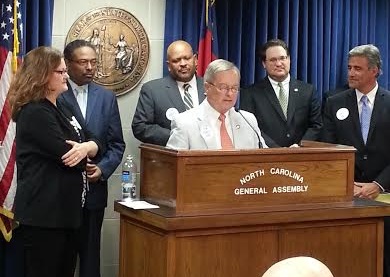
To state Rep. Frank Iler (R-Brunswick), the debate over extending North Carolina’s film incentive is like the film series “Star Wars.”
And Georgia, Iler said, “is the evil empire.”
That analogy prompted laughter at a press conference this morning that saw legislators from both sides of the aisle encourage the General Assembly to extend the incentive, which is set to expire at the end of this year.
To Iler—referring to Atlanta, specifically—the analogy holds true in what he called “Film Wars” between the two states.
“You could almost say the eyes of Georgia are upon us—us that will be voting on these incentives,” Iler said. “And the evil empire is coming to capture 4,000 jobs.
“Some of our colleagues want to surrender and give them away. I think we need to fight, and we need to have at least as good of an incentive program as we have now,” he said.
“We’ve got to fight for these jobs. And to me, it’s war. It’s an economic war with Georgia,” he said. “I love Georgia, but I love North Carolina more.”
Iler’s comments set the tone for the press conference held in the Legislative Building mid-morning today. Among those on hand were Rep. Susi Hamilton (D-New Hanover), representatives from Mecklenburg and Forsyth counties, Wilmington Mayor Bill Saffo and Councilman Earl Sheridan, aldermen from Southport, and workers and supporters of the state’s film industry.
Hamilton noted packets would be distributed to every member of the assembly containing copies of a study by an N.C. State University professor on the economic impact of the industry on the state, a legislative review of that study, the professor’s response to that review, and a fact sheet listing “the myths and misrepresentations we had to set right.”
“The debate on extending the film credit is just heating up,” Hamilton said, “and we will be making the case for keeping these clean, high-paying jobs in this state.”
That study, commissioned by industry groups and conducted by Robert Handfield, a professor specializing in supply chain management, found a positive return of $25.3 million to state and local economies in 2012—the year that productions like “Iron Man 3” and “The Hunger Games” set records for spending in the state.
“Iron Man 3” spent $180 million and received $20 million in refunded tax credits—the maximum allowed under the incentive, which provides a 25 percent break on taxable expenses for productions that spend at least $250,000. Hamilton, Iler and others have sponsored a bill that would extend that incentive by eliminating the sunset clause that would make it expire at the end of this year. The proposal would also increase the minimum spending requirement to $300,000.
Other officials, including Gov. Pat McCrory, have called for the incentive to be restructured, pointing to the legislative review that found errors in Handfield’s study and determined the incentive actually cost the state about $33.1 million in 2012 when those were corrected. A bill filed in the Senate would reduce the maximum credit allowed to $6 million per production and increase the minimum requirement to $1 million—a change that Hamilton has said would significantly impact filming in the state.
Iler, one of several Republicans involved in the bipartisan bill to extend the current incentive, pointed to that study as well—as reason to leave the incentive alone.
“We shouldn’t have to be here at all,” Iler said in the press conference. “The only study that’s been done that includes all the taxes and income…and has been done outside the ivory towers in Raleigh has been done by Dr. Handfield. And that’s conclusive it’s a winner, both on the tax side and on the economic side.”
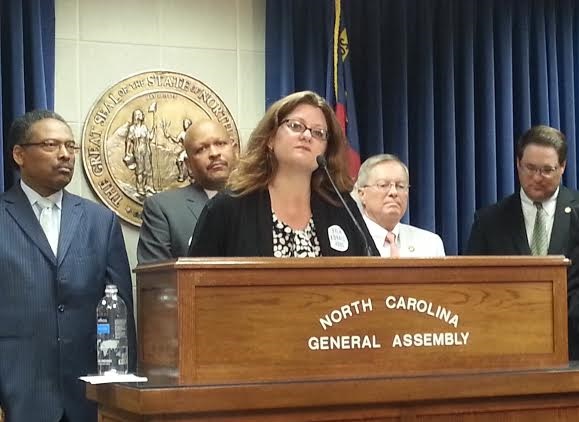
Rep. Charles Jeter, a Republican from Mecklenburg County, described the debate as “a consistency of scrutiny issue.”
“When we pass tax credits or tax cuts, we like to talk about the ripple effect. But we talk about a credit like this, then we say you can’t count the ripple effect. And that’s what frustrates me,” Jeter said. “To me, it’s an issue of consistency of scrutiny, and I think that’s what we lack to some degree in this building.
“In this day and age…anytime we can put people to work, we should do it,” he said. “And there’s tangible data that presents itself that shows this is a quantifiable job producer, if you count everything you want to count. I asked my colleagues to count it the same way they try to count everything else they try to count in this building. And if you do that, this by far meets the litmus test.”
Rep. Rodney Moore, a Democrat from Mecklenburg and a native Wilmingtonian, said he and others would fight to keep the industry strong in North Carolina.
“We’re going to fight our colleagues who have the narrow-mindedness to try to let this credit expire without at least a healthy alternative to keep this industry in our state,” Moore said, “and we will do whatever we can to make sure that this industry remains.”
Hamilton said two-thirds of North Carolina’s counties have benefited directly from filming in the state, and speakers stressed that they need to reach out to those counties that may not have seen the industry’s impact on the state firsthand.
Saffo, who noted Wilmington’s history with film going back to the 1980s, when Dino De Laurentiis established the film studios there, said the issue is about jobs—“pure and simple.”
“Forty-two hundred jobs in the state, 15,000 part-time jobs; $66,000 is the average wage that these film workers make,” Saffo said. “These people are part of our community; they’re part of our state.
“This is an industry that we’ve had in our community and in the state for a long, long time, and it would be a shame to lose those jobs, especially in this fragile recovery that we are in,” Saffo said. “The tax credits are an important tool to keep the industry viable and healthy and growing, and it will continue to grow.
“We should be proud as a state that we can go anywhere in the world and we can see productions that were built and done right here in North Carolina,” he said. “Film workers that are North Carolina residents that pay North Carolina taxes are the ones that are making these films happen in our state, and we should be very proud of that.”
Hamilton noted the House bill referred to committee and has yet to be heard. The Senate proposal, part of a larger budget appropriations bill, has likewise been referred to committee.
Related stories:
- Local governments highlight film industry as supporters lobby in Raleigh
- Film incentive hangs in balance as legislative session gets underway
- Film supporters rally to continue tax incentive
Jonathan Spiers is a reporter for Port City Daily. He can be reached at (910) 772-6313 or [email protected]. On Twitter: @jrspiers
