


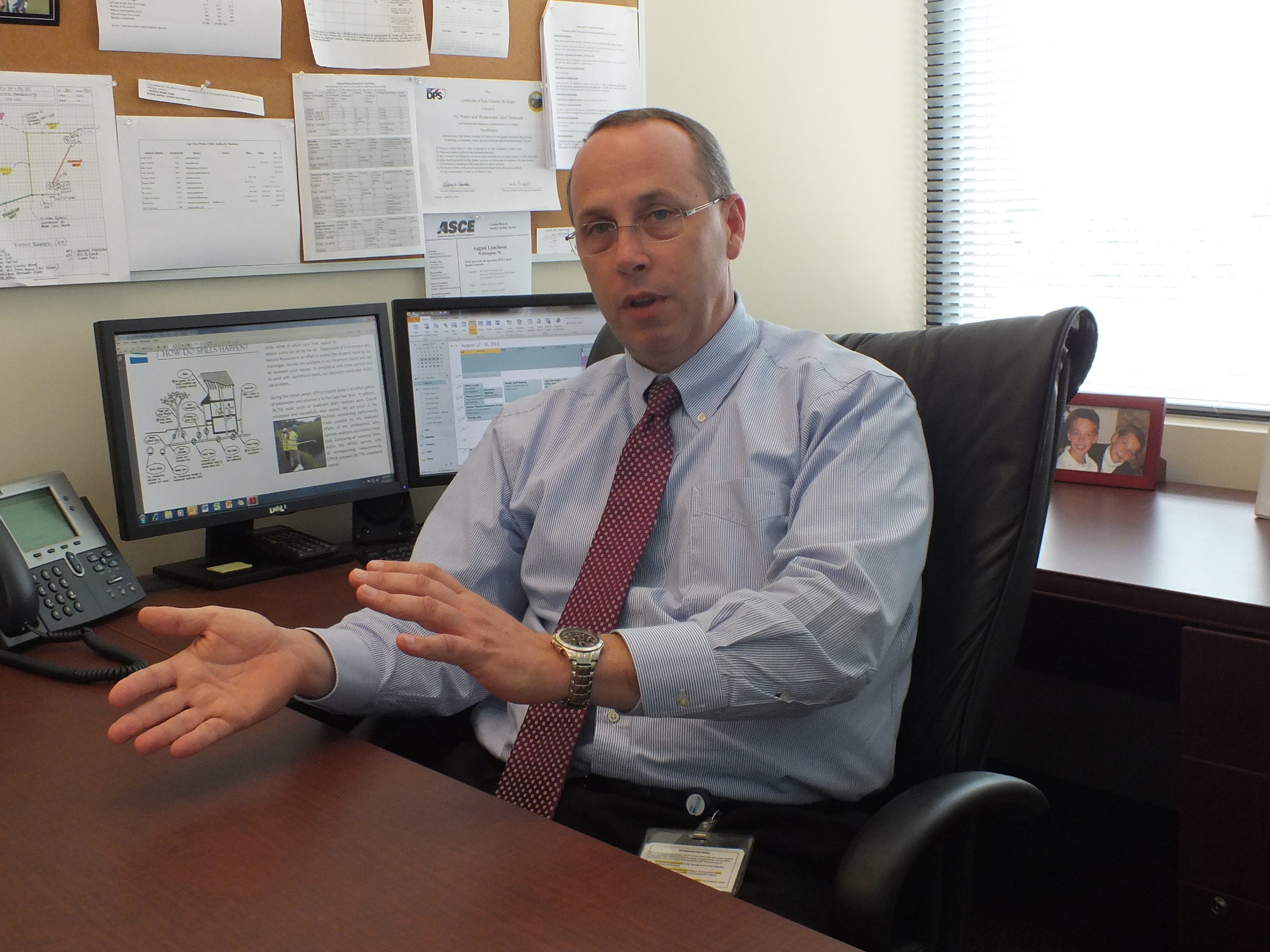
More than just a letter separates Jim Flechtner’s role as COO, or chief operations officer, of the Cape Fear Public Utility Authority and his new gig as interim CEO.
Filling in temporarily as chief executive officer—a title that’s changing to “executive director”—Flechtner finds himself at the wheel of a ship he has helped steer since the authority’s formation five years ago.
It’s a job the former employee for the City of Wilmington is interested in applying for, but it’s one the authority’s board of directors is taking its time to fill, since the departure of its first CEO, Matt Jordan.
“It’s been great,” Flechtner said of his first few months at the helm. “We have a very good staff here obviously, and Matt left us in a very good position, so we’ve been carrying on the good work that had been started and getting the new fiscal year underway. So overall, it’s been a great experience.”
Appointed as interim upon Jordan’s departure in June, Flechtner has been serving as the board’s go-to guy while overseeing operations and regulatory compliance.
“I’m enjoying it,” he said. “I’m glad the board had the confidence in me.”
Related story: CFPUA names interim CEO, plans search for permanent replacement
In the meantime, the board has started a process to search for a permanent replacement, noting from the start Flechtner’s interest in the job while also interviewing firms to help search for prospective candidates.
The board selected Springsted Inc. to help with recruitment and selection of prospective candidates, and the board’s human resources committee has been compiling a list of desired traits and characteristics.
In a presentation at the board’s regular meeting this month, John Anzivino, of Springsted’s office in Richmond, Va., offered a schedule that calls for naming a new director by the end of November. A formal presentation will be made at the board’s October meeting, when input from the public will also be accepted.
As that process continues, Flechtner will continue leading the authority’s staff, adding what he described as “another level of administration” to his regular duties as COO.
Asked to list those duties, Flechtner replied: “Working with the staff to make sure that the plants run the way they’re supposed to run; that people have the resources they need to get their jobs done; that we’re producing the highest quality drinking water that we can at a good value; that we’re managing expenses; and that we’re collecting and treating wastewater responsibly. In a nutshell, that’s what we do.”
Asked his CEO duties on top of those, Flechtner said: “Understanding the broader organization, the budget; taking a closer look at our revenues and our expenses to make sure that we’re tracking the way we expect to. And of course dealing with the board and dealing with the public to meet our organizational priorities.
“So overall, it’s similar to what I was doing before,” he said. “Just a slightly different role.”
A graduate of UNC-Charlotte with a master’s in business administration from UNCW, Flechtner moved to Wilmington from Virginia Beach, Va., joining the city in 1994 and working in the utilities department when the CFPUA was formed in 2008.
“I had quite a few different engineering roles over the years, and then when the authority formed, I made sure I was in public utilities,” he said. “I really wanted to be part of this.
“To be part of something new, to be part of something that provides such important services to the community, and to help build it from the start—that has been a fun challenge, and it’s been an exciting challenge,” he said. “It truly is a once-in-a-lifetime opportunity to be involved in something that critical.”
Critical, and criticized, as the CFPUA continues to bear the brunt of public scrutiny for sewer spills that have plagued its aging infrastructure, inherited from the city and New Hanover County when the authority was created.
The most significant spill in some time occurred in July, when nearly a half million gallons of sewage spilled into Hewletts Creek after a lightning storm knocked out the authority’s monitoring system for 29 pump stations, including the one at Hewletts Creek.
Smaller spills occurred before and after that spill, one of them due to a private construction crew hitting a sewer force main.
While those spills occurred on his watch, Flechtner said there is no rhyme or reason for the timing of each spill. “There’s no correlation among those,” he said. “Sometimes it’s just timing; they come in sets.”
While not personally responsible for those spills, Flechtner said he takes such events very seriously—as does the rest of the authority’s staff, he said.
“Nobody takes it more seriously than we do. I can attest to that,” he said. “When these things happen, sometimes circumstances are somewhat beyond our control.
“We do everything that we can to plan for them and to have contingency plans in place for when they do happen. And the recent spill at Hewletts Creek was an unusual set of circumstances,” he said.
“We will learn from that, and if there’s anything we can do to make our system more resilient and more robust, we will certainly do it. But we did have backup systems in place, and they were affected by the storm as well,” Flechtner said, adding that a challenge is: “How do you make them more resilient so that we don’t have all of our backup systems affected.”
Other priorities include development of the authority’s long-range plan, and ongoing projects like septic-to-sewer improvements for Marquis Hills and Heritage Park, which are both under design.
All in all, Flechtner said the priority for the authority is to continue the momentum it has built in its first five years—momentum that Jordan helped guide as its first CEO, and the byproducts of which still remain to be realized.
“Certainly Matt was very involved in what we were doing,” Flechtner said, “and he kept his staff involved, so it’s just been a matter of making sure that those initiatives continue on and that we keep them all moving forward. That’s been the biggest challenge: just making sure that we keep the good forward momentum that we have.
“A lot of our projects are planned many years ahead, when we’re looking at raw water supplies. That will be a five- to eight-year process, when we start talking about that,” he said. “So to have that available in the future, we have to start now in planning for it and designing and understanding the timing. That’s the fun part.”
Jonathan Spiers is a reporter for Port City Daily. He can be reached at (910) 772-6313 or [email protected]. On Twitter: @jrspiers
