


Worried the city’s reforestation plan for the historic but ailing Market Street oaks will proceed with a bit too much zeal, the president of the Historic Wilmington Foundation (HWF) this week advised the city manager and council to endorse a stepped-back, phased approach to removing hazardous specimens.
“It appears to the Foundation that the city has perhaps over reacted to the trees’ health and sturdiness and responded by calling for the removal of more trees than are necessary to limit their liability,” HWF President Don Britt wrote in a letter to the city Monday.
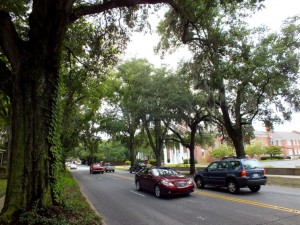
Chiefly, his nonprofit worried about a blaring change in visage. Today about 85 trees provide a scenic, tunnel-like reach over Market Street between 16th and 21st streets and “add so much to the quality of the city,” HWF Executive Director George Edwards said.
Per the trees’ ages–some of them beyond 70-years–and because several of them are suffering from “heart rot,” in which organisms are eating the trees hollow, HWF in 2011 placed the corridor on its “Most Threatened Historic Places” list and encouraged preservation efforts.
In November, the city, noting the liability of sick or impacted trees–one of them dropped a large limb onto a vehicle in July–called for the removal of 25 failing laurel oaks there in a reforestation plan set to root a cousin of the species.
The high-rise live oaks in store will, according to city officials, grow sturdier, faster and taller than their laurel oak predecessors. The 25 trees they’d marked for removal represent about 30 percent of the corridor’s canopy.
HWF, however, said it recently heard from a city arborist that as few as seven trees actually require removal. “The loss of 25 trees will clearly alter the Market Street tree corridor,” Britt said, adding that years would pass before the new high-rise plantings come into their own and restore the setting.
A phased approach, he wrote Monday, “would better serve the city.”
The same day, and not in response to the letter, City of Wilmington officials met with staffers from the N.C. Department of Transportation (NCDOT) to discuss among other things the concern about removing so many trees at once. (The project’s funding comes through a $50,000 allocation from NCDOT, which will perform the work, being Market Street is a state-owned thoroughfare.)
“The final outcome of the discussions is that NCDOT plans to move forward with the immediate replacement of the eight or nine trees that are most severely diseased,” Deputy City Manager Tony Caudle wrote in a memo Tuesday. “Those trees will be replaced with 16 or 17 trees.”
He explained the seven to eight additional trees will hit the roadside near Port City Java and Carolina Farmin’ this winter.
The rest of the trees slated for removal will be re-examined and “closely trimmed. So long as none of those trees present a clear and present danger to the public, they will be allowed to remain until next fall when the second phase of the project will remove the remaining diseased trees,” Caudle summarized.
But if the re-examination reveals the project can’t wait, the state may address the project, in full, at once.
Said city spokeswoman Malissa Talbert, “The DOT is providing the funding, so it’s really largely up to them.”
Contact Ben Brown at [email protected] or (910) 772-6335. On Twitter: @benbrownmedia
