


WILMINGTON – Local leaders have taken a significant step toward making this city a home of the Braves.
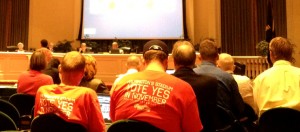
Wilmington City Council on Tuesday approved a 20-year agreement with the Atlanta Braves and sports entertainment group Mandalay Baseball Properties to erect a 6,200-seat riverside stadium downtown that would host a Braves minor-league team.
As council members repeated before the 11:15 p.m. vote, the project won’t come to fruition without city voters’ approval—a not-to-exceed $37 million bond referendum will appear on the November 6 general election ballot—but the document council accepted Tuesday does lay essential framework.
The agreement passed on a 6-1 vote, with Councilwoman Laura Padgett dissenting. Among her concerns: the lack of success with past minor-league baseball endeavors in Wilmington, notably with the short-lived Port City Roosters and Wilmington Waves.
But her fellow council members were fully supportive of the concept that Mayor Bill Saffo called a “once in a lifetime opportunity” for the city. He called the plan to build the ballpark by the Cape Fear River downtown sweet and rare and added “you can’t get any better than the Atlanta Braves organization…. This (team) is going to be owned by a major league club.”
The agreement approved Tuesday notes the cost to construct the ballpark should not exceed $31 million. The remaining $6 million the voters may approve would cover the land, which would front the Cape Fear River. A 2.5-cent property tax increase would raise debt repayment and capital reserve money while the Braves-Mandalay party would pay the city $500,000 annually for management and rent fees at the stadium.
The City of Wilmington would own it, but the Braves-Mandalay would take all revenues as the group would assume the operating expenses. The revenues would come from the sales of tickets, box and club seats, private memberships, food and beverages, broadcasting rights for home games, and advertising, signage and sponsorships.
The city would, however, take revenues from city-sponsored events, though the agreement only allows the city to reserve up to 10 days per year to that end.
Overall, “It’s the best deal and it was hard fought, I assure you,” Councilman Neil Anderson said.
Although the city’s electorate may trump it in November, the agreement’s acceptance is a major milestone in the project that has stirred up plenty of applause and ire among taxpayers. Some believe the stadium will be a kicker for the city in terms of pride and economy and will be a gift for future generations. Others believe the proposal is unsupportable as long as it involves city tax dollars.
Residents on either side of the issue used Tuesday’s meeting’s public information portion as another chance to air their perspectives on the proposal.
“The word is simple, the word is clear,” frequently outspoken stadium proponent Chuck Kuebler said into the podium’s microphone. “You vote yes for Wilmington. You vote yes for baseball.”
Kuebler said New Hanover County’s population—beyond 206,000 last year, according to the U.S. Census Bureau—was ample enough to support such a ballpark in Wilmington, and the city indeed has the spirit.
But David Padgett, a retired UNCW biology professor and self-proclaimed “ardent fan” of minor-league baseball, begged to differ.
“I’m sad to say to you that I do not support city council’s attempt to bring minor league baseball” to Wilmington, Padgett said after noting that he has observed poor attendance at UNCW baseball games as well as with past minor league efforts in town, specifically the Waves and the Roosters. He said his science background makes him more sensitive to numbers and less to “wishful thinking” that the Braves arrangement might work, particularly with tax dollars at stake.
Low attendance was one of the factors that pulled the Roosters out of Wilmington after two seasons between 1995 and 1996, according to a feasibility study National Sports Services (NSS) prepared for the City of Wilmington in the exploration of the Braves deal. The Roosters, part of the Southern League as a Class-AA affiliate of the Seattle Mariners, “finished last in their division and drew 110,233 fans through the (first) season,” said the study, presented to the council in June. “The team also finished last in 1996 and drew just 68,463 fans during the season before moving to Mobile” Ala.
NSS said an “inadequate stadium”—UNCW’s Brooks Field—and the inability to sell alcoholic beverages contributed to the Roosters’ departure.
The Wilmington Waves, part of the South Atlantic League and a Class-A affiliate of the Los Angeles Dodgers, played just one season in Wilmington, in 2001. Over 63 games the team logged 135,548 attendants, which averaged out to 2,152 per game, according to the NSS report. The Waves finished 8th in their league, which reported an average of 2,807 attendants per game.
“Due to an inferior ballpark situation (at Brooks Field), the Waves ownership sought to build a new ballpark in Wilmington but could not reach a deal with the City,” the report said. The team was sold and relocated to Albany, Ga., before the 2002 season.
Playing ball in Wilmington currently are UNCW’s team and the Wilmington Sharks, the latter established in 1997 with the collegiate Coastal Plain League. The team plays summer games at Legion Stadium’s Buck Hardee Field.
NSS indicated the Braves might be a stronger contender. “It is likely that a minor league franchise in Wilmington would benefit from being affiliated with the Atlanta Braves, which is one of the closest (Major League Baseball) teams to Wilmington,” its report said.
Wilmington Mayor Pro Tem Earl Sheridan said he thinks the proposed stadium and Braves deal, if they come to be, will indeed be “different. I think it’s something that can be successful.”
At the time of the council’s vote Tuesday the referendum that will essentially seal or kill the deal with the Braves was seven weeks away. Council members made the public’s influence on the issue abundantly clear, each of them noting it will not come together unless the voters approve the November 6 referendum.
“Tell us whether you want to do it,” said Councilman Kevin O’Grady.
“It’s going to be up to the citizens,” Councilwoman Margaret Haynes said.
“I’m excited,” said Councilman Charlie Rivenbark. “I think the voters need to make their decision.”
