


[Ed. update: Thursday evening, all council members approved the resolution and letter to be sent to federal representatives.]
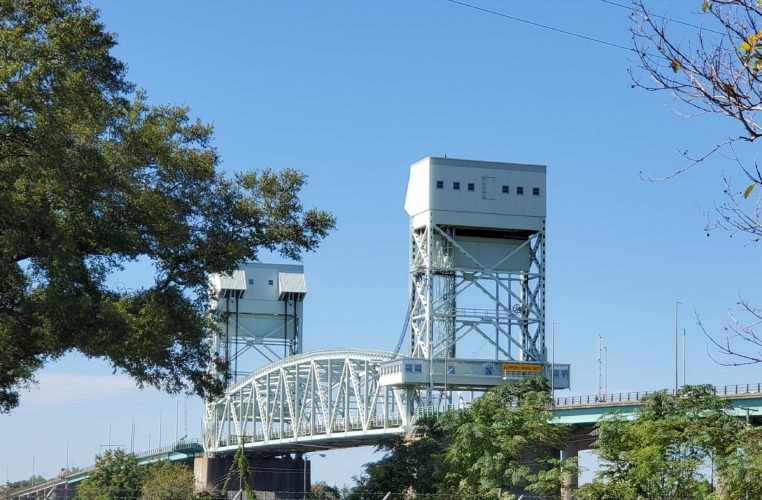
LELAND — The Leland Town Council will be taking up a resolution and voting on a letter to the area’s congressional representatives about the Cape Fear Memorial Bridge replacement at Thursday’s meeting. Both documents will push for an updated assessment of the river’s navigational needs, which elected leaders hope will prove a smaller bridge with no toll is a better option.
The resolution calls for further review of a 1996 study that the U.S. Army Corps of Engineers used to determine the height of the current replacement structure. The study found vessels moving under the bridge need 120 feet to 147 feet of clearance; however, Leland council members said it’s problematic because the kind of ships used in the study no longer pass under the bridge. In 2026, the bridge lifts mostly for recreational boats.
Council member Veronica Carter, who broached the topic at the meeting, wanted to pass the resolution in order to pressure the federal government to revisit the data.
READ MORE: Wilmington hiring consultant to find less costly, impactful CF Memorial Bridge options
ALSO: New Hanover County deploys letter, attorney to seek federal assistance on CFM Bridge
The resolution also will address further examination of bridge designs outside North Carolina Department of Transportation’s two proposals — a 135-foot fixed bridge and a 65-foot bridge with a movable span up to 135 feet.
“We’re not just gonna sit here and roll over,” Carter said.
In addition to a resolution, Leland council will take up a letter to send to Rep. David Rouzer (R-7), Sen. Thom Tillis and Sen. Ted Budd, requesting they advocate on behalf of the Cape Fear region.
Leland Town Council is following in the footsteps of other area governments east across the bridge, such as New Hanover County commissioners and Wilmington City Council. Both have signed either resolutions to find other bridge height options or sent letters to federal partners for more funding to avoid a toll and address today’s modern navigational needs.
Carter said the state representatives would have to speak to the Secretary of the Army to ask for a Section 216 review. A Section 216 review is part of the Flood Control Act of 1970 and asks the U.S. Army Corps of Engineers to reexamine completed federal water and navigation projects due to changed physical or economic conditions. In this case, the review would revisit the 1996 USACE study.
The U.S. Coast Guard determined the Cape Fear Memorial Bridge needed to be at least 135 feet so as not to limit the traffic the bridge can currently accommodate and any future traffic needing a higher clearance. The 1996 study determined the feasibility of a harbor navigation project; USACE based the harbor depth on a vessel 712 feet, a width of 106 feet, and up to 75,000 gross tons, typically needing a height clearance between 120 feet and 147 feet.
“We’re not going to dredge out and deepen the channel between the Isabel Holmes Bridge and the Cape Fear bridge,” council member Frank Pendleton said, referring to the depth needed to carry such large vessels on the northern portion of downtown.
More so, in 30 years the local economy has evolved beyond industrial needs. Kinder-Morgan, an energy infrastructure company operated a facility north of the bridge in downtown Wilmington before closing in June 2023. It sold the property to Tribute Companies, which develops apartments and commercial real estate. The site has remained undeveloped and unused since, meaning less commercial vessels traverse the north portion of the river.
As such, the bridge has decreased its number of openings since 2019, when there were 381 bridge openings compared to 168 in 2023. In 2025, the bridge opened 63 times, mostly for recreational purposes.
“I can tell you how many times the bridge went up,” Mayor Pro Tem Bob Campbell joked: “every time I was in a hurry to cross it.”
As Carter mentioned, a Section 216 review would call for a new study to be done about the kinds of ships passing under the bridge. In her motion and discussion of the resolution, Carter also asked for a Leland resident, Brayton Willis, to give a presentation at the Thursday regular meeting.
Willis is a retired senior project manager who worked with the USACE. He also spoke at the NCDOT public hearing about the bridge replacement, held in Leland on Sept. 15. Willis explained at the hearing the Corps has completed at least 14 Section 216 studies nationwide over the past 10 years, including in the Waccamaw River Basin.
“Answer the navigation questions. Answer the cost questions. Answer the toll questions, Willis said at the public hearing. “Then build a bridge that the region actually needs.
Many residents and local officials called for a third option during the public hearing. It is also something Wilmington City Council took up Sept. 1, directing staff to hire a consultant to see if another design option is available. A 100-foot fixed bridge was floated at one point but was dismissed by NCDOT as not permissible due to the height determination.
A 100-foot bridge would theoretically cost less than the two current options, both upward of a billion dollars. The project received a $242-million large bridge grant from the federal government, but to make up the remaining cost, NCDOT proposed implementing a toll on the new bridge — the first toll bridge in the state. NCDOT is putting $85 million toward the bridge if tolled, as it finally ranked in the STIP; however, an additional $773 million is needed.
A toll is currently the only viable solution to close the funding gap, according to NCDOT, since another monetary mechanism hasn’t yet been identified. There is a February deadline on withdrawing the toll as an option; though, should it remain, NCDOT hopes to break ground in September next year.
“We know that we’re under the gun. People are worried about losing the quarter-of-a-billion dollars grant,” Carter said, noting if a congressman or senator reached out, a review could be completed. “If we could get that done … we would be back at option C, the 100-foot bridge.”
Campbell said it would be less expensive to maintain a fixed-span bridge as opposed to a lift bridge. NCDOT spends about $550,000 annually to maintain the current Cape Fear Memorial Bridge’s moveable-span.
“This has just been a hair-raising thing that has went on too long,” Mayor Brenda Bozeman said. “It needs to stop. It needs to be done.”
Council member Leland Hyer asked for one addendum to the resolution: to add the Wilmington City Council to the list of local governments involved in the objection to the current Cape Fear Memorial Bridge replacement design options. He also asked the letter to the representatives in Washington be distributed to both the North Brunswick Chamber of Commerce and the Wilmington Chamber of Commerce.
“Because there’s not a week that goes by that the President’s message in the Wilmington Chamber newsletter doesn’t address something about the Cape Fear Memorial Bridge,” he said, adding if they send it to Wilmington, they should send it also to North Brunswick’s.
Wilmington Chamber CEO Natalie English has been a staunch advocate for the 135-height fixed bridge. She wrote in an August op-ed for the Wilmington Business Journal that population growth and economic expansion proves the larger bridge has a greater need.
“We believe it provides the best long-term solution for moving people and goods across the Cape Fear River while preserving the river’s role in our economy,” English wrote.
Hyer also suggested sending the letter to the Coast Guard, in addition to the USACE.
Council members voted to add both the resolution and letter to the Thursday’s meeting agenda after staff prepares the documents. The letter will be signed by each council member and the mayor.
Have tips or suggestions for Emily Sawaked? Email [email protected]
At Port City Daily, we aim to keep locals informed on top-of-mind news facing the tri-county region. To support our work and help us reach more people in 2026, please, consider helping one of two ways: Subscribe here or make a one-time contribution here.
We appreciate your ongoing support.
