


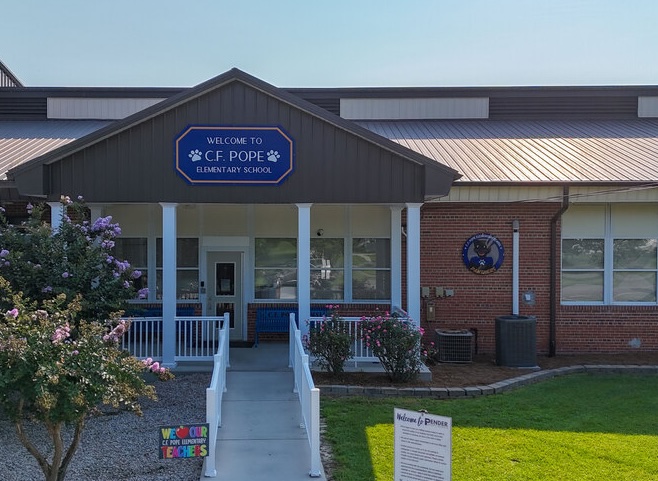
PENDER COUNTY — As the Pender County school year begins, three classrooms in two schools remain closed due to mold issues. The classrooms are waiting on a second round of remediation results before they can reopen.
Nineteen classrooms in total were tested for mold on Aug. 18 in C.F. Pope and South Topsail elementary schools. The district determined mold at C.F. Pope was caused by an HVAC project, with the district replacing portions of the building’s system. Because installing a new system took place over two weeks, the lack of air circulation and presence of humidity precipitated mold growth.
As a result, all 19 rooms went through mold remediation, involving a qualified environmental contractor, EMSL Analytical, Inc., using antimicrobial products to clean any affected area or surface.
READ MORE: Pender County Schools begins redistricting process for new K-8 school
While Fankboner does not yet have the test results for South Topsail, test results for C.F. Pope show none of the rooms had stachybotrys/memnoniella — commonly known as black mold. Stachybotrys/memnoniella can produce mycotoxins, a toxic chemical that can cause severe health risks for those with compromised immune systems.
The highest spore concentration in most rooms was for aspergillus/penicillium, commonly found indoors. It grows on painted surfaces, wood, drywall paper backing and dust. High levels of these spores can indicate water damage or moisture.
The largest classroom concentration of aspergillus/penicillium was 2,600 spores per cubic meter. The concentration dropped to 80 spores per cubic meter post remediation.
Numerous remediation companies indicate normal mold range for a room is 0 to 500; however, anything between 0 to 1,500 is typically considered safe if there are no visible mold colonies or water damage present. However, there is no federal or state indoor-air threshold for mold spores.
Aspergillus/penicillium can cause health issues such as allergic reactions and respiratory distress.
The second highest concentration of any spore in a single classroom was cladosporium — a common mold that thrives in humid environments — at 2,400 spores per cubic meter. After remediation efforts the number dropped to 300 spores per cubic meter.
Cladosporium is often linked to allergies and asthma.
Post remediation at C.F. Pope, one classroom tested above the 1,500 threshold, at 1,800 aspergillus/penicillium spores per cubic meter, while another classroom had over 1,000 spores per cubic meter.
The rooms that needed further remediation are room 127 which had a total of 1,950 spores per cubic meter and room 121 which had 710 spores per cubic meter.
Five had over 500 spores per cubic meter.
The district is responsible for interpreting tests and it works with environmental professionals to do so.
During the Aug. 25 school board meeting Director of Utility Management Tim Kiser said mold was reported in the 100 wing of the elementary school on Aug. 13 around 9:23 a.m. by the C.F. Pope principal, Brittney Moore.
Mold at South Topsail Elementary was reported by a teacher. The principal, Kathy Bates, confirmed the mold was due to HVAC issues.
Fankboner told Port City Daily district operations staff were at the C.F. Pope site within 45 minutes to assess the situation and make a plan. Dehumidifiers and HEPA airscrubbers were immediately placed in impacted classrooms.
Bill Nelson, the safety coordinator for the schools, told Port City Daily the district conducted visual inspections, removed wet or water-damaged ceiling tiles and collected temperature, relative humidity and moisture readings as part of the environmental assessment and air sampling process.
The district did not perform a formal National Institute for Occupational Safety and Health Dampness and Mold Assessment Tool, which is recommended by NIOSH to evaluate mold damage and moisture in a building.
Fankboner clarified that while a DMAT was not done, the district did do a visual inspection, moisture evaluation, relative humidity and temperature readings, and environmental air sampling.
The rooms were retested on Aug. 20, with two second grade classrooms at C.F. Pope and one classroom at South Topsail Elementary School requiring extra cleaning. The rooms are now being retested. Results are not yet available.
Aside from several rugs, no classroom materials were discarded as a result of mold.
The 100 wing of C.F. Pope — where the mold was found and where the replacement was taking place — was originally serviced by split system heat pumps and electrical heat. Unlike the old controls, which were 30 years old, the new control system that was installed will manage humidity better and use systems for dehumidification. The heaters will be able to turn on, while the air conditioning is on to dry out the air and avoid moisture.
During this week’s school board meeting, Kiser questioned the mold’s cause.
“I don’t think it’s appropriate to say that the conversion of controls caused the microbial growth, but at the same time, you know, we had to shut down this equipment to be able to convert it to the new control,” he noted. “I think we need to be careful not to speculate about causes before we have the evidence to support those conclusions.”
However, Nelson told Port City Daily operational issues with HVAC systems did contribute to elevated humidity.
Fankboner said as C.F. Pope the HVAC control system project cost $436,000 and was paid for via the district’s Capital Improvement Fund.
Invoices for remediation and third-party testing have not been received by the district so there is no current cost estimate. The payment for the services will come from local funds.
Have tips or comments for Sophia DePhillips? Email [email protected]
At Port City Daily, we aim to keep locals informed on top-of-mind news facing the tri-county region. To support our work and help us reach more people in 2026, please, consider helping one of two ways: Subscribe here or make a one-time contribution here.
