


PENDER COUNTY — As Pender County Schools’ new K-8 school moves closer to opening, the redistricting process has begun with a community engagement plan; the board is planning to have the new districts prepared for 2027-2028 school year, in line with the planned opening of J.H. Lea K-8 Schools.
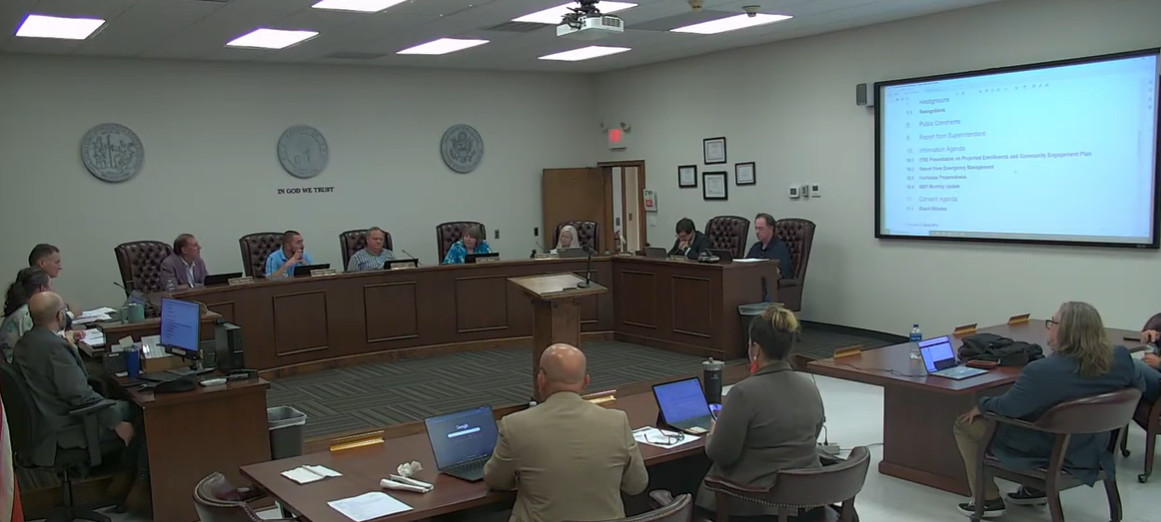
Tuesday served as kickoff for the initiative; the district hired Institution for Transportation Research and Education to organize community involvement and collate their feedback into data for the board to use. The organization’s research scholar, Linden Thayer, presented the company’s plan to the board.
“As you make decisions around new schools, new boundaries, new zoning, you need to bring the community with you,” Thayer said.
READ MORE: Pender schools to tighten spending again, after state pay raises, Title I cuts lead to $1M gap
ALSO: Pender County Board of Education secures funding to retain all positions after joint meeting
The new school, J.H. Lea, is located off of N.C. Highway 210 in Hampstead and will enroll 2,312 students. The redistricting report is an analysis used to redraw school boundaries, in an effort to determine the school students will attend. Components considered range from demographics, school capacities, funding distribution and more.
With a $15,000 contract, Institution for Transportation Research and Education is assisting the district with enrollment forecasting, capacity analysis, community engagement, and possible redistricting solutions. Final district map decisions will be made by the board.
A spokesperson for the district, Bob Fankboner, told Port City Daily it is too soon to say which schools or how many students would be impacted by the redistricting.
“Because this is a sensitive issue for families and school communities, we do not want to speculate before that process takes place,” Fankboner wrote in an email.
Institution for Transportation Research and Education plans to present its final redistricting plan in January. Superintendent Brad Breedlove noted during a July board meeting he hopes to have a final plan voted on during the same month.
“Families should expect more information as options are developed, shared publicly, and reviewed by the Board,” Fankboner said. “The district’s goal is to provide families with as much notice as possible once any final decision is made.”
Thayer said Tuesday the company hopes to encourage community involvement so the needs of the area can be best addressed. She used the example of community priorities changing from place to place. For example, one community could care more about bus schedules versus school feeder patterns.
“When we think about doing engagement, we’re talking about looking at root causes and root challenges, priorities that are most important to this district,” Thayer said. “What’s important out in the West may not be the same as what’s important here.”
She added that Institution for Transportation Research and Education looks at community engagement in four groups — the board of education, school leadership, a community advisory board put together by the company, and the broader community.
Thayer said the community advisory board looks different in every community, but the overall goal is to form a group representative of the district’s makeup. Typically, the board is made up of 20 to 30 individuals ranging from business leaders, school representatives, families, teachers and even students.
Institution for Transportation Research and Education hopes to form the community advisory board by Aug. 21 and hold the first meeting Sept. 4.
As a part of its engagement plan, the company also focuses on school leadership, specifically preparing principals to answer questions from residents.
“All of the principals are going to be your frontline folks who get all of the questions about ‘Why is this happening? What is happening? Is my kid going to end up in this school or that school?’” Thayer said, adding that principals get the first look at any information or changes in order to be up to speed on what to share with the community.
The first meeting with school leadership is planned for Aug. 21.
As for the broader population, consisting of students, families and county residents, Thayer said a digital priorities assessment will be shared sometime in mid-September. Information sessions will be held after the assessment goes live, with Sept. 23 or Oct. 2 as tentative dates.
A final presentation on solutions will be shown to the board of education in Dec. 2026 or Jan. 2027, according to Thayer’s plan. The final report from will be made available in Jan. 2027.
The board of education had minimal discussion about Thayer’s presentation and had no questions for her.
“That was pretty comprehensive,” board member Beth Burns said. “You’ve laid out a plan that we can definitely work with and I like the fact that it is going to happen quickly. Because before we know it, Christmas is gonna be here and we need to have some plans laid out, or at least really into the process before then.”
Enrollment trends
The opening of J.H. Lea is one solution to current school overcrowding. In response to the issue, Pender County residents voted in 2022 for an increase of 9.25 cents on their property taxes and to request $117 million in general obligation bonds to fund five school projects, one of which is J.H. Lea’s new build. The other funded projects include Topsail Middle School renovations, Rocky Point Elementary School addition, Burgaw Middle School cafeteria rebuild, a new central services building and a new eight-bay maintenance building.
Part of Institution for Transportation Research and Education’s process in determining its redistricting solutions is looking at the long-term enrollment trends across a district, which Thomas Dudley, project manager, shared details on Tuesday.
“What we’re talking about is continued enrollment growth, more is coming and accordingly with that there’s a need for more new schools and as part of new schools comes the conversation of redistricting,” Dudley said.
As of the 2025-2026 academic year, five out of Pender County’s 17 traditional K-12 schools were at 110% or more capacity, according to data shared by Dudley. By the 2035-2036 school year, the number of schools at 110% or more capacity is projected to rise to 10. This capacity rate does not reflect the inclusion of J.H. Lea.
Elementary schools are expected to see the most growth over 10 years, with an increase of approximately 2,682 students. Elementary schools were already at 90% to 100% capacity during the 2025-2026 academic year. They are expected to hit 100% to 110% capacity by 2029-2030 and over 110% capacity by 2031-2032.
Pender County middle schools are projected to see a 10-year growth of 1,732 students. High schools are expected to increase by 2,052 students during the same timeframe.
Dudley noted the county also is experiencing large numbers of growth.
“What we’ve learned over the time that we’ve been doing this work collectively as a group for several decades is the importance of looking at residential development when it comes to enrollment forecasting,” Dudley said.
He stated 63 residential developments — an estimated 12,700 dwelling units — are currently pending within county limits.
Have tips or comments for Sophia DePhillips? Email [email protected]
At Port City Daily, we aim to keep locals informed on top-of-mind news facing the tri-county region. To support our work and help us reach more people in 2026, please, consider helping one of two ways: Subscribe here or make a one-time contribution here.
