


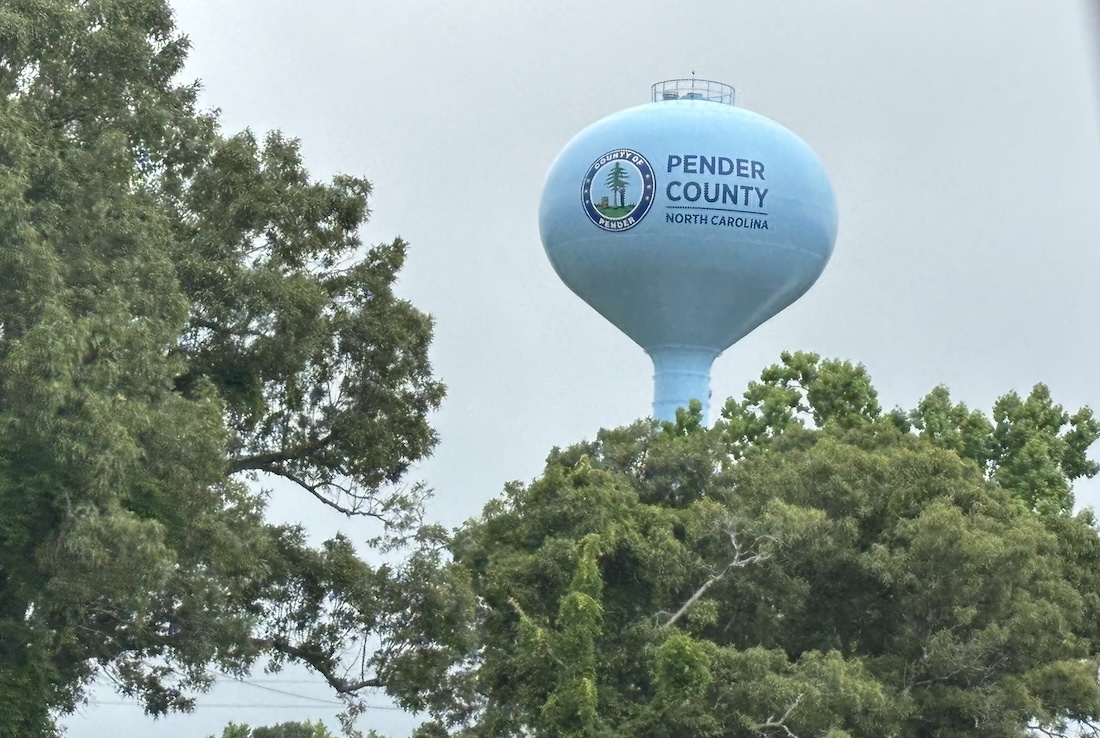
PENDER COUNTY — Water was at the center of discussion this week at the Pender County commissioners’ meeting. Ideas on how to connect utilities to a rural western part of the county were broached, as was a 20-year master plan to determine where water is needed and the process of providing it, including timelines.
Highfill Infrastructure Engineering presented to the commissioners two multi-million-dollar options for supplying water to a portion of northwestern Pender County. Public water lines are lacking in this area.
Currently, Pender County Utilities only serve approximately 11,000 of the county’s 72,000 residents — or 15%. The county’s 1,100 miles of pipeline is spread across six water and sewer districts, disproportionately not servicing rural areas.
READ MORE: Pender County planning decades of refunds for water lines not yet built
To pay for the project, spokesperson Brandi Cobb said Pender County is looking at a $25-million loan through the drinking water state revolving fund, a $35-million loan through the clean water state revolving fund and a $3-million grant through the drinking water and wastewater state reserve. All the loans and grants have a Sept. 30 deadline.
Pender and Highfill Engineering have worked together on various county projects for close to nine years. Highfill was a consultant for a 2017 drought management plan. Most recently, the pairing teamed up in 2024. Pender County Utilities entered into an agreement with Cape Fear Public Utilities Authority allowing them to construct an emergency water interconnection between the counties. Each county was responsible for extending its own waterline; Highfill was the engineering company responsible for the project.
In October 2025, the commissioners approved amending an existing contract with Highfill from the New Hanover County interconnection project to include surveying, design and permitting an interconnection with the Town of Harrells, near U.S. 421 in Sampson County. The estimated design work, surveying and permitting services is $254,000.
The Town of Harrells is outside of Pender’s existing water-main network and is near the homes of around 92 Pender County residents who want water access. The cross-county tie-in was presented only as a possibility to bring water to areas currently without lines, though no contract or agreement has been made with the Town of Harrells.
Highfill Infrastructure Engineering presented Monday its preliminary study that Harrells’ water system does not have the transmission capacity to move enough supply through its approximately 3-mile stretch of 3-inch pipelines to service the broader Pender area, according to engineer Saeed Soltani. Though Harrells cannot service Pender alone, it can be used as a backup to provide emergency water sources.
However, Highfill showed the board alternative supply route options. The first is to connect northwestern Pender County, including portions of the U.S. 421 corridor from Penderlea, for a total cost of $12.5 million. The pipeline extension would be $4.5 million, with interconnection and distribution priced at $5.7 million and a new well coming out to $2.2 million. It would serve approximately 38 people, according to Utilities Director James Proctor.
The second option would be to supply the area from Malpass, with the pipeline costing more than the entirety of Penderlea — estimated to be almost $20 million. The extension would be $14.2 million, and interconnection and distribution would come out to $5.8 million.
Soltani said servicing Penderlea would be the less expensive choice because it requires a shorter supply line but additional storage may be needed and was not included in the estimate.
But he called Malpass the “best technical solution” compared to other possibilities such as Penderlea, since it does not require a large amount of storage.
Neither option includes connecting pipes to homes. Proctor said homeowners would be responsible for those costs, anticipated to be $1,800 to $4,000.
Over the past several decades 1,552 people living in Pender have paid a tap connection fee to reserve future connection for when water comes to the area. The county has said the reason there is still no water connection, especially in rural Pender, is because it still lacks funding to lay multiple lines.
A county representative did not respond by press to Port City Daily’s questions about whether any individuals who paid tap fees will be serviced by Monday’s proposed water lines, or if they will receive a discounted price since they previously paid a connection fee with the understanding they would not have to pay in the future.
Commissioners did not vote on any of the presented supply routes, but to move forward they were told by county staff a decision would be needed by the Sept. 30 grant deadline.
“It seems like to me that it makes more feasible sense for us to go with the Malpass operation because you have more users on that line,” Commissioner Jimmy Tate said at the meeting, since Malpass would supply water to more people than the 38 near Penderlea.
Commissioner Randy Burton asked County Manager Colby Sawyer to clarify loan and grant funding, particularly conditions connected to the grants. Grants would come at no cost to the county, meaning they do not have a match. Loans would need to be repaid and would likely result in countywide water rate increases for Pender Utility customers, according to Sawyer.
Additionally, Pender staff is reviewing federal programs — a Community Development Block Grant and a Community Development Block Grant-Infrastructure, which is a sub-program focused on building or remedying public water and sewer systems.
Sawyer asked Highfill Infrastructure Engineering if the company could write the grant application. The firm already has the data needed — like maps, cost estimates, permitting information, design and more. Pender has worked on grant applications with Highfill in 2018 to secure $18 million for the central Pender expansion.
Soltani said the company would review the opportunity and determine whether it could help meet the deadline, but warned the funding process was highly competitive and a grant is not guaranteed.
Aside from discussing possible supply routes for water lines, commissioners also talked about the quality and needs of existing water systems countywide. The board discussed upgrades to well filtration used in Pender.
Proctor said well water is not the same quality as water coming from the treatment plants. During the next commissioners meeting, on Tuesday, Sept. 8, he said he would likely return to discuss a contract for resin filters for the five county wells.
“Once the resin filters are put in, then I would say that water would then rival the surface water plant,” Proctor said.
Cobb told Port City Daily filters remove minerals and contaminants from water, including PFAs. The county does not yet have a cost estimate on the filters.
Pender County has been testing its drinking water for PFAs since 2020. November 2022 testing results showed roughly a third of 188 Pender wells sampled had detectable PFAS levels, with a cluster along the U.S. 17 corridor.
The county also was presented with a timeline to tackle where future growth should occur, including water and sewer extension, and other county projects to come in the next two decades as part of its Infrastructure and Controlled Growth Initiative. It passed unanimously Monday by the commissioners, and was brought forward by Commissioner Brent Springer.
Springer told Port City Daily the initiative is important due to the growth the county has experienced — the population has increased more than 22% since the 2020 Census.
“We’re one of the fastest-growing counties, and growth is coming whether we’re ready for it or not. Our infrastructure is already behind, from east to west,” Springer said, adding he believes the county is behind demand but that the board must start somewhere. “The goal of the initiative is to take action and plan responsibly so Pender is equipped for the growth that’s coming.”
The initiative set a 60-day timeline for county staff to present the board with an outline of necessary staffing, funding and overall scope of work to be completed as part of the initiative.
The Infrastructure and Controlled Growth Initiative also mandates that by 2027 county staff must present the board with a completed draft of its Twenty-Year Master Plan and a Unified Development Ordinance Modernization plan by 2028. The drafts will include a master plan for water, waste, stormwater, emergency services and more.
Commissioner Tate expressed concern over the accelerated timeline presented. He called the initiative “very good” and “comprehensive” but feared the county did not have the capacity to actually implement it. In May 2026, Pender had 74 vacancies across county positions. Additionally, the county is tackling several big projects including the renovation of Topsail Middle School and building J.H. Lea, a K-8 school.
“We have set timelines that are realistic,” Sawyer assured. “They are aggressive, but they are realistic.”
Have tips or comments for Sophia DePhillips? Email [email protected]
At Port City Daily, we aim to keep locals informed on top-of-mind news facing the tri-county region. To support our work and help us reach more people in 2026, please, consider helping one of two ways: Subscribe here or make a one-time contribution here.
