


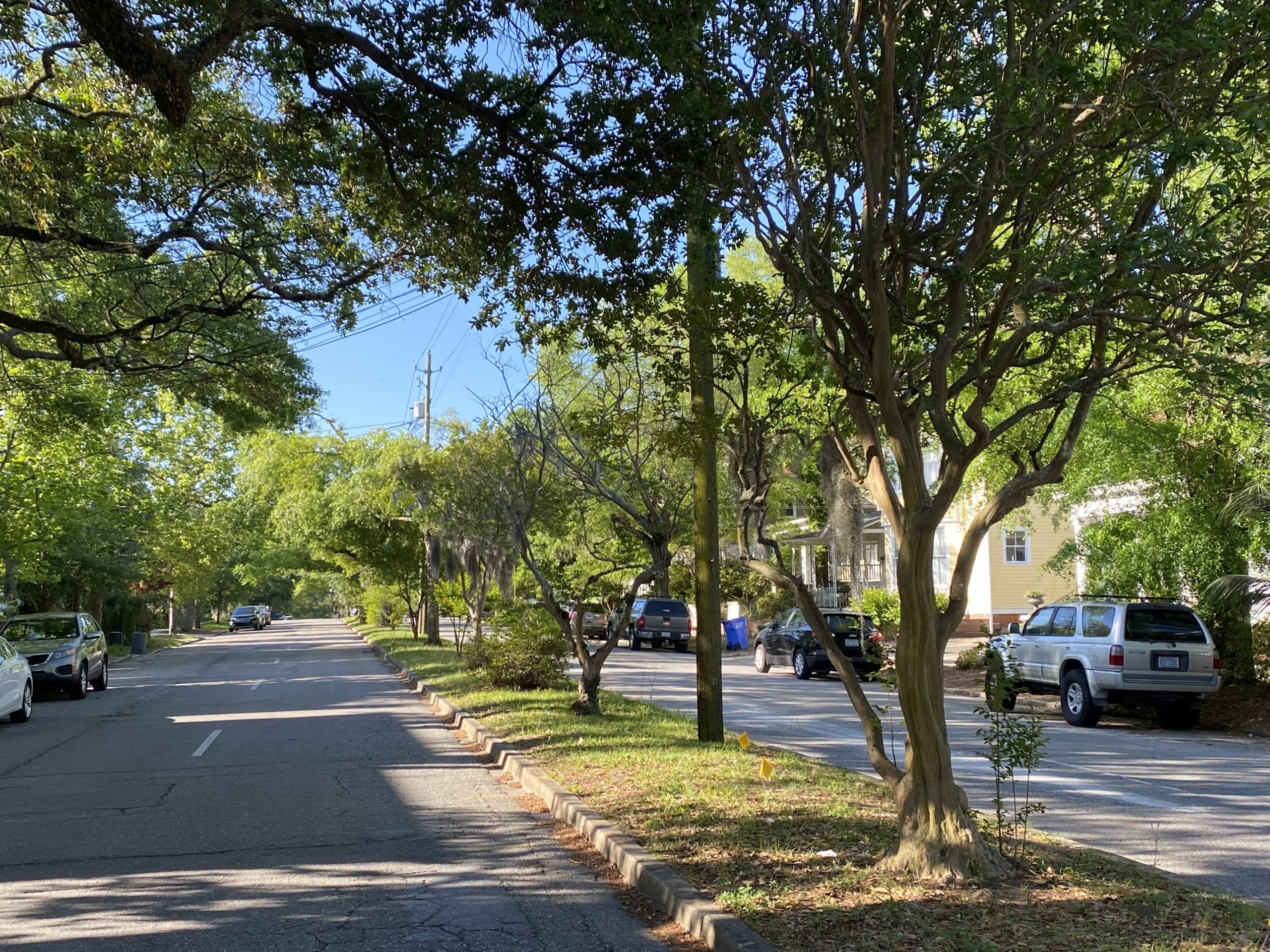
WILMINGTON — An inventory of city trees and a plan to assess vacancies to place more are on the way to Wilmington — and it won’t cost taxpayers.
The City of Wilmington plans to use $1,475,983 million in grant funding from the federal Inflation Reduction Act to maintain its urban forest — which provides benefits to the city via clean air and protection from extreme heat. The federal Inflation Reduction Act invests in reducing carbon emissions and gave $1.5 billion to the U.S. Forest Service Urban and Community Forestry Program.
Overall, there were 385 grant recipients, with $1.5 million awarded to Wilmington on June 12, 2026. The award is fully covered and the city is not expected to match funds, administered by the North Carolina Forest Service.
READ MORE: Wilmington moving forward with 400+ tree-planting despite stacked odds
The grant will assist the city in maintaining its urban forest — an estimated 40,000 city-owned trees along sidewalks, public rights-of-way and in parks. In addition to assessing its tree inventory and planting 300 trees, the money also covers the removal of 100 hazardous trees and provides money to local nonprofit Alliance for Cape Fear Trees — a nonprofit focused on preserving, protecting and planting trees, and oversaw 300 plantings last year in Wilmington and New Hanover County.
The grant covers trees on 36% of land in the Inflation Reduction Act project area — which includes the Historic Downtown, part of Martin Luther King Jr. Parkway and places in town that have endured environmental impacts, such as damage after storms.
The Alliance for Cape Fear Trees reported Wilmington’s tree canopy decreased from covering 48% of the city in 2016 to covering 40% of the city in 202, due to urban development as well as storms like Hurricane Florence. The 8-point drop represents 17% of the city’s tree canopy.
Wilmington’s Parks and Recreation Assistant Director Sally Thigpen explained during council’s Aug. 4 meeting that conducting tree inventory is one of the top recommendations in the city’s Urban Forestry Master Plan. Thigpen added inventory is important because city trees can’t be properly managed if staff are unaware of exactly how many there are.
The grant funding will help hire a third-party International Society of Arboriculture certified arborist who will use a GPS software to account for every tree and planting space. Data will include information like species composition, condition assessment, and tree health and hazards.
The inventory will provide background of overall health, location, and number of trees — used to aid city staff in deciding which trees need the most immediate maintenance and where new trees should be planted.
Maintaining a healthy urban forest can help reduce water erosion in the city, filter pollutants from the air, increase property values and lower extreme temperatures. While there is no set requirement for something to be classified as an urban city, Wilmington has been considered a Tree City USA community since 2002.
City Communication Manager Amy Willis told Port City Daily since fiscal year 2017 the City has spent $1.6 million on plantings, watering, and maintenance. This included a $50,000 memorandum of understanding with the Alliance for Cape Fear Trees.
In the current city budget, tree mitigation plantings make up $156,274.
Willis said $100,000 of grant funding will be given to the Alliance for Cape Fear Trees, in $50,000 increments over two years of volunteer planting and maintenance.
The Alliance for Cape Fear Trees has a two year contract with the city to plant and maintain 175 trees as well as distribute 1,000 per year.
The city does not know how many current vacancies it has for new plantings, however, the city will plant both native and non-native species. Trees commonly planted by the city are live oaks, Oklahoma redbuds and dwarf tulip poplars.
While the goal is to plant more trees and improve the canopy, the grant will be used to cut down approximately 100 trees as well. The city will rely on the tree inventory to identify specific trees that need to be removed. Willis shared that the 100 trees are just an estimate of what may be identified as hazardous during inventory but the exact number, species or location of the impacted trees will not be known until the inventory is complete.
“We do love trees,” Landscape Superintendent Ben Misleh said at the council meeting. “We want to keep them. We want to plant more of them. But at the end of the day, the benefits that a tree provides, like shade and wildlife habitat, is not worth the risk to a life. It’s not worth harming somebody who happens to be walking by or driving their car by.”
Misleh noted in 2025 the urban forestry team responded to 142 emergency calls, from trees falling. Within the past two years, six cars were damaged by city trees. To mitigate further accidents or damage, city staff prune and remove hazardous trees.
Two weeks ago the removal of a Laurel Oak on Live Oak Parkway stirred controversy from a former council member, Luke Waddell. Waddell posted on social media on July 14 the city was planning to cut down “mature oaks” on his street. Due to the trees’ outwardly healthy appearance, community members were confused as to why they were being cut down. Many voiced their concerns that the trees didn’t look decayed.
Upon Waddell contacting city representatives, staff agreed to stop the work until they met with the neighborhood so residents could speak with arborists and ask questions. In the end, three laurel oak trees were cut down due to internal decay and cavities in its branches, as determined by city arborists.
“We asked for an independent second opinion before anything came down. The City said no,” Waddell said in a post. “Then the City admitted it dropped the ball on communication with residents before any of this started. They knew they failed us. They still took the trees down.”
Mayor Bill Saffo asked staff at the city council meeting what would happen if a resident hires a private arborist who disagrees with the city’s assessment that a tree needs to be removed.
City Manager Becky Hawke said the liability and risk belong to the city when it comes to possible tree hazards, which is why the city would side with its own arborist. City staff include an arborist, assistant arborist, nine tree trimmers and a landscape superintendent, who is also a certified arborist.
“The moment we know that [a tree is hazardous] the liability is ours,” Hawke said.
Councilmember Salette Andrews referred to a July “Ask an Arborist” event — public events throughout the year in the city.
“I really didn’t hear any disagreement amongst the experts that were there,” Andrews said. “There was a lot of different opinions amongst the residents, including two of the residents in the Andrews household.”
Saffo stressed the importance of keeping residents up to date on tree removals.
“I think it’s only fair that we share that information,” he told staff, “because I think a lot of misnomers and misinformation that is spewed out there can be rebutted by people that do understand what’s happening.”
Willis, who presented the city’s communication strategy for tree work at the city council meeting, told Saffo staff are currently working on a “better process” to keep residents informed about landscaping activities while combating misinformation. She added talking about trees requires a multifaceted approach, including social media posts, yard signs and year-round work like the city’s “ask an arborist” event.
The city is also launching a tree maintenance webpage with educational videos, links to volunteer opportunities, the urban forestry master plan and a space to report concerns.
For every tree the city removes, it tries to plant a new one, according to Misleh. The ones on Live Oak Parkway will be replaced with live oaks, a sturdier species than the laurel oaks originally planted.
According to Misleh the city is no longer planting laurel oaks, which are prone to internal decay, have a shorter lifespan than its counterpart the live oak and have weaker wood.
Typically, there are six months between taking a tree down and replanting, allowing for the soil to settle. Staff also waits for the planting season, November through February.
To aid in assessments of which trees may need to be cut down as part of the grant funding, Misleh said the urban forestry team is looking into purchasing a Sonic Tomograph — a tool that measures the inside of a tree using sound waves. While staff usually has a “pretty good idea” of what is happening inside a tree, the tool can help confirm or rule out ideas.
At this time, city spokesperson Willis said the city is considering its purchase. The city has not received any official quotes for cost.
Willis told Port City Daily the city does not yet know options it may pursue for the other 64% of land not covered by the grant. The intent is to use the same inventory software as purchased by the award. However, Willis said the grant is still in its beginning stages of implementation and that any needs must be evaluated by the the North Carolina Forest Service.
[Editors notes: The piece has since been updated to reflect that AFCT will plant 175 trees per year, not in total. They also planted 300 trees in New Hanover County last planting season. PCD regrets this error.]
Have tips or comments for Sophia DePhillips? Email [email protected]
At Port City Daily, we aim to keep locals informed on top-of-mind news facing the tri-county region. To support our work and help us reach more people in 2026, please, consider helping one of two ways: Subscribe here or make a one-time contribution here.
