


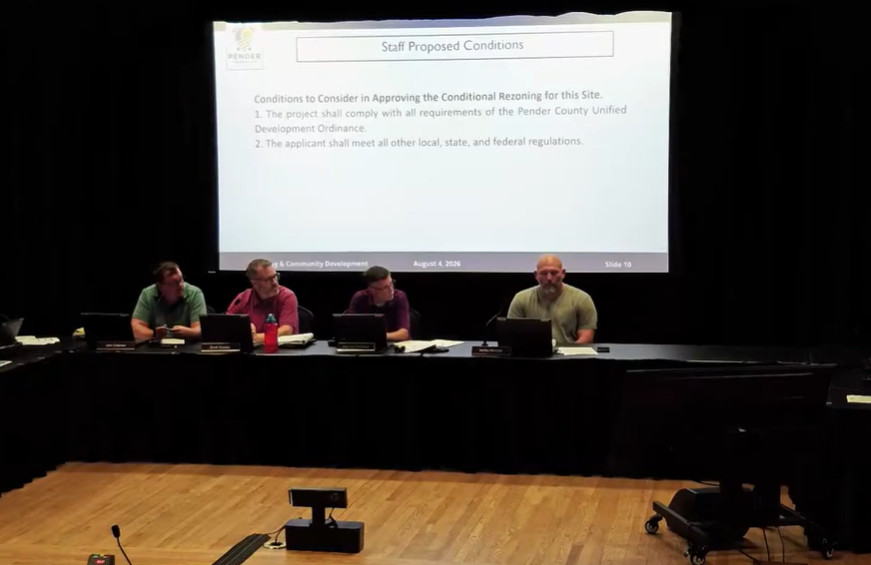
PENDER COUNTY — On Tuesday, Aug. 4, the Pender County Planning Board denied approval of a residential development that conserved more land than required under conditional zoning and recommended approval of a wastewater plant neighbors vehemently opposed.
A 1,023 single-family home development in Rocky Point was rejected after questions arose about services being able to handle the influx of residents.
However, the board gave the green light to a Topsail Township private wastewater treatment plant, presented for a second time. While the board’s initial concerns about the amount of wastewater output per day were addressed, community members presented their own apprehensions over possible environmental impacts.
READ MORE: Pender County planning decades of refunds for water lines not yet built
ALSO: Sewer constraints prevent Surf City hotel from moving forward
Rocky Point development
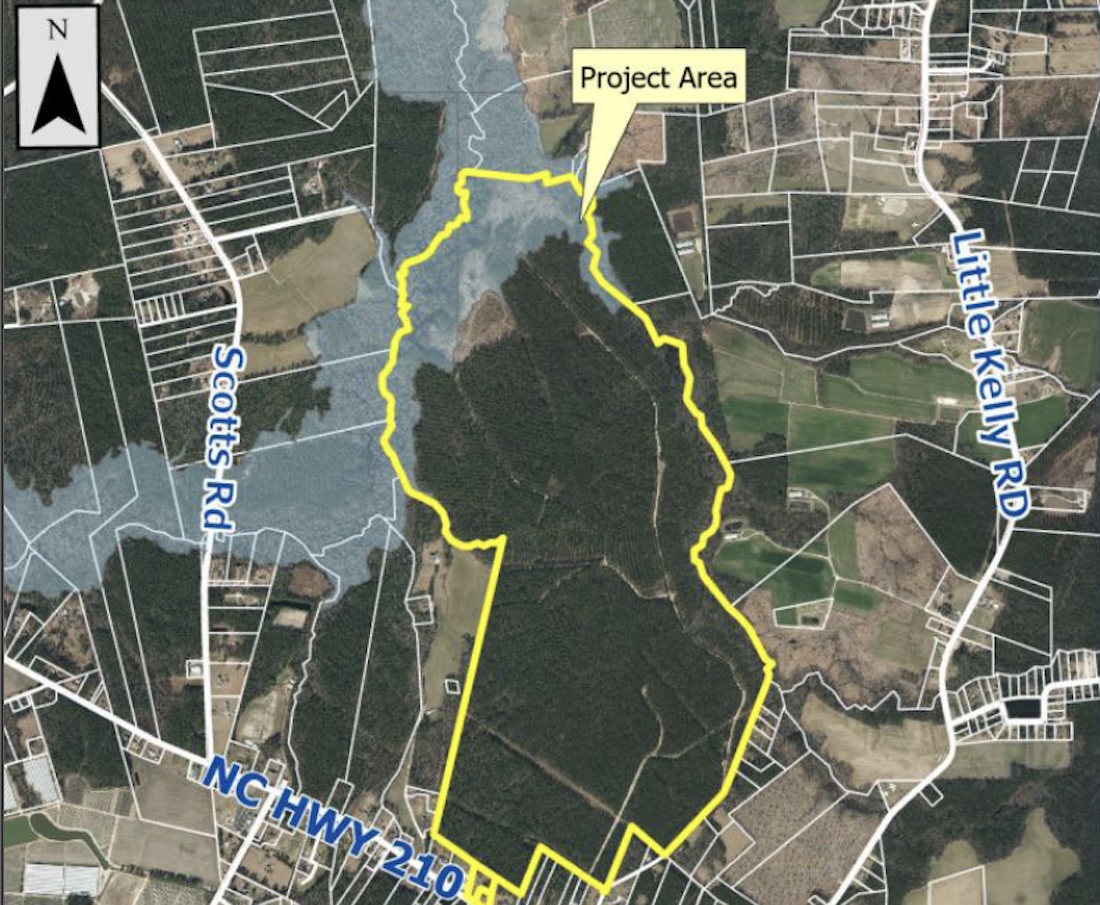
Bill Clark Homes needed a conditional rezoning to move forward its home development build on 603 acres located in Long Creek township, near the intersection of NC Hwy 210 and Pine Village Drive. Zoned rural agricultural, meant for non-residential agricultural purposes or low-density residential developments, the planning board denied the request, citing sewer lines infrastructure, unsustainable growth and access to emergency services as problematic.
Despite Bill Clark Homes calling their proposed neighborhood “conservation-foward,” due to preserving 253.52 acres — which staff recommended be put in a formal easement — board members and residents had concerns about increased traffic, overcrowded schools and overdevelopment of a rural area.
Board member Brett Keeler said the development had to provide improvements to the overall community, else there wasn’t an equitable cost-versus-benefit balance.
“The only winners in this can’t be the developers and the people that live within the community because then the losers are everybody that’s been here before and comes outside of that community,” Keeler said.
Throughout the meeting Keeler voiced multiple concerns, including a need for more emergency services and healthcare.
“We talk a lot about the vision themes and about infrastructure and lots about roads, schools, parks, water and wastewater. But one that we don’t talk about a lot is health services, emergency services and law enforcement.” Keller said. “Are we talking with both law enforcement, as well as emergency services, about coverage with these larger scale developments that are not by-right?”
Keeler added the county is already feeling pressure of increased population size, growing nearly 11,908 residents since 2020. He brought up a need for more hospital beds.
The State Health Coordinating Council — in charge of deciding what medical equipment, hospital beds, and specialized care facilities across the state need — published the 2026 North Carolina Medical Facilities Plan indicating there would be a deficit of 605 beds at Novant Health Pender Medical Center by 2028. However, Novant petitioned to remove the 605 bed acute care need in 2025, saying the data for the 605 beds was inflated and a reporting error.
For the years of 2021 through 2023, Novant Health Pender submitted incorrect Hospital Industry Data Institute — used to determine bed needs — numbers. In 2023 and 2024, data was based on pre-Covid-19 pandemic numbers; however, Novant caught the incorrect data used to calculate growth rates for the 2026 State Medical Facility Plan.
Thus, Novant submitted a petition to the Acute Care Committee to correct the mistake and remove the 605 acute beds needed, stating Pender Memorial actually had a surplus of 36 beds.
State Health Coordinating Council’s 2026 North Carolina Medical Facilities Plan has not been updated, though Novant corrected its data.
“We can’t get services to our people right now,” Keeler told the planning board, using Novant Family Medicine Rocky Point as an example.
Keeler noted they only have two physician assistants and one doctor, leaving people with a wait of six months for intake.
Currently, the center told Port City Daily it has one provider taking new patients, with the earliest appointment available at the end of September.
The applicant, along with Interim Planning Director Justin Brantley, did not have a response to board questions about which emergency services — EMS, fire and law enforcement — the development would be in the jurisdiction of or costs the county would incur for providing emergency services to the area.
Edith Shannon owns property adjacent to the proposed development and was one of seven who spoke and opposed the project during the public hearing. She echoed Keeler.
“Is fire and EMS ready to handle an extra 1,000 homes and over 2,000 people?” Shannon asked.
She also believed the new development would add to flooding of existing rural communities, particularly since the property is located near Riley’s Creek. Out of the site conserved land, 81.54 acres are in the 100-year floodplain and 103.02 acres are uplands.
The 1,023 homes will be clustered along 376.51 acres across 13 sections — each section would house no less than 25 lots.
The development has approximately 58 acres of ponds, which can hold up to a 50-year storm event, which is a storm with a 2%, or 1-in-50 chance of happening during any given year. The county requires developments to be able to accommodate 10- to 25-year events — having the infrastructure to respond to storms with between a 4% and 10% chance of occurring — and analyze impacts of a 50-year storm event.
Chase Rouse, lifelong Pender County resident, seconded Shannon’s fears. He hoped the board remembered the effects of Hurricane Florence.
The National Weather Service reported more than 1,000 people within Pender County had to be rescued from flooding. In Rocky Point proper — which is an unincorporated part of the county, expanding only 6.9-square miles — the Coast Guard rescued 26 adults, 11 children and seven dogs via helicopter.
“I know these houses are right against wetlands and all wetlands Florence flooded,’” Rouse said. “I mean, just because these houses are out of a floodplain, they’re not safe. And these people moving here are depending on us to make sure that their homes are protected.”
After hearing from community members, the board focused mainly on the overall density of homes and zoning, as well as infrastructure.
“I don’t think it’s fully consistent with the broader goals and policies,” Keeler said, referring to Imagine Pender 2050 Comprehensive Plan.
The area is currently the lowest density zoning in the county at rural agriculture, which allows 1 dwelling unit per acre; however, the Imagine Pender plan labels the land as rural neighborhood, encouraging low-density single family homes at 2 dwelling units per acre and using private wells and septic systems.
The new development suggests extended sewer service, as currently the area is not serviced by county sewer and would require line extensions.
Planning board member John Coleman also asked for further clarification on the proposed density, as he believed the development would allow for six houses per acre, basing his math of each lot averaging 6,750 square-feet per lot.
Lead planner for the development project, Alison Engebretson, explained the developers used an equation specified in the unified development ordinance, the density came out to 1.62.
Board members voted against recommending commissioners give final approval of the rezoning application, 3-1, with Keeler, Coleman and Todd Morrison voting down the request.
Vice Chair Ron Satterfield was the outlier recommending approval; he believed the applicant went above and beyond on conserving the land — setting aside 184.56 acres more than required.
“I appreciate the applicant coming in with a cluster conservation type subdivision,” Satterfield said. “By-right developments could have been included in the floodplain. Not saying it would, but it could. So I appreciate the fact that you are proposing to protect the floodplain and the wetlands on the site to the best of your ability.”
A by-right development in the rural agricultural zoning district would allow approximately 555 homes, while the rural neighborhood would allow approximately 1,110 homes. Under the conditional zoning that maximum allowed homes are 1,119 — 96 more homes than proposed by the developer.
Board members Delva Jordan and Robert Gallagher were absent from the meeting.
Castle Bay wastewater treatment plant
The planning board heard from Pluris Hampstead, LLC for the second time — nearly a month after the board tabled making a decision on the company’s proposed private wastewater treatment plant. This time around, residents from a nearby neighborhood sent an attorney to the meeting to oppose the development on their behalf.
In July, the board determined it needed to “better understand” the plant’s environmental and neighborhood impacts, its relationship to the land use plan and the relationship the plant would have to Pluris’ existing Blake Farms’ location.
However, during the Aug. 4 meeting the board recommended approval, stating the applicant had followed through with modifying a special use permit tied to Blake Farms — the wastewater plant, located off of Blake Farm Boulevard in Scotts Hill.
Mike Gallant, a design-engineer with Pluris, confirmed the company has submitted an application to modify its Blake Farm’s special use permit to officially state the maximum the plant can produce is 1.5 million gallons per day. It is currently restricted to 3 million gallons per day; however, the site is currently built to produce 1 million gallons per day.
Pluris wants to spread production across two plants, explaining there is not enough space at the Blake Farms site to build the site to full capacity. Without amending the special use permit, approved a decade ago to allow 3 million discharged gallons, Pluris could maximize both sites at 4 million.
Satterfield asked county staff if they received the application for the modification, which they confirmed is under review. Now with the SUP request in, the planning board can address rezoning for the new plant.
County attorney Katie Barber-Jones said while the board can take into account Blake Farms’ output and special use permit, their decision to approve rezoning of the 32-acre parcel off of Hoover Road should not be contingent upon the permit.
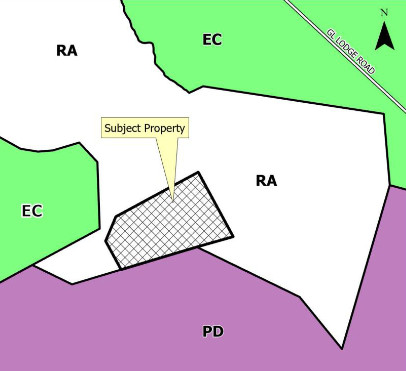
Pluris wants to build a new plant to relieve pressure and lessen hydraulic strain on the current facility. The new plant, located off of Hoover Road in Topsail Township, would serve 5,500 customers in the Hampstead and Scotts Hill areas. A conditional zoning is needed on the plat, currently zoned rural agricultural.
Though the largest point of contention — gallons per day Pluris would be discharging from both facilities combined — was settled, Castle Bay residents still had apprehensions. The community is located 3,000 feet away from the proposed site.
The neighborhood hired attorney Stan Green to represent them at the board meeting. He presented complaints that the community did not feel there was adequate public notice for a public hearing or enough environmental protection.
“We don’t believe that the process has been followed entirely,” Green said. “There’s a lot of missing parts.”
He claimed Pluris had violated the unified development ordinance by not having enough public meetings. The county’s land code requires one public meeting before an application goes to the planning board.
Pluris said it has held two to date: an official public meeting March 24 and an invite to visit the Pluris facility June 12. Per documents submitted to the planning board, the company considered the June visit to the Pluris facility as a public meeting.
However, Green did not consider the site visit a public meeting.. He claimed that because the meeting was requested by the Castle Bay Homeowners Association and had not been incentivized by Pluris, it was not an official meeting.
Keeler said Pluris had followed the unified development ordinance and added, for the first public hearing, residents within 500 feet were notified per the ordinance. Castle Bay does not fall within the notification zone, as the community is 3,000 feet away from the proposed site.
“It stinks because a lot of times, especially with these larger tracks, they’re enveloped by other larger tracks and within that 500 feet nobody that cares, per the letter of the UDO, is notified,” Keeler said, noting no policy had been violated despite Castle Bay residents’ frustration.
Green also brought up environmental concerns. Discharge from the wastewater plant, he worried, could contaminate ground water and the Holly Shelter Game Land, located adjacent to the proposed site. The attorney stressed Pluris had not mentioned getting a National Pollutant Discharge Elimination System permit, a license under the Clean Water Act that aims to control pollution by regulating point sources such as discharge.
“Nowhere in the materials have they said: ‘Oh, yeah we’re definitely gonna get one of those,’” he spoke to the planning board. “I think it’s because they don’t want to get one if they don’t have to.”
Gallant told the board the company was already required to get the permit: “This plant can’t be built without one.”
Andy Wood, director of the Coastal Plane Conservation Group, added that 1,4 dioxane — a manmade chemical, often the byproduct of detergent, shampoo and soaps — comes from wastewater treatment plants, specifically from households. Wood largely opposed the development.
“Don’t think that this wastewater is drinkable on a daily basis,” Wood said, referring to a Pluris promotion where an employee drank a glass of water treated by the plant. “It’s contaminated, or will be.”
Gallant shared that 1,4 dioxane is an “emerging pollutant,” and they are not required to test for it currently.
The Environmental Protection Agency does not have a legal maximum for how much of the compound can be in drinking water. However, it does have a health advisory in place with a suggested limit of 35 parts per billion.
Gallant said if a government agency ever required plants to test for the chemical, they would comply. However, currently there is no policy in place.
“We can’t overstep the DEQ,” Keeler said in response to community pushback. He added that while the board can put in a condition requiring all applicable permits be met, the municipal board cannot “overreach” the power of a governing agency such as the Department of Environmental Quality.
The board — whose main concern regarding the special use permit had been heavily discussed at the previous meeting — voted unanimously to recommend approval of the rezoning under the conditions the plant will comply with all requirements of the Pender County unified development ordinance, meet federal, local and state regulations and the facility must not begin operations until the county has received all applicable state and federal environmental permits and approvals from the applicant.
The special use permit modification and the rezoning for the wastewater treatment plant will go before the Pender County Board of Commissioners on Sept. 21.
Have tips or comments for Sophia DePhillips? Email [email protected]
At Port City Daily, we aim to keep locals informed on top-of-mind news facing the tri-county region. To support our work and help us reach more people in 2026, please, consider helping one of two ways: Subscribe here or make a one-time contribution here.
