


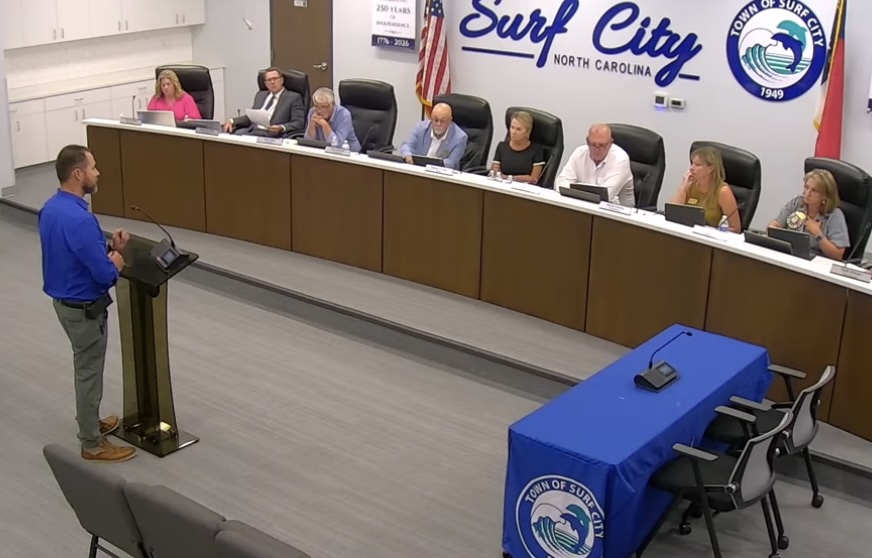
SURF CITY — A rezoning to usher in a 118-room hotel failed in Surf City this week. The majority of town council expressed concerns over one project eating up a large amount of commercial sewer capacity.
The town utilizes a sewer waitlist for incoming developments and allocates 30% for commercial, 50% for residential and 20% for reserve, to ensure the resource is always available to the town.
No commercial capacity is available currently in Surf City until 2029. The 30% allocated for commercial uses maxes out to 120,000 gallons per day. According to Surf City Public Utilities Director David Price, SpringHill Suites is estimated to take up 9,000 gallons a day.
READ MORE: 118-room hotel pitched for Surf City to go before council
ALSO: Surf City hones approach to wastewater capacity between small and large developments
Council voted 4-1, with Mayor Teresa Batts recusing herself and council member John Koloski dissenting (Batts did not respond to Port City Daily by press about her recusal). They denied rezoning 2.92 acres C3-CZ conditional — extended commercial — from R-15, which allows single-family, detached homes on 15,000 max square-foot lots.
While sewer capacity took up the majority of the conversation, traffic congestion, economic and community benefits also were broached.
Council member Andy Pleil said congestion is problematic at Highways 210 and 50, the intersection near the proposed location of the four-story hotel at 230 Florence Way. The project didn’t trigger a North Carolina Department of Transportation traffic impact analysis, as the hotel is bringing in less than 1,000 trips daily — 964 average vehicle trips, with 63 in the morning and roughly 71 in the evening.
“I imagine this is primarily tourism-driven. People come here not to visit the Statue of Liberty but to dig holes on the beach. So I’m concerned about the impact it has on traffic,” Pleil added. “Traffic driven by a 118-room hotel is different than what you might get from a Dollar General.”
His colleague, Trudy Solomon, agreed.
Addressing traffic, project engineer Tom Murphy said Surf City’s 30,000 summer visitors are coming no matter what — whether the hotel is built or not. Not only would it provide a place for people to stay, but he suggested they could encourage biking and other pathways to the beach, located 2.7 miles away.
Only one local, Albert Almeida, spoke during the public hearing and suggested the company sponsor part of Surf City’s multiuse path as a condition. The 19.2-mile transportation project is designed to safely connect mainland shopping areas, subdivisions, and the island beaches. Almeida’s suggestion didn’t gain traction.
Council member Dana Hawley didn’t think another hotel was needed now. She acknowledged if council approved a rezoning, but the contract purchase for the land by SpringSuites somehow didn’t go through or the $20-million hotel didn’t get built, council would be stuck with a rezoning allowing another hotel by-right.
“Once it’s in there, it’s in there,” she said. “And that just gives me pause.”
Town manager Kyle Breuer clarified town ordinance allows for a three-year review, so if no progress takes place on the project, it can come back to the board for further action.
“If that’s a concern, you can condition the approval based on a timeline or performance factor if the applicant agrees to something like that,” he said.
Pleil pointed out development in the area also needed to benefit the locals — via retail and restaurant access.
“The value of the hotel is more to the people that don’t have a place to stay,” Pleil said. “I’m not getting the warm feeling about the benefit of another hotel at this point and time.”
“Aren’t the people who use a hotel going to use our restaurants and our stores?” council member John Koloski asked.
“I’m looking at our residents, John,” Pleil said. “The economics of a hotel make sense. There is no doubt it makes sense, but I’m trying to look at the intrinsic value it adds to the community.”
SpringHill Suites posited it would generate $300,000 to $350,000 in occupancy taxes and create around 40 local part- and full-time positions.
Tom Tumur — with Raleigh-based Five Star Capital LLC, a Marriott licensed franchisee — said the hotel is entering more into area coastal markets. One was constructed near Wrightsville Beach in the last decade and another is being built in Carolina Beach as well, though from different real estate investment companies.
“During an emergency, we are planning to help the town,” Tumur said, “allowing four rooms for the town to occupy.”
The town would pay for the rooms, with a permanent reservation during hurricanes or other emergencies listed as a condition of the rezoning. The hotel was poised to be located next door to town hall.
Tumur said the hotel will service the community beyond tourism, particularly if residents need a place to stay during hurricanes or if they’re homes flood, not to mention contractors and tradesmen that work year-round in the area. By Five Star’s calculations, hotel visitors would add around $1.2 million to the local economy.
He added if the hotel received its building permits, construction would likely take until 2029. Thus it could potentially wrap at the time sewer becomes available.
“They would essentially put in dry lines,” Surf City Community Development Director Jeremy Smith told council, “waiting for the switch to be turned on for sewer.”
Hawley asked about projects in the pipeline already for sewer; mixed-use Medlins — a 46-acre development located along N.C. Highway 50 and Juniper Trail — has conditional approval.
“They’re in the same boat: getting a site plan approved, waiting for allocation,” Smith said.
“How much would their project take up?” Hawley asked.
Price clarified since it also has a residential component and he hasn’t viewed final plans, the allocation currently is unknown. However, the whole project will count as commercial.
“That starts chewing up a lot of our reserve,” Pleil said.
Hawley was wary the hotel would infringe upon other plans the town has considered — such as building out the Highway 17 corridor.
Pleil asked about capacity comparisons for commercial space instead of a hotel. It would depend on the use, according to Price, though retail tends to be low and restaurants are higher.
“To put it into perspective, if you have a restaurant with a bar, it’s about 50 gallons per seat; without a bar, it’s about 75 gallons per seat,” Price said.
Pleil broke down the usage for the hotel to roughly 65 gallons per room.
“That’s without a kitchenette in it,” Price clarified.
Project architect Murphy suggested Florence Way isn’t ideal to draw in needed foot traffic for those other uses.
“You mentioned restaurants or retail going here but that’s not going to be in the tertiary properties; this is a couple properties off the main drag. You’d have a hard time getting retail to take the same spot,” he said.
Devin Staley with Blue Ridge Engineering, also working on the project, gave a real-life scenario as to why Surf City needed the hotel.
“I could have booked it tonight instead of driving to Snead’s Ferry when we get finished here,” he said, adding had the meeting ended earlier — it lasted more than eight hours due to a separate quasi-judicial hearing — he also would have eaten at an area restaurant.
More so, Staley said the nearby Publix, Walmart and Lowe’s often have regional and district managers, as well as corporate executives coming through, all who need places to stay. Only one other hotel is on the mainland in Surf City — a four-story, 110-room Hampton Inn being built 0.2 miles from the proposed SpringHill Suites. Otherwise, four independent lodging establishments are on the island proper, which is also peppered with homes and condos for rent.
“I know one hotel is under construction, but Surf City can support another one,” Staley said.
Despite SpringHill Suites receiving favorable recommendations from the planning board, the council moved in the opposite direction. But it didn’t come without an attempt from Koloski to approve; however, his motion failed to gain a second.
Hawley made the motion to deny the rezoning request — it passed with Koloski against.
At Port City Daily, we aim to keep locals informed on top-of-mind news facing the tri-county region. To support our work and help us reach more people in 2026, please, consider helping one of two ways: Subscribe hereor make a one-time contribution here.
We appreciate your ongoing support.
