


WILMINGTON — A private developer’s unsolicited proposal to construct the Cape Fear Memorial Bridge replacement project was turned down by a North Carolina Department of Transportation working group and an oversight committee.
In February, Delivering Bridges submitted a proposal to design, build, finance, operate and maintain a new six-lane fixed-span bridge, with a target opening for 2031. The total cost of the bridge is expected to be $1.1-billion and has some funding from North Carolina Department of Transportation and a federal grant; the company proposed a toll to make up the rest at up to $2.75 per crossing.
However, the committee and NCDOT deemed the proposal “not materially different than what was already submitted and programmed” in the state transportation plan. Additionally, the terms presented were either “not allowable or not beneficial to NCDOT.” Additional details on the review were not disclosed.
READ MORE: CF Memorial Bridge toll decision due by February to keep grant, other funding options stall
The decision, announced Wednesday at the Wilmington Urban Area Metropolitan Planning Organization’s meeting, is only a determination on Delivering Bridge’s proposal. It does not preclude the replacement bridge from being tolled, nor does it mean the project could not be constructed with a public-private partnership in the future.
NCDOT Division 3 Engineer Trevor Carroll said the agency will continue moving forward like the replacement bridge will be a traditional toll project, meaning the bridge would be tolled by the North Carolina Turnpike Authority and not a private company.
The agency could still choose to pursue a public-private partnership with a developer in the future. If so, the project would be sent out to bid; the company who submitted the unsolicited bid, Delivering Bridges, would still be able to bid on the project. It would not, however, be shortlisted.
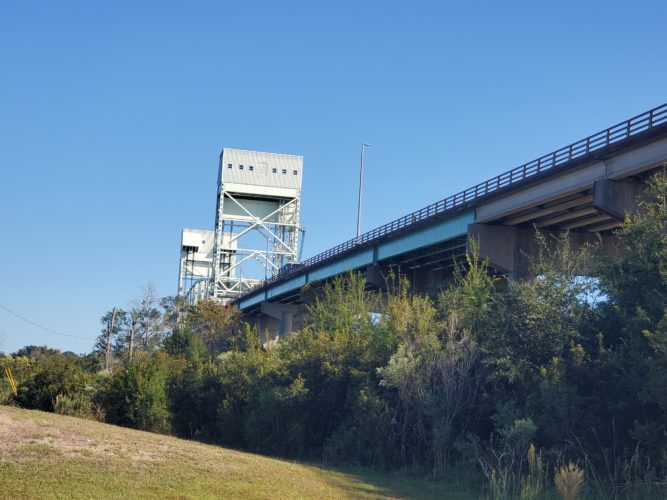
Built in 1969, the Cape Fear Memorial Bridge needs replacing because the parts needed for its movable span are becoming obsolete, making the structure costly to repair. The replacement, which will not score high enough for state funding without a toll, will move forward as a tolled project unless the Wilmington Urban Area Metropolitan Planning Organization decides to pull it from the state transportation plan or additional funding to pay for the $1.1 billion structure is located.
Delivering Bridges is a spinoff of United Bridge Partners, who submitted an unsolicited proposal for the replacement project in 2021. Though this too was rejected, it sparked the community conversation over tolling the Cape Fear Memorial Bridge’s replacement.
Though state law prohibits tolling existing roadway facilities, the state considers the replacement bridge to be a new build, thus allowing for a toll.
After receiving Delivering Bridges’ proposal, NCDOT put together a working group of NCDOT, WMPO and turnpike authority staff to review it. The committee reached the decision to reject the proposal, which was affirmed by the oversight committee, formed of different members from the NCDOT, WMPO and turnpike authority.
“We’ve said it, and we’ve heard it time and time again: We’re going to explore all options,” Carroll said at Wednesday’s meeting.
The WMPO has voted twice to continue exploring all funding options when it comes to the Cape Fear Memorial Bridge. Two design options are still on the table — a 135-foot fixed bridge or a 65-foot bridge that can open to 135 feet, both costing around $1.1 billion.
The NCDOT has dedicated $85 million to the project and secured a $242-million federal grant. Without alternative funding means — such as a tri-county transit sales tax that a WMPO subcommittee briefly discussed last year — the facility would need to be tolled.
With a public-private partnership, the state and private developer would sign a revenue-sharing agreement, but unlike a fully state-run facility, the developer would not have to stop charging the toll once it recouped the debt issued for the project.
One benefit to the public-private partnership model would be the option to offer tolling discounts for lower-income drivers or frequent crossers. The state is currently unable to set different prices for various customers.
The next step in the development process will be NCDOT’s release of its environmental assessment on both bridge options, expected within the next few months.
At Port City Daily, we aim to keep locals informed on top-of-mind news facing the tri-county region. To support our work and help us reach more people in 2026, please, consider helping one of two ways: Subscribe here or make a one-time contribution here.
We appreciate your ongoing support.
