


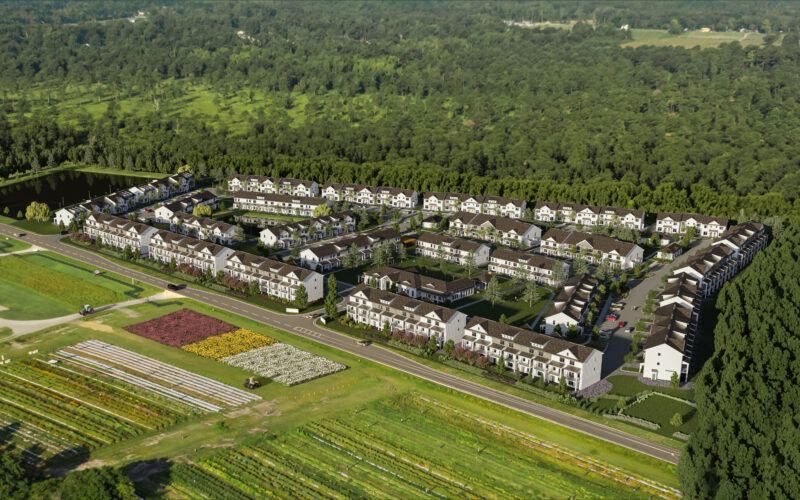
NEW HANOVER COUNTY — The New Hanover County commissioners approved a new multimillion workforce housing strategy on Monday and simultaneously struck a deal with Cape Fear Development to use half of the funding for its proposed townhome development.
In a unanimous vote, commissioners agreed to transfer $4 million from the county’s Revenue Stabilization Fund to a new Workforce Housing Development Fund. The fund is designed to loan money to developers for multi-income housing projects, setting aside at least 20% of units to households earning between 60% and 120% of the area median income. U.S. Census data lists the county’s median household income as $75,166.
Each project chosen — to be voted on by commissioners — will be required to pay back the county’s full investment, plus 5% interest.
“In other words, we’re making money,” Commissioner Rob Zapple said during Monday’s meeting.
READ MORE: NHC commissioners push back on workforce housing, community relations committee dissolutions
The county has already anointed its pilot project — a 236-unit townhome subdivision from Cape Fear Development planned for Blue Clay Road, located across from Trask Family Farms.
Called The Proximity at Blue Clay, in line with the company’s other Proximity projects, the development will provide 32 one-bedroom units at a monthly rent of $1,311, 134 two-bedroom units at $2,001 a month, and 70 three-bedroom units at $2,345 a month.
At the 5% interest rate, the county would bring in an additional $100,000 per year in interest payments from Cape Fear Development.
NHC Chief Finance Officer Eric Credle told commissioners Cape Fear Development plans to move forward with the project regardless of the county’s buy-in; the 236 units can be constructed by-right per the property’s rezoning to residential multi-family low density in 2022. Should the county not have supported the project with the new fund, Cape Fear Development would charge “market rate” rents — $1,828, $2,339 and $2,795 for one-, two- and three-bedrooms, respectively.
Per commissioner approval, also unanimous, Cape Fear Development will be required to maintain rents between 60% and 120% of the AMI (which is adjusted on an annual basis) for a period of 10 years.
Credle told commissioners Cape Fear Development representatives wanted to assuage concerns that rents would spike in a decade, noting the company said it is “in their best interest” to maintain high occupancy rates and avoid abrupt market shock.
“At the 10-year expiration, the property will be moderately aged, and market rental rates would reflect that, and would presumably be lower than the new product that’s coming onto the market,” Credle said.
According to the company, partnering with the county allows for an 18-month turnaround on The Proximity project, rather than a four-year process if Cape Fear Development were to seek federal tax credits. Preliminary applications for the federal Low Income Housing Tax Credits are due in January, with the full submissions due in May; it then takes several months to score applications.
Credle noted if the pilot project succeeds, Cape Care Development would like to replicate the model on a regular basis.
As for the remaining $2 million in the fund, the county plans to evaluate whether to use the fund as projects come in. Commissioner Dane Scalise said he would like to see the county invest in adaptive reuse projects, where a developer works within an existing building footprint to create more housing.
Chief Strategy Officer Jennifer Rigby said the commissioners could offer incentives to developers, such as expedited plan review, coordinated permitting and approvals, priority inspection services or building fee reductions. The incentives would not be automatic based on meeting certain criteria, but rather decided on a per-project basis.
Zapple raised some concern with showing favoritism to some projects or developers.
“That’s a valid point, but we’re not suggesting this is the suite of incentives; these are options that are available because every deal is going to look different, and a developer may need some sort of different partnership,” County Manager Chris Coudriet said.
The $4 million is a one-time transfer from the county’s Revenue Stabilization Fund, established with $300 million from the 2021 sale of New Hanover Regional Medical Center to Novant Health. The interest garnered from the fund will automatically revert back to the Revenue Stabilization Fund unless commissioners chose to allocate it elsewhere on an annual basis.
“I would like to see us do something with it, so I hope we do,” Commissioner Stephanie Walker said.
The Revenue Stabilization Fund became a centerpiece of the commissioner’s latest budget cycle. As the board’s Republican majority had no desire to raise the tax rate to accommodate growing revenue needs, the county manager suggested the budget be balanced with the Revenue Stabilization Fund. The county already uses interest gained with the fund for this purpose.
Commissioners, particularly Walker and Zapple, were wary of using the fund for recurring expenses, noting the county would be pressed to raise taxes the following year to accommodate inflationary rises or continue to deplete the Revenue Stabilization Fund.
“Y’all said it was like a credit card, just blowing the revenue stabilization fund,” Commissioner Bill Rivenbark said, referring to comments Walker and Zapple made during budget workshops. “So I would like to see [the interest] go back into the system, and then if we decide we want to do something else like this, we can.”
The Workforce Housing Development Fund will restore, albeit in a different way, the county’s funding commitment to workforce housing. In 2021, a different set of county commissioners voted to approve a five-year, $3-million annual commitment to workforce housing projects. However, during the 2025 budget cycle to reach a revenue neutral tax rate, commissioners eliminated the workforce housing strategy to make up $36 million in cuts from the county’s expenditures at the time. Shortly thereafter, the county also dissolved its participation in the Workforce Housing Advisory Committee, a joint venture with the City of Wilmington.
“We took a lot of heat about affordable housing when we got rid of our $3-million workforce housing fund, and we dissolved some committees, but this is the out-of-the-box thinking that we were talking about back then that we’re seeing this year,” Commissioner LeAnn Pierce said.
Cape Fear Development plans to break ground on the development in the next few months.
At Port City Daily, we aim to keep locals informed on top-of-mind news facing the tri-county region. To support our work and help us reach more people in 2026, please, consider helping one of two ways: Subscribe here or make a one-time contribution here.
We appreciate your ongoing support.
