


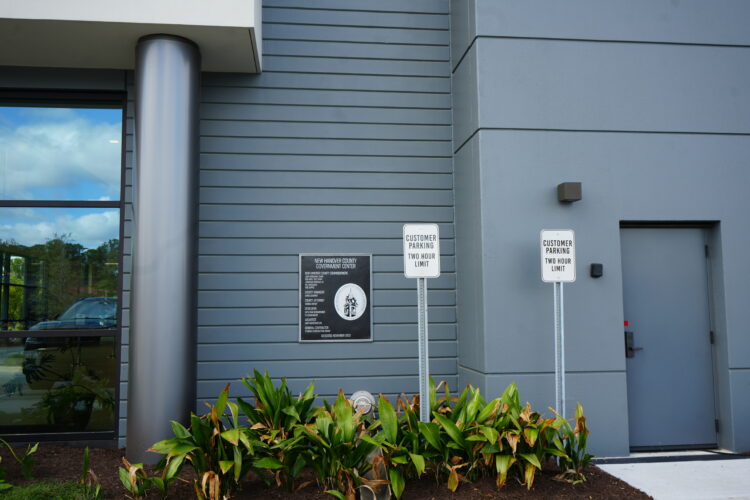
NEW HANOVER COUNTY — Tapping into a nearly $300-million fund to balance its budget — and dodge a tax increase — was at the center of New Hanover County commissioners’ budget discussion Wednesday.
“I promised the board that I would not recommend a tax increase this year because the board did reset policy [on the tax rate] and there is a mechanism to achieve a balanced budget without raising taxes, but it does require the use of Revenue Stabilization,” County Manager Chris Coudriet said during the meeting.
READ MORE: New Hanover County needs $4M to balance budget at current tax rate
ALSO: ‘Between the offices’: Relationship between NHC election director and county manager on shaky ground
Two funds — the $300 million Revenue Stabilization Fund and the $50 million Mental Health and Substance Use Disorder Fund — were established in 2021, with proceeds from the county’s $1.1 billion sale of New Hanover County Regional Medical Center to Novant Health. These pots of money are unique to New Hanover County, which at 30.6 cents, has the fifth lowest tax rate among North Carolina’s 100 counties.
Other counties with budget deficits have three levers to pull — raise the tax rate, pull from fund balance (savings) if there’s money available or reduce expenditures.
Since the hospital sale, the county has used interest generated from the Revenue Stabilization Fund plus roughly $8 million from the corpus, or principal, amount to supplement the budget.
The hospital’s asset purchase agreement outlines the purpose of the fund, including:
- Reserves for unexpected emergencies, including natural disasters and pandemics
- Budget shortfalls during economic downturns
- Minimization of tax and fee increases
Like in previous years, the county is planning to use $6.6 million in interest generated from the fund. To meet a previously reported $4 million deficit, however, county staff have now proposed using $4.86 million from the principal amount, which would leave roughly $287 million left in the fund.
“The only way we’ve been able to balance the budget is to use one-time revenue,” Coudriet said. “We’ve done that in the current year and I’m recommending that if that’s the continued course — and at this point it’s the only way — that we use money out of the Revenue Stabilization Fund instead of fund balance.”
Though the state allows for a minimum fund balance of 8% of general fund expenditures, county policy is for its fund balance to remain above 16.7%; with $16.67 million left, Coudriet said they are “at the floor” of what’s required.
If commissioners were to break their own policy, credit rating agencies could dox the county’s bond rating, affecting the amount of debt it can issue and interest rates it can obtain. The county could change its policy, though Coudriet said he didn’t know how that move would be viewed.
Still, the commissioners expressed concerns about continuing to pull from the Revenue Stabilization Fund. Rob Zapple thought it was unsustainable and the only way to pay for additional services and rising costs was to bring in more revenue.
Chair LeAnn Pierce shared the concerns raised, but noted this year might not be the year to raise taxes. She pointed out a $320.5-million school bond will be on the ballot in November, plus residents already facing financial hardships. Housing and energy costs continue to rise, as the Iran War affects escalating gas prices; New Hanover County’s average gas price is $3.96 a gallon as of April 2, slightly less than the national average of $4.01.
“People are silently saying ‘recession recession,’” Pierce said.
Commissioner Dane Scalise agreed but remained more “optimistic” that the economy will pick up — including sales tax revenue, which has come in under projections by several million dollars for the last couple months— and allow the county to reduce reliance on the Revenue Stabilization Fund.
With no end in sight though, Commissioner Stephanie Walker worried the move would put the county further in a hole each coming year.
“We can’t keep borrowing from it — or can we?” she asked.
Though the county has latitude to spend from the fund, it isn’t necessarily a renewable source — continuing to pull from the corpus and use interest will draw down the fund, thus affecting how much interest can be generated.
“That Revenue Stabilization Fund is going to be gone one day,” Commissioner Bill Rivenbark said, claiming several former commissioners “begged” him not to continuously spend from the fund.
However, county staff said members of the community they’ve spoken to have been supportive of the county’s fund use. Several public feedback sessions brought in requests for leaders to use the Revenue Stabilization Fund rather than raising taxes, staff said.
Scalise stated plainly he would not be in favor of upping the tax rate.
Walker pointed out if the county had adopted a “reasonable” tax rate last year — when the county’s property revaluation brought forth a 67% rise in property values on average — the commissioners may have avoided this year’s dilemma.
During last year’s budget cycle, the tax rate was set at 30.6 cents, which was as close to revenue neutral as commissioners could muster — a goal of Rivenbark, Scalise and Pierce to reduce impact to tax bills.
Property taxes are decided by multiplying a person’s home value to the tax rate; during revaluation years county and municipal governments have to, by law, publish the revenue neutral rate, which is the rate needed to bring in the same amount of money as the prior year’s budgeted amount.
Complicating matters further in the 2025-2026 fiscal year, the commissioners approved more spending than budgeted in 2024-2025. Essentially, it meant the county needed more funds than what the revenue-neutral rate would bring in. The county manager’s recommended budget suggested a tax rate of 35 cents.
Still, the Republican majority pushed lower, resulting in the need for cuts. The county offset roughly $16 million cuts by paying for some health and human services items from the Mental Health and Substance Use Disorder Fund and balancing its bottom line with interest from the Revenue Stabilization Fund.
Based on Wednesday’s conversation, both Pierce and Walker told county staff they would like to see what the revenue deficit would look like without reliance on the Revenue Stabilization Fund.
So what’s in the budget?
To reach a total revenue of $478.6 million — a 2.1% increase over the current year’s budget — county staff is projecting a 2% increase in property tax revenue and a 1.9% increase in sales tax revenue. The county is planning on issuing $34,549 in debt, while $9.14 million is set to be pulled from the Mental Health and Substance Use Disorder Fund along with the $4.86 million from Revenue Stabilization Fund.
The current budget conception does include $2.26 million in additional funding for New Hanover County Schools plus $2.8 million in capital expenses for the school district. CFCC will also see an additional $524,000 under this proposal.
The county is planning to pick up the cost of the Community Justice Center’s eight district attorney and legal assistant positions, whose funding through the New Hanover Community Endowment will expire at the end of year. This will total $427,882 for the next fiscal year, though the annual cost moving forward will be double that amount.
The county is also planning to provide the CJC an additional $71,279 for a veteran treatment court coordinator and operating funds for the veteran treatment court.
In addition, the budget conception includes $488,000 to improve on-time performance for the new routes in Wave Transit’s Reimagine Plan.
And despite the recent controversy between the county and New Hanover County Board of Elections, the county is meeting the board’s ask with an additional $77,411 for a new elections specialist position and software upgrade.
The budget request was put together by Assistant County Manager Lisa Wurtzbacher and Interim Director Crystal Whittaker before the permanent director DeNay Harris was hired. Democratic board member Derrick Miller questioned why only one position was being requested when several were asked for the year before under different leadership, but the budget request nonetheless passed unanimously.
Harris has since been put on administrative leave, but during her two-month stint on the job she asked for a conversation with the county about raising salary amounts for her staff. However, these pay raises were not part of the county’s enhancement conversation.
Other enhancements across various county departments include:
- $906,697 for a new sheriff’s deputy, K9 deputy and CSI detective along with various upgrades to camera platforms and equipment
- $87,500 for digital assessor tablets for the tax department
- $25,925 for a contamination tracking study for Page’s Creek
- $84,950 for an administrative position in the 911 call center and batter replacements for the backup center
- $140,000 for a parks master plan update (done every 10 years) and an Ogden Dog Park shade structure
- $139,181 or a Fire Services quality assurance coordinator
- $22,856 for two stormwater maintenance worker positions (the total cost is $124,856 but is canceled out by a reduction in temporary contracts)
- $773,000 for recycling and solid waste upgrades and a consultant position for waste diversion
Reach journalist Brenna Flanagan at [email protected].
At Port City Daily, we aim to keep locals informed on top-of-mind news facing the tri-county region. To support our work and help us reach more people in 2026, please, consider helping one of two ways: Subscribe here or make a one-time contribution here.
We appreciate your ongoing support.
