


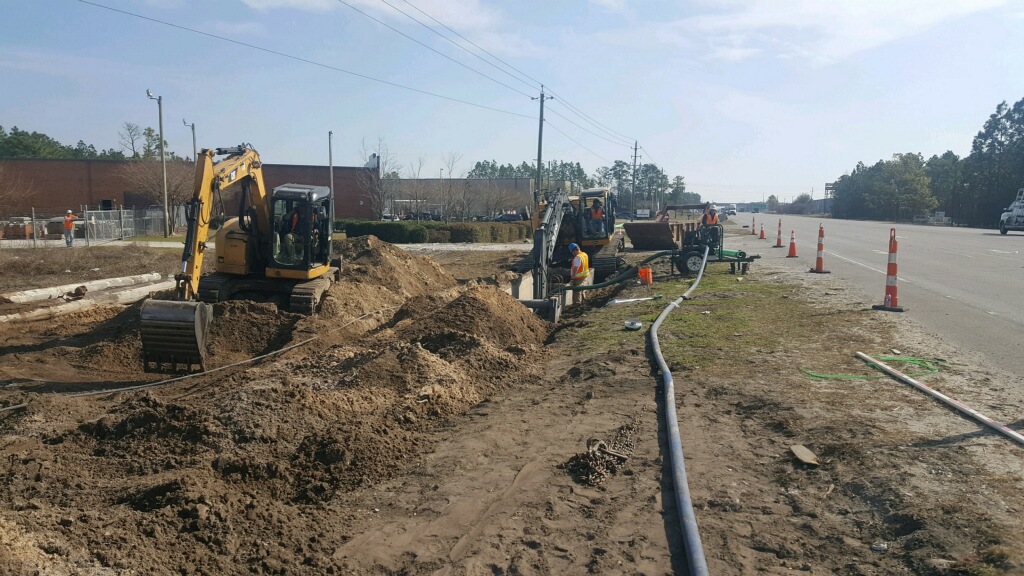
BRUNSWICK COUNTY — Following persistent calls from residents, Brunswick County has taken a step toward improving access to public water.
The Brunswick County Board of Commissioners unanimously approved a $20-million project Tuesday to extend a water transmission main along Highway 87. It’s a step officials say will increase water service capacity and provide residents along the corridor with publicly supplied drinking water. Port City Daily asked the county how many people the new line will hook up to, but a response was not received by press; it will be updated when the county retrieves the numbers.
READ MORE: Brunswick commissioners respond to calls for clean water, apply for grant
ALSO: Brunswick County hits sewer capacity snag under new state law, freezes permits
The approval comes amid long-standing calls from local residents and advocacy groups, who showed up to the meeting with signs: “Your neighbors don’t have clean water.”
The majority of people affected have been rural residents from historically underserved areas, reliant on private wells. Those wells are often costly to maintain, subject to fluctuating water quality, and in some cases, unsafe for everyday use, according to residents.
The Highway 87 project is funded in part by a $13.1-million federal grant from the U.S. Army Corps of Engineers and $6.9 million from the county’s Water Enterprise Fund — supported by system development fees paid when connecting to county water. The water line will stretch from U.S. 17 near Maco Road to an existing line near Malmo Loop Road, along Highway 87. Officials estimate the line will cover roughly 44,500 linear feet — about eight miles — creating a foundation to allow for future water service expansion along the corridor.
During board discussion, Commissioner Pat Sykes asked how the project would serve rural households amid new development. Recent activity in the area includes the Terrapin master‑planned community in Leland, expected to bring roughly 3,400 residential units to the area between U.S. 74/76 and Malmo Loop Road. Another major project moving through county review is the proposed Maco Road Planned Development, a conceptual plan outlining nearly 12,500 homes on a 4,378‑acre tract along Maco Road between Highway 87 and Town Creek Road. The development has not been approved and is under early technical review.
“I don’t know how it’s benefiting the rural customers when there’s a lot of houses going up on 87, so why was this area picked?” Sykes asked.
Deputy Director of Public Utilities Brent Lockamy said the corridor was selected because it falls within a qualified census block identified by the North Carolina Department of Environmental Quality, which makes the area eligible for certain state and federal grant funding.
“It was identified in our master planning in 2006 and so it’s been a project that has been looked at for many, many years.”
Lockamy further explained the project is intended as a trunk line, meaning it will be the main transmission pipe carrying water along Highway 87 and serves as the backbone of the system. Once the trunk line is operational, smaller lateral lines can be added to connect side streets and individual neighborhoods, expanding access to more residents. He also noted the project will provide redundancy, with multiple pathways for water to reach customers even if a section of the system is out of order, helping maintain continuous service during maintenance or emergencies.
Residents and advocacy groups have long pressed county officials to prioritize water access. Audrey Schreiber, U.S. campaigns officer with EarthRights International, an international human rights and environmental advocacy group, spoke during Tuesday’s public comment period.
“People have been asking the county for water access for over 20 years,” Schreiber said.
She addressed the board on the issue in March 2025 and EarthRights has coordinated with the Brunswick County NAACP since 2023.
“Many residents in historically Black neighborhoods rely on well water that is often foul, discolored, or polluted with sediment, forcing them to buy bottled water,” Schreiber said. “Brunswick County has an ethical obligation to ensure that residents — your neighbors — have access to clean water.”
Carl Parker, president of the Brunswick County NAACP, highlighted the human impact of unreliable and unsafe water access. Parker has come before the board numerous times in recent years, continually asking the county to prioritize funding for more water line extensions.
“The people need it. If you don’t believe it, go and visit some of the homes,” Parker said Tuesday. “Look at the rust in the bathroom, look at the folks that have to go to the laundromat because they can’t wear the same dress that they’ve been wearing because it got dirty, and they stick it into the washing machine and get the odor from it, get the rust from it. These are the things that we’re fighting for people not to have to do.”
As Parker noted, many resident wells are aging and some provide water with high iron content and a foul smell, forcing residents to buy bottled water.
The public discussion highlighted a persistent challenge in Brunswick County: As development accelerates along certain corridors, demand on water systems grows, yet many rural and historically marginalized neighborhoods remain without access to public water lines. Advocates at the meeting pointed to past grant applications and missed funding opportunities as examples of the county’s inconsistent progress on water equity.
In 2024, Brunswick County applied to the North Carolina Department of Environmental Quality’s Community Water Supply Grant program to fund extensions of public water lines to roads including Mulberry Road and nearby underserved neighborhoods. The application was denied because it did not score high enough in the state’s competitive ranking system.
A year later, county officials missed the filing deadline for a separate state grant for water infrastructure expansion, attributed to an internal oversight in tracking and submitting the application on time. Advocates like Parker said the missed opportunity delayed access to safe, reliable water for families on private wells.
Tuesday’s approval represents one of the most substantial investments in water distribution infrastructure in recent years. Broken down, the $20-million appropriation includes $17 million for construction, $1.5 million for architecture, engineering, and legal expenses, and $917,000 for administration. Also, $500,000 is set aside for land acquisition which will be used to secure any necessary easements for the transmission main along Highway 87.
Although the board voted to commit the funding for the Highway 87 project, Schreiber encouraged the county to allocate further funding to put the issue to bed for good. Advocates cite neighborhoods like Mulberry Road and Albright/Brown communities as still needing public water access.
“Apply for more water access grants, dedicate funding for water line extensions in the 2027 budget, and create a five-year plan to ensure this issue does not continue,” she said, noting roughly $14 million in county funds could extend multiple water line projects and provide relief to affected communities.
Details about the exact start and end dates for construction of the water line have not been announced. Outreach to affected residents, including information on connecting to the new line and applicable fees, will take place as the project moves forward.
Have tips or suggestions for Charlie Fossen? Email charlie@localdailymedia.com
At Port City Daily, we aim to keep locals informed on top-of-mind news facing the tri-county region. To support our work and help us reach more people in 2026, please, consider helping one of two ways: Subscribe here or make a one-time contribution here.
We appreciate your ongoing support.
