


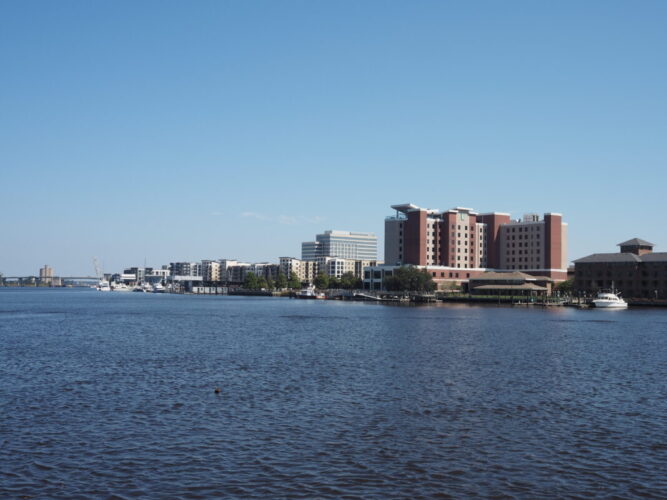
SOUTHEASTERN N.C. — The Department of Environmental Quality’s Division of Coastal Management has officially objected to the $1.35-billion Wilmington Harbor 403 Dredging Project following a federal consistency review of the U.S. Army Corps of Engineers’ Draft Environmental Impact Statement.
First proposed by the Port of Wilmington in 2019 to bring in larger vessels and increase imports and economic growth to the region, many people have spoken out that the economic benefit does not outweigh the harm it could bring municipalities and islands along the shipping channel. The USACE had to conduct a DEIS on what the economic and environmental impacts could be to dredge from 42 to 47 feet, starting 16 miles offshore and working its way 38 miles up the Cape Fear River to the Port of Wilmington.
READ MORE: OKI joins joint regional statement calling for more mitigation efforts in harbor project
ALSO: Legal fees mount amid Bald Head Island concerns with harbor deepening
AND: Southport pushes for stronger protections in $1.3B Wilmington Harbor deepening plan
The state also had to weigh in on the plan. DCM issued a statement Feb. 24, signed by agency director Tancred Miller, stating reasons for denying USACE’s Draft Environmental Impact Statement. It noted there was insufficient information regarding the exacerbation of PFAS contamination in the river, flooding and sea-level rise, and placement of dredged material in wetland areas.
DCM also found the proposal inconsistent with North Carolina’s Coastal Management Program because of its potential “adverse impacts” to coastal resources like fisheries, further aggravating erosion and shoreline instability, and harming “state and historic properties.”
“The Division of Coastal Management’s decision will protect public health from forever chemicals like PFAS and preserve treasured coastal resources in the lower Cape Fear River Basin,” DEQ Secretary Reid Wilson said in a press release. “If the Army Corps of Engineers can make changes to its proposal to protect people’s health and the environment, we are at the table to continue this conversation.”
The objection comes after the federal consistency review, done to ensure dredging aligns with environmental policies, was unpaused on Feb. 16. The USACE requested the review be put on hold on Jan. 16 so the organization could parse through public and department comments made in criticism of its DEIS.
The project has been met with backlash from municipalities along the river. Many government entities — Southport, the City of Wilmington, Oak Island, Bald Head Island, Caswell Beach, Sunset Beach, Kure Beach and Leland — have passed resolutions questioning the project in its current form due to its lack of mitigation measures. Concerns have risen over erosion, impact to bird islands along the river, and the dredging of chemicals including mercury.
A joint regional statement issued to DCM from coastal municipalities — including Southport, Bald Head Island, and Oak Island — cited similar reasons, and pointed to a project of the same caliber in Savannah, Georgia. Savannah deepened its channel from 42 feet to 47 feet and spent $500 million in mitigation efforts; the Wilmington Harbor 403 project only proposed $60 million to coastal and environmental preservation and maintenance.
After the state’s decision to object was publicized earlier this week, the Southern Environmental Law Center responded to it as “welcome news” for preservationists of the Cape Fear River and its surrounding natural areas.
Ramona McGee, senior attorney at the SELC, wrote in a statement: “This $1.3 billion project would put at risk the communities and wildlife that call this region home by exacerbating flooding, destroying habitat, and damaging wetlands. The Lower Cape Fear is already threatened by sea-level rise and industrial pollution — we shouldn’t be further damaging this special place with an unnecessary and costly project.”
SELC noted in addition to its hefty billion-dollar cost, the harbor deepening also would require $14 million annually in maintenance work.
USACE’s Draft Environmental Impact Statement found the project would allow larger vessels to travel the port, helping foster a 3% economic increase — with the annual economic benefit of the project’s completion predicted to be $83,278,000. Some have called the numbers “inflated” and expressed concern they were based on national standards and not specific to Wilmington.
While the ruling from the DCM was not in the USACE and Port of Wilmington’s favor, the project is not dead in the water. Rather, both entities can return to the drawing board and present a new draft to be evaluated by the environmental agency.
“The North Carolina State Ports Authority values the work of the North Carolina Department of Environmental Quality and respects the concerns raised in this objection,” a spokesperson with the port wrote in an email to Port City Daily on Thursday. “We also appreciate the continued support of the U.S. Army Corps of Engineers as we review the content of this letter and determine next steps. Regardless of the path forward, we will continue to deliver on our mission to enhance North Carolina’s economy by serving as a gateway to global markets.”
The DCM letter did recognize the revenue gains it could bring the port. It suggested:“Accordingly, should the USACE choose to postpone final federal action on the 403 Project and participate in the dispute resolution mechanisms … DCM is committed to working with the USACE to try to resolve the concerns detailed in this objection.”
At Port City Daily, we aim to keep locals informed on top-of-mind news facing the tri-county region. To support our work and help us reach more people in 2026, please, consider helping one of two ways: Subscribe here or make a one-time contribution here.
We appreciate your ongoing support.
