


NEW HANOVER COUNTY — As midterm primaries approach in March, local races also remain hotly contested. One of the most crowded local contests is for the New Hanover County Board of Education, with six Democratic candidates and five Republicans vying for four open seats.
Port City Daily talked with most of who filed to run, to learn more about what prompted them to campaign. Topics ranged from funding to low-performing schools and how each will stand out as a candidate.
The crop of candidates include three Republican incumbents — Melissa Mason, Josie Barnhart, and Pat Bradford. Their colleague, Pete Wildeboer, current board chair, chose not to run again. Joining the Republican slate is Chris Sutton, who campaigned for a school board seat in 2022 but lost in the primary.
A few more familiar faces are popping up among Democratic candidates, such as Nelson Beaulieu, a former school board member who lost his seat in the 2022 primary, and Jerry Jones, who lost in the 2022 general election. Joining them both are newcomers Brittnei LaRue, Rick Southerland, Margie Gewirtzman and Wendy Dale.
Both parties will have a primary election in March to narrow their fields to four candidates. Though with current school board member Tim Merrick running for North Carolina House District 20, the New Hanover County Democratic Party could appoint another candidate — or someone else altogether — should Merrick win the state contest against current NHC Commissioner Dane Scalise.
Port City Daily spoke with eight of the 11 candidates about their campaigns — Jones, LaRue, and Mason did not respond to PCD’s interview requests by press.
From those conversations emerged a split in approaches and philosophies, though not along party lines (though these fissures could still show themselves). Rather both insiders and outsiders to the district presented that status as their strength. The insiders say their advantages come from being embedded within New Hanover County schools and knowing the ins and outs of NHCS, either on the board of education or through advocacy work. The others believe bringing in an outward perspective and strategies from other school districts could push NHCS past its funding and programmatic plateaus.
While each candidate shared a unique viewpoint, Port City Daily also asked candidates to respond with thoughts on two of the biggest challenges facing the school district — funding and low-performing schools.
In July, Superintendent Christopher Barnes announced a loss of $5.3 million, including a little less than $1 million in pre-K funding, $2.34 million in supplemental funding at the state level, and $1.6 million in federal Title funding. Though some has since been recouped with other monetary sources, without additional funding, any increase to the district’s bottom line would jeopardize staffing levels. Barnes described the district as running on “subsistence level” in the aftermath of having to remove nearly 300 positions from its rolls in the 2024 budget cycle.
The district also saw more schools deemed “low performing” by the state this year than in the last two. It had 10 schools qualify as low-performing, given when a school’s test grades fall in the D or F range and growth metrics are not exceeded; that’s only one less than the Covid-19 pandemic era.
Many of the schools, particularly the recurrently low-performing schools, are located in areas of concentrated poverty. These schools have the highest student minority populations and a significant amount of students qualifying for free or reduced lunch.
Several strategies have been raised to address these schools, including redistricting with the intention of diluting the concentration of poverty in certain schools. This would alleviate staff and educators as well, who would theoretically have less students with many barriers to learning they were tasked with overcoming.
Though, redistricting is politically unfavorable. The oft-cited alternative is targeting millions of extra dollars to the low-performing schools to pay for additional resources and additional pay to incentive staff members to stay in the school.
The school board candidates gave their thoughts on those two topics and more in the conversations below.
Nelson Beaulieu
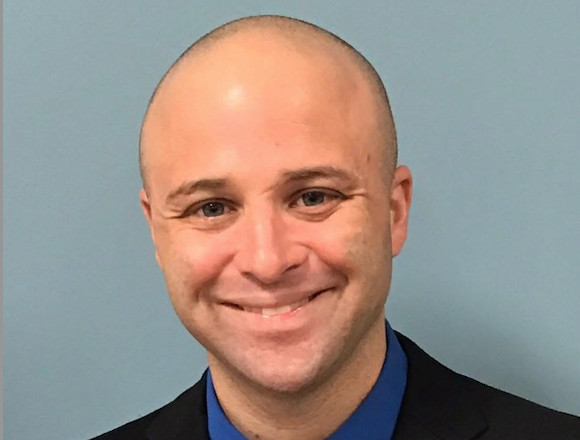
After losing his reelection bid three years ago and skipping the 2024 election campaign trail, Beaulieu told Port City Daily he’s now ready to make a comeback.
“I feel like there’s a lot of unfinished work,” he said. “And then there’s also some work that’s been returned to an unfinished status, that was a lot of progress made on my time on the board.”
For example, test scores have failed to return to pre-pandemic levels, according to Beaulieu. He served on the board from 2018 to 2022, a tumultuous time amid outrage over Covid-19 mask mandates, lessons on race and equity and revelations of sexual abuse at the hands of NHCS employees.
Despite the chaos the board often faced, Beaulieu said he was proud of the accomplishments, particularly the board’s efforts to make bipartisan decisions, specifying the Republican-controlled board voting for a Democratic chair and vice versa. He also pointed to implementing the school district’s new strategic plan, approving a pay raise for teachers, undergoing a redistricting, creating Title IX and diversity committees (both of which have been dismantled now) and hiring a new superintendent, Charles Foust, though he was fired in July 2024.
“It’s not always pretty to disagree, but in the case of that old board, it was extremely effective,” Beaulieu said.
In contrast, he believes the current board has become too partisan.
“We’re not doing as well academically as we need to be doing and I really want to bring the board into a place where we can get a little bit uncomfortable, whether you’re a Democrat or Republican and look at what we are doing wrong,” Beaulieu said.
The former board member — and instructor at Cape Fear Community College — said he would push for the board to travel to and learn from successful districts, specifically pointing to Mississippi. The state has dramatically improved its third-grade literacy through the introduction of “The Science of Reading” curriculum (also recently adopted by North Carolina) and mandating third-graders be held back for not meeting standards. The success has been dubbed the “Mississippi Miracle” and, to Beaulieu’s liking, didn’t require significantly more funding to accomplish.
“We’re a very wealthy district compared to our North Carolina neighbors; we’re an innovative district. We’ve always been innovative. And so, what could that look like?” Beaulieu said.
When asked about the district’s low-performing schools: Beaulieu said both redistricting and a targeted increase in funding are “sort of the lazy thing.”
“Sometimes I feel like redistricting masks the really big problem. And, then, with regards to funding, again, you got to go back to the data. I know people don’t like to do it, because it’s just there’s a lot to unpack, but you have to go back to the data and take a look. The more you spend, do you get benefit?”
Ultimately, Beaulieu said, improving the lower-performing schools is a “broader societal problem” that the county commissioners and state legislature have to come to the table with the school district on.
When asked about the district’s funding level: “I think we need to be innovative. We need to be creative … Yes, we need more money, but in terms of results oriented, how is this money going to impact what we see at the school level, we need to be more strategic.”
How he will stand out as a candidate: “I volunteer, I actually teach our high school students. My kids still go to public school in New Hanover County. My wife works in New Hanover County. So this is personal for me.”
Amy Dunning
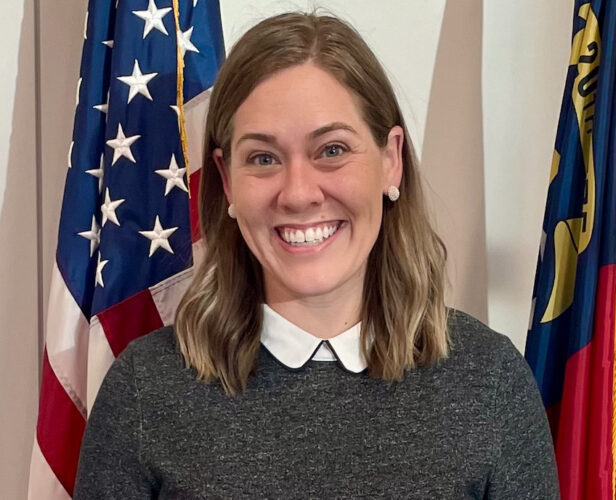
Dunning is a newcomer to New Hanover County Schools and the county as a whole, moving to the area just a year ago from Illinois. Though she currently teaches at the private Myrtle Grove Christian, her past experience includes teaching elementary math in a Title I school in Rockingham County.
It was during her master’s program Dunning said she realized she wasn’t using “best practices,” despite earning a bachelor’s degree in teaching.
“You’re telling them what they need to know, what they need to do, and then you give them a test, and you’re expecting them to output everything that you just learned,” Dunning said.
She said moving to a focus on “conceptual understanding” resulted in major shifts in her classroom. Now, she’d like to ensure teachers in New Hanover County Schools have the best tools to provide a high-quality education.
“I think, oftentimes, we’ll say, ‘Well, this group of kids, they’re going to get the most experienced teacher,’ and that’s not equitable, right? We need teachers who have this experience to teach all students,” Dunning said.
Though she’s been in the shoes of a public school teacher, educational leadership is also on her résumé, as she taught at and served on University of Illinois Springfield’s Faculty Senate and the University of Illinois Board of Trustees.
“I’m used to working with governance, developing policies and highly vocal people who stay firm in their convictions, as they should,” Dunning said. “But at the end of the day, for the school board, we have to figure out what’s going to work best for our students.”
If elected, her focus would be to facilitate and take cues from teachers in a bottom-up approach to leading. She would like to see the district host more open houses to generate feedback.
In prompting Dunning how she would respond to people questioning her choice to be a private school teacher while running to represent a public school district. She said she understood the concern, but noted teaching privately was a way to continue teaching; North Carolina law prevents teachers from serving on their own school boards due to conflicts of interest.
When asked about the district’s low-performing schools: Dunning believes in asking the teachers directly — “It goes back to the teachers; they know these students the best, and they know what they need … [it’s] asking them, what do you need to help these students, this community be successful?”
When asked about the district’s funding level: “Obviously, more money is going to be helpful; North Carolina consistently ranks at the bottom,” she said, referring to a study from the Education Law Center that shows the state ranking dead last in funding effort for education.
“I think it is important to continue to advocate for that. I think that also looking at what we do have and how it’s being spent, and ensuring that it is being spent in the best way possible for our students and our teachers,” Dunning said. “And then I also really think when it comes to advocating for money, looking at this funding formula, and how are they determining at the state level how much New Hanover County is going to get.”
How she will stand out as a candidate: “My experience and expertise having been in public education.”
Jerry Jones
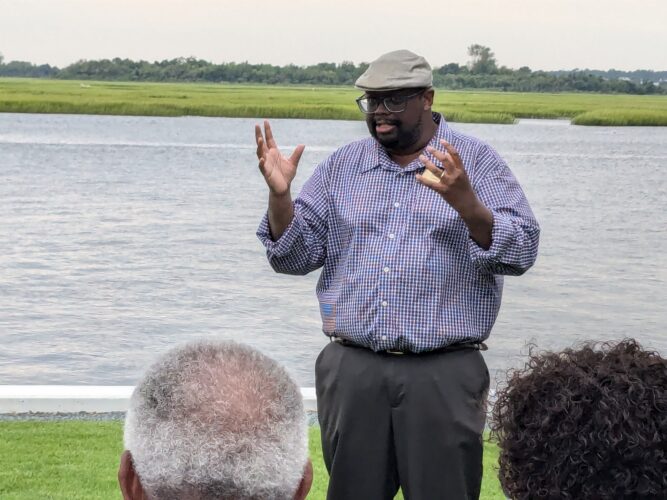
Jones, co-founder of The Roasted Bookery and a chemist with experience teaching middle-school science, is returning to the ticket because, right now he doesn’t see representation of working-class families in the current school board’s actions.
Jones said this was evident in the logistical functioning of the board, pointing to meeting times at 5 p.m. or in the middle of the day being hard to attend for the average family. Some policy actions, he described, are more indicative of a culture war than educating kids.
“My focus will be on working-class families of all stripes, whose children depend on a fully available public education to make that jump from where they are to where they want to be,” Jones said.
Approaching his second bid for the school board, Jones said he’s learned how to properly organize and run a campaign this time around.
“Since then, I’ve gotten some proper training, and I’ve gotten some professional help — definitely looking to build on the lessons and mistakes of the past,” Jones said.
Top priorities for Jones include advocating for funding needed to run a “top five public education system” in New Hanover County. He’s also interested in “democratizing” the school district’s feedback loop and restoring trust in the district’s teachers to do their job.
“I think that we need to have a structural process to bring in more voices — the voices of students, the voices of teachers and faculty, the voices of all staff, so everyone, from bus drivers and janitorial staff to the educator to the administrators, they have to have a say in how we run this this district,” Jones said.
When asked about the district’s low-performing schools: “I don’t want to
fall in love with studying the problem.”
Jones said it’s clear there’s an overlap between lower testing outcomes and socioeconomically disadvantaged communities. He acknowledged several ways to fix the problem — but, ultimately, said what’s lacking is a long-term commitment to one strategy.
“I would say that if we can, as a governing community, decide upon a course of action that is embraced by those who have to execute a course of action, then whatever resources you need, I will go to bat for you to get those resources,” Jones said.
When asked about the district’s funding level: “Our focus needs to be on developing a relationship with the county commission that allows us to be effective advocates. So there are other candidates, other folks who are focused on state-level politics, and we have a role in that one, even if it’s just being unafraid to call up our local reps, state senators, state House representatives, and say, ‘Hey, we need your help in the General Assembly to achieve these goals.’ So we have to have that kind of relationship. But I think our most effective partnership is going to be with the county commission.”
How he will stand out as a candidate: “I think drawing the clear connection between the availability of a freely available high quality public education and economic advancement. That’s it in America — public education is it, unless you come from a family who’s already advantaged economically or socially.”
Chris Sutton

A former school board candidate, advocate, and regular attendee and speaker at New Hanover County Board of Education meetings, Sutton has launched his campaign with a focus on increasing transparency and accountability in NHCS operations.
Sutton pointed to the board’s agenda review meetings, described as problematic because they often don’t include information on what’s being discussed. Additionally, the board has intended for agenda reviews to be information only, yet the board does sometimes vote on items.
“These systems, these policies, were used against our community before to stifle our ability to get things done,” Sutton said.
Sutton has been an outspoken advocate for the survivors of sexual abuse, some of them his classmates, that were abused by Michael Kelly, convicted in 2019. More recently he’s been assisting the family of a student allegedly assaulted by a teacher’s assistant at Alderman Elementary, telling Port City Daily he wants the district to be more open about those incidents.
A few months before the Alderman incident, a teacher was arrested on charges of assaulting two special needs students at Anderson Elementary. In the Anderson incident, the accused educator resigned before law enforcement and school-based investigations were completed, though the Alderman TA was terminated.
“If we do an investigation, and our investigation determines that there’s a credible chance that a teacher struck a student and they tried to resign, we push for termination instead,” Sutton said. “We hold them accountable so it makes it more tough for them to jump to the next county over or end up back in our school system.”
In both incidents, Sutton noted it was good teachers that saw and reported the incidents; he said he wants to explore ways to keep dedicated and experienced teachers in the school district with incentives.
“It’s time to be doing policies that work in favor of our teachers, that don’t cost us any money,” Sutton said, noting an example would be giving preference to teachers’ students when it comes to the district’s lottery schools.
When asked about the district’s low-performing schools: “You should not have to bust a child around for them to receive a quality education. And I believe that funds should be allocated in a manner that ensures all children are successful.”
When asked about the district’s funding level: “My personal views on state level funding doesn’t matter as much as what my fiduciary duty should be. Which anyone that takes the oath and is supposed to represent our school district should 100% be lobbying to get more funding for our school system, whether that be supporting Leandro, whether that’s lobbying our county commissioners to help fund more of our school or whether that’s even the bond referendum that’s coming up.”
How he will stand out as a candidate: “We need someone that truly understands and knows different people at every level of our district. And I’ve lived here my entire life, and I know people, whether it’s school bus drivers or people in the kitchen serving the food or, you know, the maintenance side of things we need.”
Wendy Dale

Dale is a contracts specialist that told Port City Daily her career in the negotiation of legal terms and commercial contracts has taught her how to develop policy and know when to compromise and stand firm. Most important, she said, is her experience as a single mom relying on the school system for support in raising her son.
“That really meant the world to me and I think seeing public education from that perspective, I think, really gives me a good advantage to view the entire system,” Dale said.
Dale’s son went to school in Orange County, which Dale described as “known for being really good, really well-funded schools.”
“There were just a lot of resources and I think that is really, for me, it’s the primary, fundamental issue,” Dale said.
She said she remembered a time when North Carolina public schools were the envy of the nation, but in the past decade, has seen schools struggle with chronic underfunding, also pointing to the Education Law Center’s report showing North Carolina ranking last in funding effort.
“We’re obviously not the poorest state in the nation,” she said. “We should be doing better for our kids and making sure that our students succeed in school and funding has been shown to have a direct correlation to that.”
Dale also wants to ensure NHCS has efficient policies in place designed to use funds efficiently. Port City Daily asked if she had any examples of it not being done now and Dale pointed generally to the school district consulting different groups before passing a policy change.
“Consultation is going to take time and money to consult with all of those people just to change a policy that the board has authority to change,” Dale said. “So it’s things like that, people wanting to put their fingers into every little thing. It’s really not an efficient way to run the schools; we really need to trust the educators, the board that is elected.”
When asked about the district’s low-performing schools: “I haven’t got an exact answer for you right now. I will take that under consideration and look into that more. I think we do engage in some progressive distribution of funds, so I certainly am not opposed to providing more funding for the schools that need it because they have, maybe, a greater percentage of needs, or greater percentage of children that may have disabilities, or learning disabilities, or anything like that, or anything that affects their education.”
When asked about the district’s funding level: “The board of education, the local board, doesn’t have a lot of power over the total budget … that is more of a state issue. But I, as a board member, would be a very strong advocate for funding, and if there are local sources of funding, I would definitely do what I could to make sure that those are accessible to our public schools.”
How she will stand out as a candidate: “I think my background as a single mom is really important … but I would also point to my professional experience in negotiation. I feel particularly suited to a role that would involve me perhaps marking up policy, changing the wording of things and negotiating those little details.”
Josie Barnhart
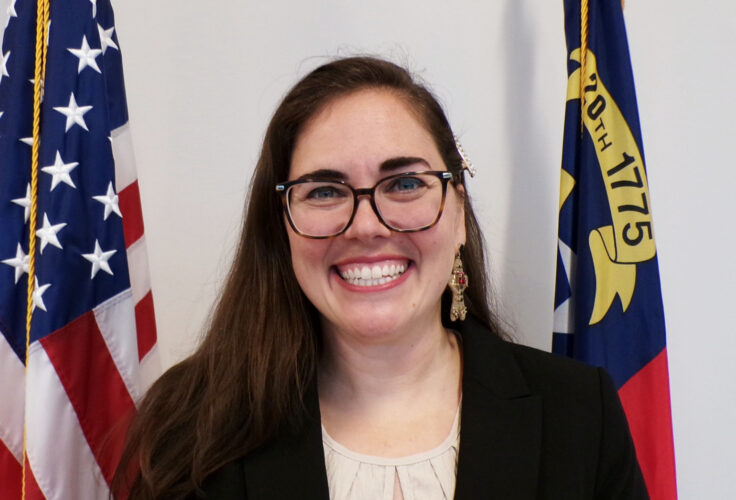
Elected in 2022, Barnhart is one of three candidates looking to retain a seat on the school board.
“Stability helps with leadership,” she said. “This last year, I’m really proud to say, the turnover rate for us was under 10% — the first time that we’ve had that in over a decade.”
She said consistent staffing leads to better quality education, and under the same premise, consistent leadership overseeing that staffing is also crucial.
Some of the current board’s successes she named include putting together a $320.5 million bond referendum and an increase in the student population’s proficiency rate. Barnhart also noted the board’s success in implementing the agenda review meeting, where, as she described, every board member has the chance to ask questions and understand an issue before a meeting vote.
Should she be voted into a next term, Barnhart said she wants to continue finding ways to promote student innovation, pointing to the district’s Spark Labs and Ashley High’s CTE program building tiny homes that can be deployed in the community.
“We’ll be able to auction it off and to bring it back to the program so some more kids down the line can be positively affected by that,” Barnhart said. “So I just want to continue to build partnerships and just showcase the different pathways of education.”
When asked about the district’s low-performing schools: In a previous PCD article, Barnhart said she would support exploring replicating a grant to provide incentive pay to teachers at Forest Hills and Rachel Freeman elementaries at all low-performing schools.
“I think there’s a lot to unpack that question, but I think when you’re looking at things districtwide, as far as support level is, how can we help support effective teaching practices?” Barnhart asked rhetorically.
The board member pointed to the district’s creation of a hub of materials to help teachers share and learn about different practices.
When asked about the district’s funding level: “I believe that having a target focus will allow for, more than likely, a better result in the end run, whether that is a specific staffing number or a higher dollar amount.”
An example of this “targeted advocacy” is a tiered funding model for EC students, with the funding tailored to varying levels of support for students with disabilities. Earlier this month, the board of education passed a resolution urging the state to raise its EC funding cap, as the district has more than 100 EC students over the amount covered through state support.
Barnhart hopes changes to the funding model will open up the conversation around staffing EC classrooms and potentially implementing co-teaching in classrooms.
How she will stand out as a candidate: “It takes four people on a board to get anything done and so I have always been one to step up and to step into my role and not be afraid to talk to people. I’m constantly in schools, going to events, networking in our community to bring the crossed paths together.”
Rick Southerland

Having attended public school in New Hanover County, Southerland is now returning home after working as a dance instructor at several universities and school districts — East Carolina University and Charlotte Mecklenburg Schools — across the country.
Southerland gave high praise to his New Hanover County education because of the educators that supported him and the opportunity to participate in various arts programs.
“I want to make sure that New Hanover County Schools is still that place for the current students who are future leaders of tomorrow to be able to have the same opportunities as I did that allowed me the successes and achievements that I have had,” Southerland said.
Not only is he focused on the student experience, Southerland said part of his platform is returning educator voices to curriculum and advocating for them to receive livable wages and professional development in their expertise.
“This is another venue, another way for me to give back to this community which really grounded me and provided such a solid foundation,” Southerland said.
The instructor said he wants to dive into the curricula provided in the district and also ensure the experts that developed and chose the course of study see their intentions honored. He alluded to the district’s banning of the book “Stamped: Racism, Antiracism and You” in AP English.
“I don’t see it as a responsibility to vote down just a single content area within an AP curriculum,” Southerland said, noting it is the board’s place to facilitate community conversations around curriculum to ensure families can ask questions and receive a full understanding of what’s being taught.
When asked about the district’s low-performing schools: “We need to look at where the neat greatest needs are and be considerate of all the extra income that does come into the various schools.”
Southerland noted he understood the reasoning behind it, but thinks the neighborhood schools districting model was a decision of “convenience.”
“We need to dig deeper about the nature of convenience,” Southerland said. “You know, I think everybody who puts their child into a public school, they do ask for the best of the best, and it shouldn’t matter, no matter where they go.”
When asked about the district’s funding level: “It’s about fundamental need and that there is a kind of equity as well as equality with finances.”
Southerland said he hoped the funding changes and uncertainties, particularly at the federal level with the dismantling of the U.S. Department of Education, would spark conversations about the importance of public education and focus attention on what is in the best interest of children, regardless of their socioeconomic status.
How he will stand out as a candidate: “I’m a born and bred New Hanover County public school student, never attended private school. I’ve experienced many different public schools, and they were all just wonderful places to be, and so I have a depth of knowledge through my own lived experience about what it was and what the possibilities for the future can bring.”
Pat Bradford
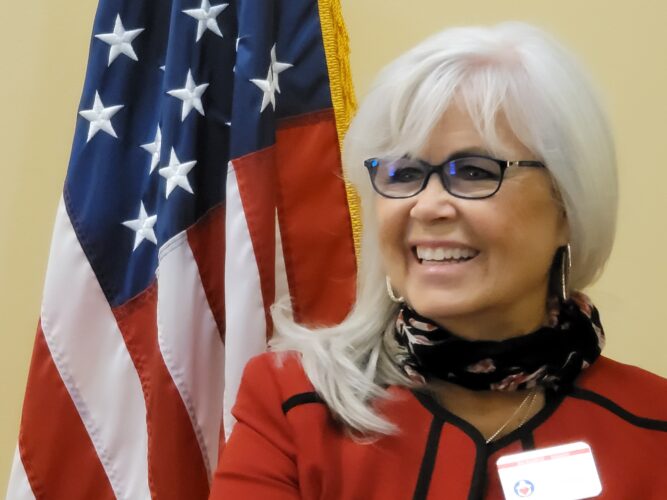
Vying for a second term, Bradford emphasized the current funding crisis the district is facing.
“We’re operating on a shoestring in the number of employees … the 2023 budget with its shortfall, positions decreased by around 300, yet the workload increased. That’s not sustainable long-term.”
Bradford, chair of the district’s Capital, Bond and Finance Committee, said the district’s finances is and will continue to be her biggest concern and focus. A large part of that is facilitating and pushing for the passage of the capital projects in the 2026 bond package; if passed, she’d like to continue to see through the next phase of the projects.
“I’m going to focus on safety and discipline, organization accountability, but my big focus will continue to be increasing funding, the transparent and responsible allocation, all the while continuing to improve the district’s relationship of trust with those who fund us,” Bradford said.
When it comes to the other needs — academics, overseeing staff — Bradford said she was proud of hiring Superintendent Chris Barnes and being able to trust in his attention to those areas, claiming the district has “improved daily since then.”
“Teachers, principals, staff, students feel heard, they feel respected and supported,” Bradford said. “Standards in our proficiency are on the increase, and our focus is grounded on student outcomes. The district has done a U-turn, restoring dignity, integrity and transparency — I want to see that continue.”
Bradford also stood by the controversial changes to the district’s display policy, which restricted what educators could show in their classrooms, in hallways and on sports fields and other outdoor areas. The changes passed 4-3 in May 2024.
“Every month since then, I have been more pleased with that policy,” Bradford said.
She continued: “This is America. We put the American flag up, we put the North Carolina flag, we put our alma maters up, you know, we put our schools up, but we don’t need to have our campuses having students pitting Israel against Hamas, or, you know, Russia against Ukraine. That was my point.”
When asked about the district’s low-performing schools: “I believe if we get a favorable bond referendum in November, and things will start to correct as schools come up out of the ground, as everything in the bond gets implemented, I believe we’re going to see some shifting, and we’ll wait until then to reimagine what may need to be done.”
Bradford added she attended an online seminar where the concept of open enrollment, or essentially not assigning addresses to school districts, was discussed; the board member said she was originally put off by it, but became intrigued and would consider exploring that option as well.
When asked about the district’s funding level: “The big thing is, the relationship between the county and school district has improved greatly, and we’ll start back as a committee together in February, working towards the budget that will be due in April.”
Bradford also added she will lobby state legislators to raise or eliminate the funding cap for EC students.
How she will stand out as a candidate: “I’m going to stay away from anything that doesn’t advance student outcomes. So I’m just going to stay in my lane, do my thing and trust that the voters will look at my record and see what I’ve advanced and how much better the schools are in just three years.”
Margaret Gewirtzman

New to the area with a background in nonprofit work, Gewirtzman is a mother of three kids with special needs and has been motivated to run for school board due to interactions with teachers and behavioral specialists for her child..
Gewirtzman shared one her children learns by having the material read aloud to him, which presents a challenge in a traditional classroom. However, her child uses a laptop with technology to transpose written content and read it aloud to him, though the tech and other supports provided to her child are costs to the district.
“It is an impossibility to raise a child that requires this much assistance alone,” Gewirtzman said. “Nobody has enough private money to pay for all of them … so I want to go in and help champion getting the money back into our school district so that we can be supported as a whole group.”
This, in turn, could help alleviate behavioral issues faced in some classrooms, Gewirtzman said. She believes with enough staff and technology to accommodate students who need extra help can help alleviate any shame around learning differently. Gewirtzman pointed to her 11-year-old son as an example.
“He is aware. It’s not like he can’t see peers around him just throwing out sentences and paragraphs like it’s nothing, and it is an incredible source of shame inside of him,” she said. “When he’s asked to hand-write something, and he knows he can’t, he acts out.”
Gewirtzman also noted her kids, as being white-presenting, are often given the benefit of the doubt more than a student of color would be, and thus, wants to address the discrepancy in discipline.
One of the changes she’d like to see is hiring an education technologist in the district that could troubleshoot and teach educators how to use and implement accessibility tools in their classrooms.
“Every kid just wants to meet expectations, and it breaks their heart and makes them feel horrible when they can’t, and it’s not their fault,” Gewirtzman said.
When asked about the district’s low-performing schools: “I’m not 100% sure, but I do think, and this is something that [NHC school board member] Tim Merrick had proposed the last meeting was mentoring with students who wish to from the local university, to come in and help bridge some of that gap.”
When asked about the district’s funding level: Having previously been part of the Eanes Independent School District when her family lived in Texas, Gewirtzman said she is used to having to pick up the state’s funding slack.
“They had a really aggressive parent run nonprofit organization that raised money like nobody else to fund those missing positions, because they believed that a school should not be safe without nurses, librarians, music teachers, P.E. staff,” Gewirtzman said.
She added she would still want to advocate for more funding on the state level, hopefully forming coalitions with other school districts to increase might.
How she will stand out as a candidate: “Being a mother of kids with special needs, I’ve given up comparing myself to anybody else. I can only be who I am, and if the public feels like I fill them with confidence and enthusiasm that we can stop a lot of these disparities, that I have those skills and I gain their confidence, that’s all I can do.”
Reach journalist Brenna Flanagan at [email protected].
At Port City Daily, we aim to keep locals informed on top-of-mind news facing the tri-county region. To support our work and help us reach more people in 2026, please, consider helping one of two ways: Subscribe here or make a one-time contribution here.
We appreciate your ongoing support.
