


WILMINGTON — The UNCW Board of Trustees unanimously approved a resolution in support of a pedestrian bridge across S. College Road for North Carolina State Department of Transportation consideration.
READ MORE: UNCW cancels 3 events as part of ‘freedom of expression’ pause
“UNC Wilmington has an opportunity to advance a long-discussed pedestrian bridge project across South College Road adjacent to campus,” the resolution states. “This crossing would greatly improve safety, expand multimodal access, and create a more welcoming gateway for the university.”
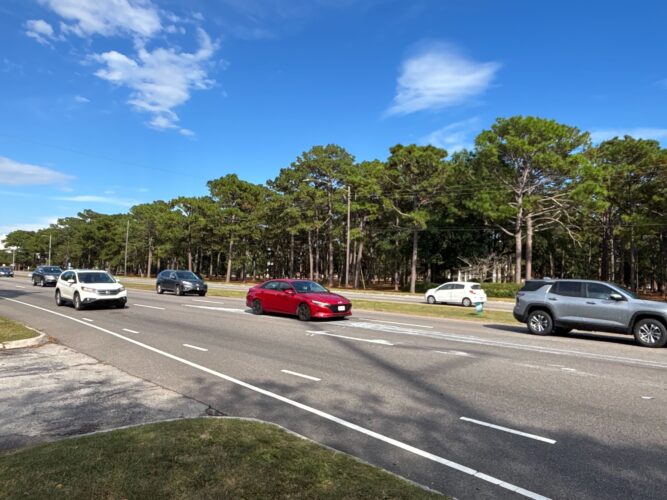
The bridge would extend across S. College Road’s eight lanes running parallel to Randall Parkway, connecting UNCW’s campus to the Bank of America parking lot. According to feasibility documents, the bridge would need to clear 20 feet above S. College Road and will be accessible via stairs and elevator.
College Road is one of the busiest thoroughfares in Wilmington, its intersection with Randall Parkway seeing 15,000 to 20,000 annual daily trips. The road features a crosswalk from UNCW’s campus to the other side of the street, but pedestrians, many of them students trying to walk home, have to cross eight lanes of traffic, navigating two right turn lanes. Many student living apartments have popped up in the Randall Parkway area over the last decade; because students within a one-mile radius of campus can’t drive to campus, that puts more pedestrians on the street.
The project is being submitted for the North Carolina Department of Transportation’s State Transportation Improvement Program. It’s a 10-year state and federal-mandated plan, updated every two years, that identifies the construction funding for and scheduling of transportation projects throughout the state in all modes, including aviation, bicycle and pedestrian, ferry, rail, transit, and highway.
Within the prioritization process, NCDOT and the planning organizations — like the Wilmington Urban Area Metropolitan Planning Organization — submit projects to compete for funding based on a quantitative ranking system. The next cycle, the P8.0 prioritization, is accepting projects through Sept. 30.
It’s the same program used to rank Cape Fear Memorial Bridge and Military Cutoff/Eastwood overpass, though the pedestrian bridge would be ranked against other bicycle and pedestrian projects. Scores are anticipated to be available at the end of spring 2026. The NCDOT Board of Transportation won’t approve the final STIP until July 2027.
The pedestrian bridge is being submitted by NCDOT Division 3, not the WMPO. Division 3 gets 10 project submittals outside of ones submitted by the WMPO, though they are still reviewed by local stakeholders before submission by the NCDOT Division 3 engineer.
Bike and pedestrian projects are required to have a 20% local match. The pedestrian bridge, for right-of-way acquisition, utility relocation and construction, is estimated at $13.7 million. This would make the local match approximately $2.74 million.
The resolution signed Monday noted UNCW is committed to finding the local match.
“For the purposes of the Prioritization 8.0 process, the Board of Trustees endorses the University’s commitment — working in partnership with local agencies — to secure the required 20% local match,” the resolution states.
Port City Daily asked the university if the resolution meant UNCW was committing to cover the local match with its own funds, instead of asking a local government agency, such as the City of Wilmington, to cover it. UNCW didn’t confirm it would pay up or ask for the money.
“UNCW’s action confirms that a local partner is committed to ensuring that match, so the project is eligible and competitive in the DOT’s review process,” UNCW spokesperson Krissy Vick wrote to PCD.
This week’s vote builds upon the trustees prior authorization of a feasibility study of the pedestrian bridge in 2021. The study was completed in 2023, though the bridge has not yet been submitted for the STIP.
A pedestrian bridge across S. College Road has been talked about for more than a decade.
In 2013, the City of Wilmington’s Transportation Advisory Committee included the pedestrian bridge in a list of its top priorities, at that time estimated to cost $3 million. The plan was to link the bridge with the Gary Shell Cross-City Trail, which legs onto the UNCW campus parallel to South College Road.
The Wilmington City Council voted to cover the 20% local match for the project, or $600,000, that year. The plan was to request the WMPO fund the remainder, though the application would’ve had to compete with others in the MPO’s jurisdiction.
However, in the fall of 2013, the WMPO’s Transportation Advisory Committee chose to reallocate funds that would have gone toward design and engineering for the bridge, to another project, a greenway on Park Avenue. Port City Daily reporting at the time notes the project had failed to progress beyond the university’s board of trustees’ business affairs committee. Though the pedestrian bridge ranked highest in the WMPO’s allocation of the federal Surface Transportation Program Direct Apportionment funding, members of the WMPO cited an apparent lack of support or commitment from the board of trustees.
“I think it’s a bad idea. It’ll cost millions of dollars,” Woody White, representing the New Hanover County commissioners on the WMPO, said in August 2013. “It’s the idea of putting a bridge over a span of the busiest road in this part of the state with no data whatsoever to support that it would ever be used.”
The bridge was brought up again in 2021, when council member Charlie Rivenbark requested the feasibility study.
“It might be 10 years before it gets built,” Rivenbark said at a June 2021 meeting. “But it won’t ever get built if we don’t start somewhere.”
Tips or comments? Email [email protected].
Want to read more from PCD? Subscribe now and then sign up for our morning newsletter, Wilmington Wire, and get the headlines delivered to your inbox every morning.
