


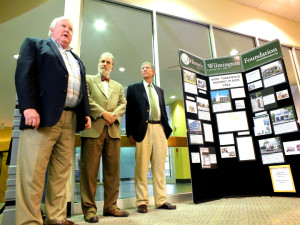
The Historic Wilmington Foundation (HWF) is taking advocacy for imperiled heritage on the road.
After months of work and collaboration with funders, the nonprofit on August 28 rolled out a traveling version of its “Most Threatened Historic Places” list to exhibit around the tri-county region. The goal: to promote awareness of the area’s venerable architecture and objects endangered by neglect or development.
While the media may give historic preservation sporadic focus, “It is the Foundation’s hope that the exhibit will expand and extend the discussion about the need to protect and preserve our irreplaceable historic resources throughout the year,” HWF explained in an announcement.
“It’s a way to keep the discussion alive,” said HWF Executive Director George W. Edwards as he discussed the roughly 7-foot-tall, three-panel display of photos and information on threatened sites in New Hanover, Brunswick and Pender counties.
The traveling exhibit is currently on view at the New Hanover County Library on Chestnut Street in Wilmington until September 13. Its second stop will be the county’s Northeast Regional Library on Military Cutoff Road, where it will be displayed from September 14 through October 12. Appearances in Brunswick and Pender counties will follow.
A grant from the Landfall Foundation funded most of the nearly $3,000 project, which highlights 2012’s most-threatened list and informs about past years’. HWF has released a list every spring for the past seven years.
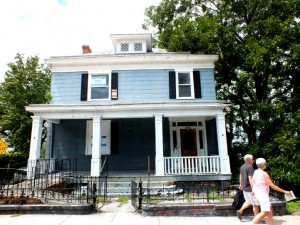
The 2012 edition recognized among other properties the blue, two-story building at 226 S. Front St. in Wilmington that in recent history housed the popular Taste of Country southern-cooking buffet. Now, the 3,781-square-foot structure, built in the 1890s, sits dormant in a state of “severe deterioration,” according to HWF. It’s also for sale—a real estate listing asks $475,000—but it’s stable and could be restored, HWF says. Due to the property’s age, it’s eligible for federal and state preservation tax credits that could boost such an effort, though the building’s real estate listing indicates a demolition permit is in hand should the buyer have other development plans.
Pender County’s Rosenwald Schools, which served as African-American learning institutions in the early 20th century, also made the 2012 list. “Unless dramatic action is taken, these important reminders of our state’s history of inequitable education will disappear,” the HWF entry states.
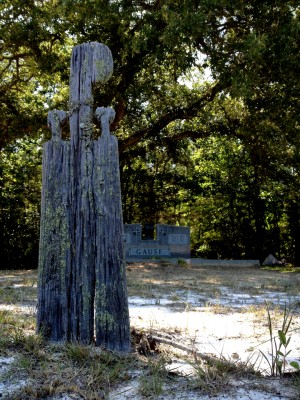
In Brunswick County, rare, wooden grave-markers from the late 19th or early 20th centuries are fighting time and neglect and were thus given a continued spot on the 2012 most-threatened list after being added the year prior. “These vanishing markers need to be documented for future generations to appreciate this form of funerary art,” HWF’s narrative said.
“The exhibit was created with the idea that it would involve the viewer and motivate people to think about the buildings and sites in their towns and neighborhoods that are important and should be saved,” a press release from the foundation stated.
The annual most-threatened lists have indeed inspired action, Edwards noted. Four years ago, HWF placed the entirety of Brunswick County on its most-threatened list, in part because the county lacked a comprehensive survey of its history, old buildings and cultural heritage. Alarmed by the void, the Brunswick County Board of Commissioners in 2009 paid $55,000 to a preservation company to identify and photograph historical sites, speak with long-lived natives and record the entire experience.
The result was the “Comprehensive Historical & Architectural Site Survey of Brunswick County, North Carolina.” It logged in detail 506 buildings, more than half of which were in Southport, and led HWF last year to deem Brunswick County’s history “saved.”
HWF and collaborators hope the new exhibit’s presence in area libraries will inspire more success stories and a diverse appreciation for the past.
“By being in the public library, it’s seen by a lot of people—particularly, we hope, by young people,” HWF President Don Britt said at the unveiling Tuesday. “We have to get our young people thinking about preservation going forward if we intend to keep it moving forward.”
The exhibit also features a drop-off spot where persons can submit candidate sites for future most-threatened lists.
Travel schedule for the exhibit:
New Hanover County Library, 201 Chestnut St., Wilmington – Aug. 28-Sept. 13
Northeast Regional Library, 1241 Military Cutoff Road, Wilmington – Sept. 14-Oct. 2
Harper Library, 109 W. Moore St., Southport – Oct. 3-22
Rourk Library, 5068 Main St. Shallotte – Oct. 23-Nov. 12
Pender Central Library, 103 S. Cowan St., Burgaw – Nov. 13-Dec. 3
Hampstead Library, 75 Library Drive, Hampstead – Dec. 4-21
