


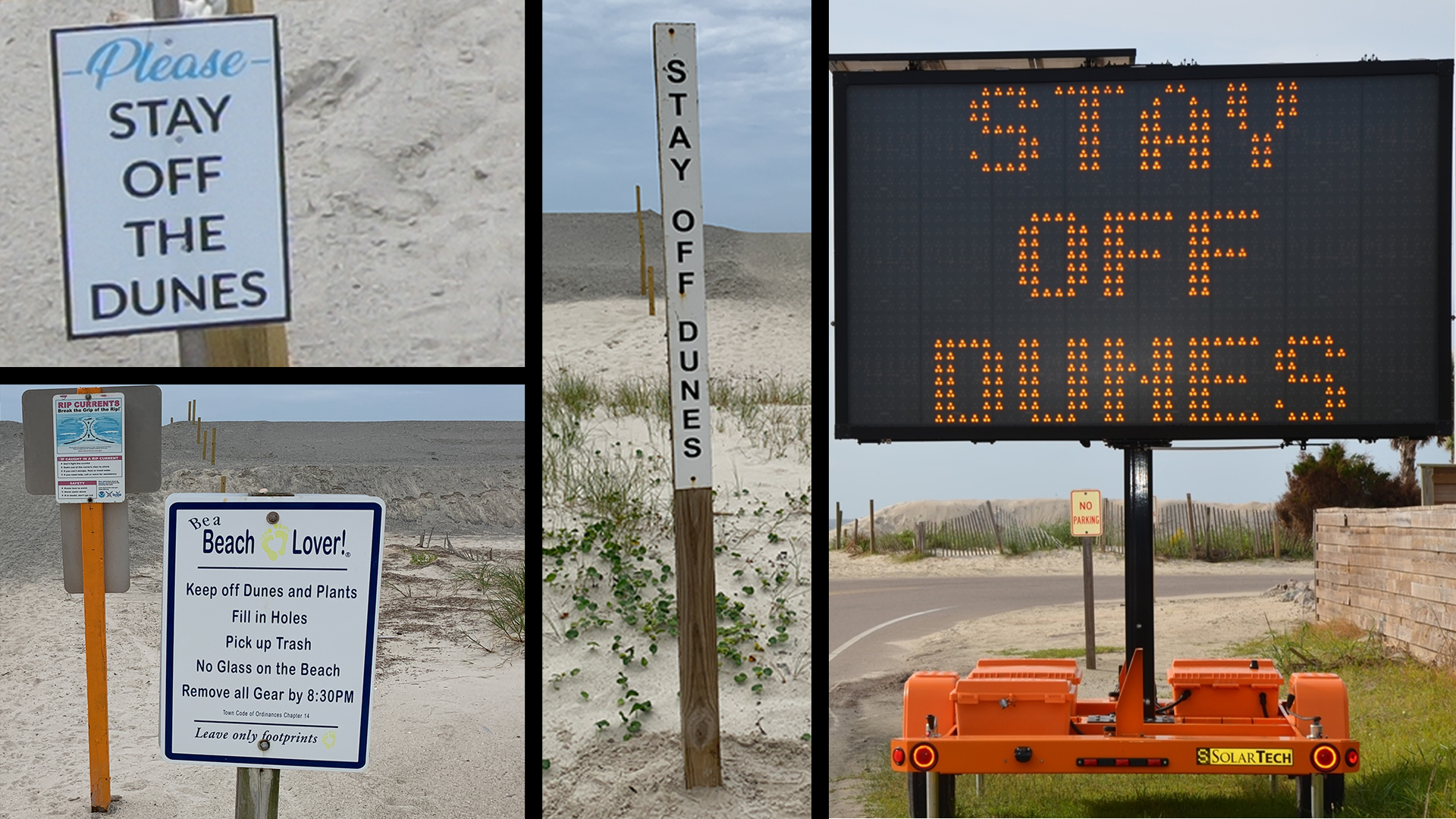
OAK ISLAND — In peak summer months, crowds on the nearly 10 miles of Oak Island beaches can swell to upward of 100,000 people per day. The large numbers of visitors traipsing the oceanfront have created a long history of dune destruction, punishable by fine.
At a special-called meeting Monday, the town council stressed the desire for steeper citations against violators who ignore signs and damage dunes at a cost to the town. Oak Island police assistant chief Frankie Cooke emphasized the department is doing what it can while short five officers. It also is hiring for an additional 12 part-time seasonal officers.
Dunes are crucial to protecting the integrity of the beach, wildlife and development. When people walk across them, violating town laws, it erodes the sand banks, damages the vegetation that holds them intact and deters new vegetation from taking root. Beachgoers are supposed to use one of the 67 designated access points to enter the beach; however it’s common for tourists or children to opt for shortcuts, despite the vast number and different versions of visible signage forewarning: Stay off the dunes.
Mayor pro tempore John Bach said the main focus needs to be on “flagrant violations,” where renters are tunneling through the dunes for more direct access to the beach, as opposed to following the appropriate pathways.
“Anyone renting property should have to sign on the rental form, ‘If I violate the dunes violations, I have to be subject to fines,’” he said at the meeting. “They need to be stopped.”
More citations, less warning
In 2021, Oak Island police reported almost 200 citations for dune violations, with a $50 fine for the first offense and $100 for the second.
Cooke, currently leading the department since Chief W.L. “Speedy” Ingram III retired in October, explained officers also handed out an extensive number of warnings that did not result in tickets.
Council member Bill Craft asked the question: “Can we see more citations instead of warnings this year?”
Cooke explained many of the violators are children under the age of 10, who don’t know any better, and that education is key.
“Just because people should know the law, doesn’t mean they do,” he said. “Our first priority is to educate people. If they’re cooperative, we’ll do the best we can.”
Oak Island communications manager Mike Emory told Port City Daily the largest issue is people are unaware they cannot cross the dunes.
“In large part, once properly educated, most of those we interact with happily stay off the dunes and/or remove their children from them,” Emory explained. “That is why we’re focusing a large effort toward preventative education.”
Protecting the beach investment
Due to the substantial financial commitment to rebuild dunes and retain adequate sand, council is adamant on protecting these areas.
A Federal Emergency Management Agency (FEMA) reimbursable project to repair damage from Hurricane Florence began this week to dredge sand from the ocean floor and transport it to the beach, west of Middleton Avenue, along West Beach Drive
Once the project is completed, the areas along East and West Beach drives will have similar dune profiles and access requirements, creating a consistent message to stay off roped off areas. This should assist with deterring people from crossing the dunes, Emory said.
In May 2021, the town completed the first portion of what’s referred to as the “Hurricane Matthew Project,” repairing damage from the 2016 storm. It serviced areas from SE 63rd St. to Middleton Avenue.
Oak Island is also set to invest nearly $40 million in long-term beach nourishment. In November 2021, the state included $20 million, which the town must match, in its 2021-2022 budget. The town’s long-term plan has been in the works since 2016 and is ongoing.
Since 2015, the town has invested roughly $10.5 million in nourishment efforts. Brunswick County provided $500,000, the state funded $9.4 million and the federal government chipped in $12 million.
Lack of manpower
The Oak Island Police Department is no stranger to the nationwide shortage of officers and currently lacks adequate manpower, making it even more difficult to enforce stronger dune regulations in spite of council’s wishes. Right now there are 25 employees and the department is considered fully staffed at 30. That includes 24 full-time, four part-time and two non-sworn administrative staff members.
“We’re in the negative with manpower and we have been for a long time,” Cooke said. “I don’t know the last time [the department] was fully staffed. People don’t want to get into law enforcement anymore, so we’re doing a lot more with a lot less.”
Emory said while many vacancies are attributed to the pandemic, other factors, including low interest in the industry as Cooke mentioned, are also at play.
“While Oak Island offers a competitive salary and benefits package, it is difficult to compete with departments of larger municipalities,” he said. “We receive interest, but for many, the salary and benefits are a deciding factor.”
The hiring range is currently $39,887 to $48,964, depending on experience. Emory added the dramatic cost of living for the area has “priced it out of consideration” for many prospective new officers.
Oak Island Police is also advertising 12 part-time non-sworn seasonal positions to help with parking enforcement at $15 an hour, and beach patrol at $17.50 per hour.
Cooke said at Monday’s meeting one sworn officer, supplemented daily by a civilian officer, will be responsible for beach patrol for the 102 days between Memorial Day and Labor Day. Both will travel the oceanfront on utility task vehicles (UTVs). Based on the department’s schedule, beach patrol officers will essentially be assigned to work during an “off-duty” day.
The department is currently recruiting additional civilian officers and has already received about 20 applications, one week after posting the job. Many who have shown interest are past or even current part-time law enforcement, Cooke said. Civilian officers are employed by the town and have the authority to issue citations.
The department could assign additional interested civilian officers to help with the shortage of beach patrol; however, it only has the two UTVs, Cooke said. He suggested renting one as the more fiscally sound option rather than buying one at $12,000 to $14,000. There is also currently a lag time of about four to six months to get one in stock.
Even with UTVs, it typically takes the two officers four hours to cover the entirety of the beachfront, starting at opposite ends, Cooke explained. This is during normal population days, which average 10,000 beachgoers a day.
“We should have four officers on shift, but we’re lucky if we have two or three,” Cooke said. “Last year, we had some officers working 14 days in a row before a day off, rotating day and night shifts. It depletes your force and burns everyone out; quality of work drops down.”
Emory said during the peak of summer season, some officers average as much as 20 hours of overtime per month.
During holiday weekends, Cooke said a third officer will be on duty with a primary focus on Beach and Ocean drives.
Drones help target violators
The Oak Island police also utilizes a drone to patrol major hot spots during the summer. The drone is set up with a pre-recorded message, warning people to stay off the dunes if violations are spotted in progress.
“If [the drone pilot] sees areas where more people are in dune violations, we can adjust our patrols accordingly the next day,” Cooke said.
It’s unlikely a drone picture is sufficient to issue a citation. Cooke said that’s only possible if the photo can clearly prove who it is and what they are doing.
Council member Mark Martin suggested, instead of the drone operator creating a targeted list for follow-up assessment, the pilot could contact someone on duty who could be dispatched to handle the issue that same day.
“It’s not great we didn’t address the infraction when it occurred,” he said. “I believe education is better utilized when it’s actually enforced. A $50 fine is not enforcing education. It should be a $500 fine and not a first-time warning but immediate citation. That’s what would get the word out, and we would see a lot less violations pretty fast.”
Council agreed to discuss this with the town attorney and consider the possibility of modifying the ordinance to raise fines.
“Holden Beach has a $500 citation,” Mayor Elizabeth White said. “They had a lot of resistance to that. We would have to be willing to endure that pushback. The second year, they had less. Now anyone that vacations on Holden Beach stays off the dunes.”
White added there needs to be a method where the public can participate in protecting the beaches. Right now, people call 911 to report violations, but she said “it’s not what 911 was created for and we’ve got to find a way to work around that.” She suggested designating a phone number for reporting beach infractions and hiring volunteers to staff it.
“We need a clear method by which our citizens can participate,” she said. “It’s their $40-million investment.”
Bach said a campaign needs to roll out that is highly visible to create more immediate results. He even suggested buying an additional drone, equipped with real-time technology to communicate with officers on duty.
“We should use our technology as an advantage instead of throwing manpower at the problem,” he said.
Bach went on to assure Cooke that the council will make every effort to assist with the police force shortage and acquire necessary resources.
“I will do what we can to get you what we can,” Bach said.
Tips or comments? Email amy@localdailymedia.com.
Want to read more from PCD? Subscribe now and then sign up for our morning newsletter, Wilmington Wire, and get the headlines delivered to your inbox every morning.
