


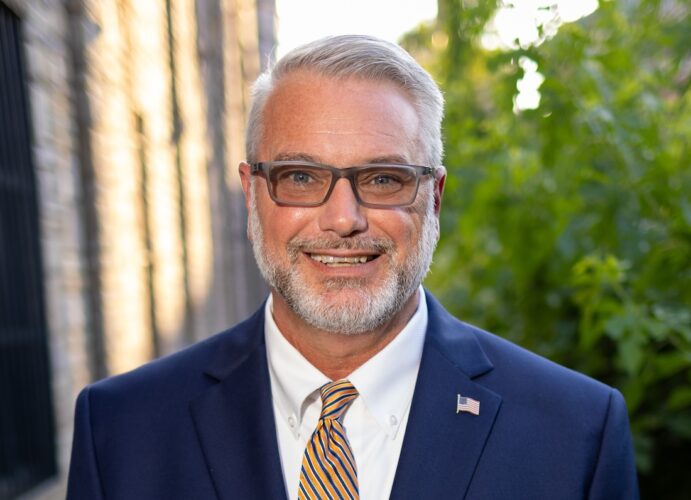
WILMINGTON — A civil engineer for McKim and Creed, Richard Collier is running for his first term on Wilmington City Council.
Though Collier has not held office, he has served the public — two terms on the New Hanover County Planning Board and he is on his third term with the Wilmington Planning Commission.
“Those roles have given me a front-row seat to the challenges growth brings, and how critical it is that we make decisions with foresight,” Collier said. “I’m running because I believe Wilmington needs more than politics — it needs problem-solvers who know how to get things done.”
The city council is a nonpartisan race, though Collier is affiliated with the Republican party. He’s up for one of three seats and running against him are: incumbents Luke Waddell (R) Clifford Barnett (D), and newcomers JC Lyle (D), Kelly Roberts (R), Cassidy Santaguida (D), and Chakema Clinton-Quintana (D). Sean Guerrero (R) will also appear on the 2025 municipal ballot, though he dropped out of the race earlier this month.
Collier told Port City Daily Wilmington is at “a turning point” with rapid growth and believes his experience can help prepare and shape the city.
“Our infrastructure, housing, and public safety systems aren’t keeping up,” Collier said. “I’ve spent my career as a civil engineer solving problems, building systems that work, and planning for the long term. I believe now is the time to put that experience to work for my community.”
Port City Daily asked all candidates a slate of questions about topics that are tracking high with voters and residents of Wilmington currently. Collier’s answers have been edited below for clarity.
A few things to consider this election season:
- A valid ID is required to cast ballot in North Carolina
- Election Day is Nov. 4, 2025, with voters required to go to their assigned precinct locations
- Early voting opens Oct. 16 and closes Nov. 1, and voters can cast a ballot at any of these four sites: Northeast Library (1241 Military Cutoff Road), Carolina Beach Town Hall’s Police Training Room (1121 N. Lake Park Blvd.), Cape Fear Community College’s McLeod Building, (411 N. Front St.), and New Hanover County Senior Resource Center’s Multipurpose Room, (2222 S. College Road). See all hours of operation here where you can also track the wait times at each early voting location.
- Anyone who wants to register to vote can do so here through Oct. 10 or register and vote in one stop during early voting
The paywall has been dropped on candidate profiles to help voters make informed decisions ahead of the election. Candidate opinions and statements are not a reflection of Port City Daily.
Port City Daily: What makes you qualified for a seat on council and sets you apart from other candidates?
Richard Collier: What sets me apart is experience where it matters most. For 30 years I’ve been a civil engineer, planning and delivering projects that shape how communities function—roads, stormwater systems, utilities, and developments. Right here in Wilmington, my work includes projects like Mayfaire and RiverLights, which required balancing growth with infrastructure, environmental protections, and community needs.
I also understand how city codes, zoning, and permitting work because I’ve lived them both professionally and as a planning commissioner. Too often, city council makes decisions without fully grasping how they impact the systems that keep our city running. I know where the gaps are, how to fix them, and how to make our policies more effective.
Other candidates may bring political or advocacy backgrounds, but I bring technical expertise and practical solutions. Wilmington doesn’t need more talk — it needs leadership that knows how to turn plans into results.
PCD: Homelessness continues to be debated among area leaders; what isn’t being discussed about it, in your opinion, that you think could help better steer its direction? Do you support implementing the former joint strategy that the city and county devised in September 2024? If not, why and what strategies do you think should be implemented? How much money would you support the city dedicating to the effort?
RC: Homelessness is one of Wilmington’s most difficult challenges, and I think too often the debate focuses on symptoms rather than root causes. Mental health, addiction, and lack of affordable housing all contribute, and unless we address those head-on, we’ll continue to see the same cycle.
I support elements of the joint city-county strategy adopted in 2024, but my concern is that it lacks clear accountability and measurable benchmarks. We need stronger partnerships with nonprofits, churches, and healthcare providers who are already doing good work on the ground. The city’s role should be to coordinate, streamline resources, and ensure services are connected — not to duplicate efforts or throw money at short-term fixes.
Funding is important, but so is accountability. I would support targeted funding to expand shelter beds, treatment options, and job training programs, but I would also insist on clear metrics: How many people are being served, how many are finding stable housing, how many are entering recovery or employment? Dollars without results won’t solve the problem.
Public safety has to be part of the equation, too. We must keep downtown and neighborhoods safe while showing compassion and providing a path forward for people in crisis.
PCD: In development conversations, the supply of housing and affordability are often at odds with residents’ desire to keep density low. How would you propose tackling these issues respectively? Do you think it’s possible for the city to satisfy both desires? Why or why not?
RC: It’s absolutely possible to pursue affordability while respecting neighborhood character, but it requires smart planning. Not every part of Wilmington is suited for high density — but some areas are. I believe we need to guide new housing toward corridors that already have infrastructure, transit, and access to jobs, while protecting established single-family neighborhoods from incompatible infill.
I support zoning reforms that allow accessory dwelling units (ADUs) and multi-family housing in targeted locations, paired with incentives for developers who include affordable or workforce units. At the same time, I believe we must hold developers accountable for quality design, buffers, and compatibility with surrounding areas.
The truth is, Wilmington’s housing shortage won’t be solved by saying “yes” to every project or “no” to all density. The answer is balance. We can expand supply, bring down costs, and preserve the character of our neighborhoods — if we have leaders willing to make thoughtful, long-term decisions.
PCD: What does balancing green space with development needs look like in your view, such as when it comes to protecting wetlands or rebuilding the tree canopy? Do you have examples of cities or developments that have done this successfully?
RC: Wilmington’s natural assets — our waterways, wetlands, and tree canopy — are part of what make this city so special. They’re not just nice to have — they’re critical for flood protection, storm resilience, and quality of life. Protecting them must be part of how we manage growth.
To me, balance means requiring developers to do more than just meet minimums. That means preserving tree canopy on site, investing in planting, and using best practices in stormwater management. It also means building more connected greenways and trails, so development and open space work together.
I’ve worked on projects where this balance was achieved. RiverLights, for example, incorporated buffers and stormwater systems that protected surrounding wetlands. Development can go hand-in-hand with greenway expansion, creating healthier, more resilient communities. Wilmington should take those lessons and build on them.
As an engineer, I know how to design with conservation in mind — and I’ll make sure that perspective is part of every decision city council makes.
PCD: With the Cape Fear Memorial Bridge price tag escalating to more than $1 billion, how to fund it also remains debated. Both a toll has been floated and a transit sales tax, which would need voter approval potentially in a tri-county referendum that could include multiple projects in New Hanover, Pender and Brunswick counties. Do you support either and/or is there another option you think should be considered to fund the bridge replacement?
RC: The Cape Fear Memorial Bridge is more than a Wilmington project — it’s a regional lifeline. It carries commuters, freight, and commerce that affect Brunswick, New Hanover, and Pender counties. That’s why its replacement must be approached regionally.
I do not support tolling the bridge. Families who already deal with traffic shouldn’t be asked to pay for something that should be a core public investment. Before asking voters for a sales tax, we should fully pursue any and all state transportation dollars and federal infrastructure grants.
If a sales tax is considered, it should be structured regionally and tied to multiple projects — not just the bridge — so voters in all three counties see the value. But my first priority will be collaboration. Wilmington must have a seat at the table in negotiations, but we can’t solve a billion-dollar project on our own. This will require coordinated advocacy at every level of government.
PCD: Traffic is a main complaint for Wilmington residents — how do you envision the city’s role in addressing it? Do you think the city should promote public transportation or the expansion of it? How so? Do you think the city’s current plan to maintain and improve the roads it owns is/will be effective?
RC: Traffic is one of the issues I hear about most from residents. As a civil engineer, I know firsthand how poor planning creates gridlock — and how smart planning can ease it.
The city’s role is twofold: coordinate closely with NCDOT and the WMPO to ensure state-funded projects align with local growth, and invest directly in the roads, sidewalks, and intersections we control. Simple improvements — like synchronized signals, turn lanes, and roundabouts — can make a big difference.
I do believe public transportation should play a bigger role, but it has to be flexible. Fixed-route buses alone won’t meet Wilmington’s needs. We should pilot microtransit, shuttle services, and better connections to the airport, job centers, and UNCW. Expanding bike and pedestrian networks is equally important to give people safe, sustainable alternatives to driving.
The city’s current road plan is a step in the right direction, but without stronger coordination and investment in multimodal options, it won’t be enough. We need leadership that understands how transportation systems work — and how to design them for the future.
PCD: With a new police chief starting his post for the Wilmington Police Department, what areas would you like to see him focus on to strengthen public safety and create a sustainable workforce? Explain.
RC: Public safety is the foundation of a thriving city. I’d like to see our new police chief focus on three things: rebuilding morale inside the department, rebuilding trust outside of it, and building stronger partnerships with other agencies.
Inside the department, we need to address retention and recruitment. That means competitive pay, but also leadership that supports officers and gives them the tools they need. Outside the department, we need more community policing — foot patrols, bike patrols, and stronger engagement in neighborhoods. People are more likely to trust officers they know.
Finally, coordination with the district attorney’s office is critical. Targeting drug-related crime and repeat offenders requires both agencies working in lockstep. If we want a sustainable police force, officers must feel supported, residents must feel protected, and the system must deliver real results.
PCD: As the city continues to see an influx of residents, how do you think city council should ensure Wilmington’s economy keeps pace and opportunities remain varied across all ages and types of households? What can the city do to ensure its residents have a high enough wage to afford life in Wilmington?
RC: To keep Wilmington’s economy strong, we need a strategy that supports both existing businesses and emerging industries. The port is one of our greatest assets, and I’d like to see continued investment there. At the same time, we should promote advanced manufacturing, technology, and small business growth by cutting red tape, streamlining permitting, and ensuring infrastructure — roads, water, and broadband — keeps pace.
We also need to focus on workforce development. I’ll support partnerships with Cape Fear Community College and local employers to align training with 21st-century job needs. A strong economy is one where residents don’t just have jobs — they have careers with wages that allow them to live here.
Finally, growth must be balanced. Economic investment shouldn’t just go downtown or to certain corridors — it should benefit neighborhoods across the city. A rising tide must lift all boats.
PCD: Some residents have accused the city council of only representing a select few in the community, rather than the needs of all. Do you agree with this sentiment? Explain. What would you do in a leadership position to represent more equitably?
RC: I’ve heard that concern and I think it’s fair. Too often, residents feel like decisions are made for developers, insiders, or a select few, rather than for the community as a whole. That perception erodes trust in local government.
If elected, I’ll work to change that. Transparency and communication will be priorities. That means engaging neighborhoods earlier in planning processes, explaining the “why” behind decisions, and listening to feedback — even when it’s critical.
On the planning commission, I’ve seen firsthand how important it is to make residents feel heard. People don’t expect to win every debate, but they do expect honesty and fairness. If I bring anything to this role, it’s the commitment to represent all of Wilmington — not just the loudest voices in the room.
PCD: What is one other issue not discussed above that you have a plan to address if elected and how would you do so?
RC: Stormwater and flooding don’t make headlines every day, but they affect every resident. Wilmington’s stormwater systems are aging, and they weren’t designed for today’s growth or the frequency of severe storms we face. That’s a recipe for flooding, property damage, and public health risks.
As a civil engineer, I’ve spent my career designing stormwater systems and green infrastructure solutions. On city council, I’ll push for strategic investments that combine traditional infrastructure with sustainable practices, like permeable pavements, rain gardens, and natural buffers.
This isn’t just an environmental issue. It’s an economic one. Flooding hurts businesses, homeowners, and taxpayers. Addressing it now will save money and protect property in the long run. My focus is on building a city that’s resilient, not just for today, but for decades to come.
Have tips or comments? Email info@portcitydaily.com
Want to read more from PCD? Subscribe now and then sign up for our morning newsletter, Wilmington Wire, and get the headlines delivered to your inbox every morning.
