


https://www.youtube.com/watch?v=w0TCbUQwTrI&feature=youtu.be
Marine technology students at Cape Fear Community College (CFCC) received a hands-on lesson Wednesday on what to do during an emergency at sea.
According to Jason Rogers, chairman of CFCC’s marine technology program, the demonstration taught students what to expect in case of an emergency at sea and provided students with hands-on experience with the life raft and equipment.
Students who participated in Wednesday’s demonstration are in their first semester in the program. And part of their curriculum includes a boat handling and seamanship course.
Students in the course “work on handling boats and driving boats–learning the rules of the road on the water,” Rogers said. “But they also get familiar with all the safety procedures that are required while we’re underway. That would be things like man overboard, fire, and what we are seeing today…an abandoned ship.
“Part of an abandon ship drill would be to deploy the life rafts….the procedures that are required, how to safely get the raft inflated and then, of course, how to board it.”
Led by Steve Beuth, captain of the college’s research vessel the R/V Cape Hatteras, students ignited signaling flares and smoke canisters before the raft was inflated. The life raft is designed to hold up to 25 people and inflates in less than 30 seconds.
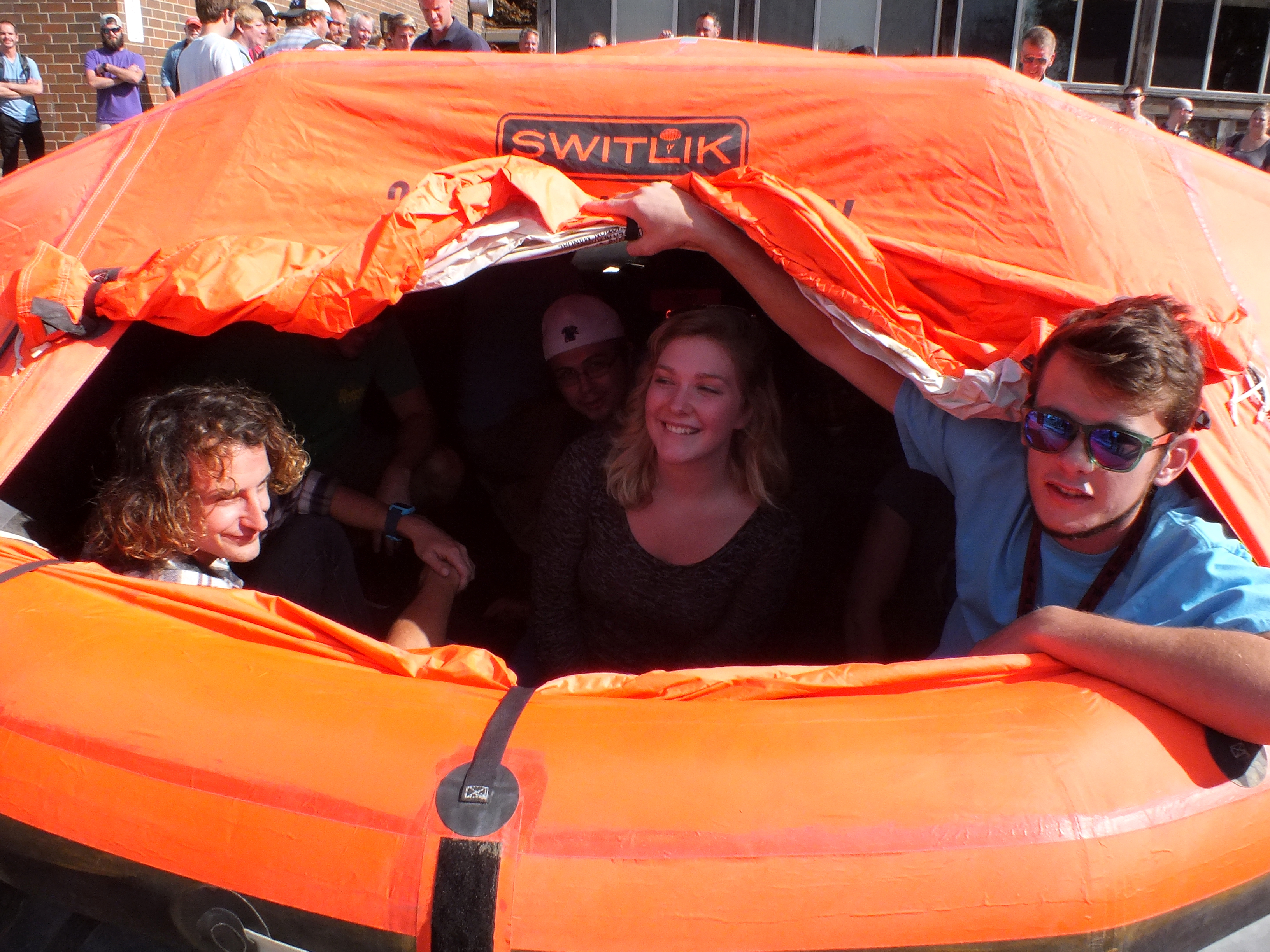
“So it’s easy to talk about life rafts and how to deploy it but we would much rather show them how they are deployed,” Rogers said.
Rogers said the life raft used Wednesday was for demonstrational purposes only. Two identical life rafts are on board the R/V Cape Hatteras and are only used in emergencies at sea.
In an emergency situation, the raft would contain food, blankets, first aid supplies, fishing equipment, a desalinization kit and “anything that you would hope to have on board, if you needed to survive at sea for a long period of time,” Rogers said.
The Marine Technology program takes students out to see as far north as Baltimore, Maryland, and as far south as Nassau, Bahamas, according to Rogers. During training voyages, students are underway for 10 days at a time.
Every student in CFCC’s Marine Technology program spends a total of 32 days at sea over a period of two years, according Hardin. More information about the Marine Tech program click here.
