


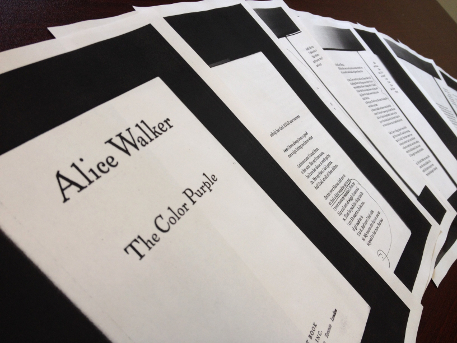
The head of Brunswick County Schools has upheld an earlier decision to keep “The Color Purple” as part of the district’s curriculum.
But the debate has not ended there.
In response to an appeal filed by Brunswick County Commissioner Pat Sykes, Superintendent Dr. Edward Pruden issued a letter defending the inclusion of the Pulitzer Prize-winning novel by Alice Walker.
Sykes immediately challenged Pruden’s decision on Dec. 11 and, following district guidelines, the issue will now go to the board of education for consideration during a special meeting at 10 a.m. Jan. 3 at central office.
Sykes–the only person to file an official complaint since public debate about the book began in October–called “The Color Purple” pornography and took issue with the strong language, including the use of the “N word.”
That complaint, filed Dec. 1 at West Brunswick High School, was reviewed by a team of educators there. After considering her argument and reading the novel, the panel decided to keep it on the bookshelves.
District policy requires that such complaints start at the school level but allows for appeals to be made to the superintendent and, ultimately, the school board.
In his response to Sykes, Pruden acknowledges that “The Color Purple” covers heavy subject matter and includes profanity.
“Admittedly, ‘The Color Purple’ contains graphic descriptions of sexual acts, sexual abuse, physical and emotional abuse and violence. It is a book for mature readers and would certainly not be appropriate for children,” he wrote.
But, he added, with any controversial reading material, a school system must consider the “educational value” of the book and any “unique qualifiers” for inclusion in the curriculum, as well as who plays a role in the selection of the literature and at what age it could be appropriate.
“Regarding educational value, ‘The Color Purple’ was awarded the Pulitzer Prize for Fiction in 1983, as well as the National Book Award for Fiction…Scholars cite the book as an exemplar of the following literary elements: language, mood, narrative structure, syntax, theme and tone. It is also celebrated for its use of allusions, irony, flashbacks and foreshadowing,” Pruden argued.
He said many groups–including the National Council for Teachers of English, the American Library Association, the North Carolina Department of Public Instruction, The College Board (which publishes Advanced Placement Exams) and the district’s team of English teachers and school library media coordinators–weigh in on decisions to include a book like “The Color Purple.”
“The consensus among educators regarding the age at which ‘The Color Purple’ would be appropriate is the upper levels of high school, for students at least 16 years old. Our school system’s practice is consistent with this advice,” Pruden noted.
As in “The Adventures of Huckleberry Finn,” another oft-challenged novel, he said “The Color Purple” uses profanity for a purpose, not simply to “offend” or “degrade.”
“Mark Twain used the ‘N word’ to faithfully convey the dialect and culture of the time, and in doing so exposed the moral evil of slavery to his readers,” he said. “Similarly, the ‘F word’ is used in ‘The Color Purple’ to accurately portray the operant culture and the powerlessness and marginality of the main character and others caught in similar circumstances.”
Read Pruden’s letter in its entirety here.
Since the matter remains in the appeals process, Brunswick County Schools Spokeswoman Jessica Swencki said district leaders could not comment on it and have declined requests for interviews.
On Wednesday, the National Coalition Against Censorship submitted a letter to the Brunswick County school district, urging the board of education to “resist pressure to censor from someone who finds a book offensive and to stand by the professional judgment of district educators, who selected the work because of its literary and educational merits.”
In that letter, the organization argues that it is unconstitutional for school boards to ban reading material on any ground other than an educational one, citing that Supreme Court ruling in the 1982 case, Board of Education, Island Trees Union Free School District No. 26 v. Pico.
Previous story: ‘The Color Purple’ at the center of fierce debate in Brunswick County schools
Hilary Snow is a reporter at Port City Daily. Reach her at (910) 772-6341 or hilary.s@hometownwilmington.com.
