


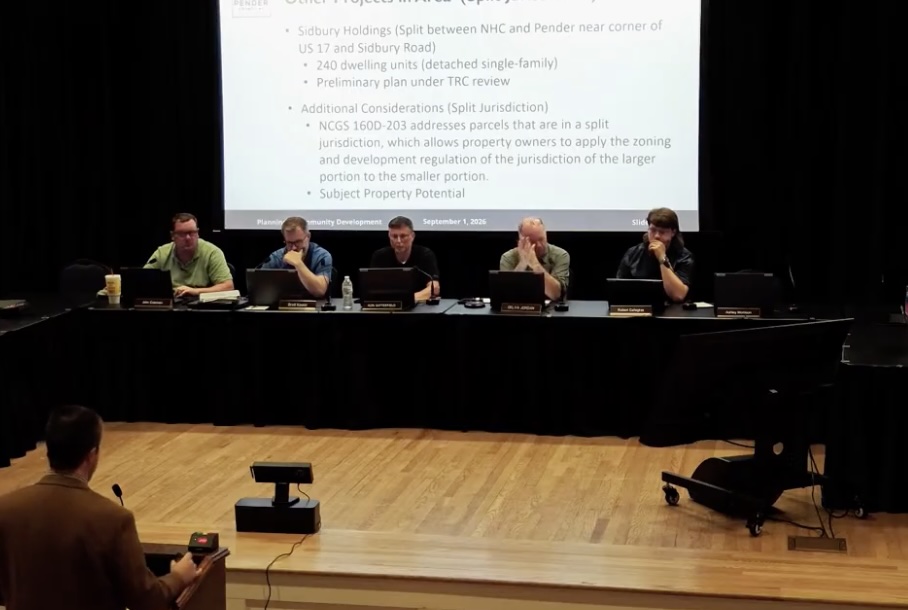
PENDER COUNTY — An age-restricted residential community took up the majority of the planning board’s discussion in Pender County on Tuesday. McAdams Homes requested a conditional zoning district from rural agricultural to bring almost 1,000 homes to northern Sidbury Road, though most board’s members weren’t on board with recommending commissioners agree to the request.
The developer wants to build 930 single-family homes on 404 acres of land, located roughly 2 miles from U.S. 17 and Sidbury Road. Representing McAdams Homes was Amy Schaefer of Lee Parker Kaess — co-owned by Sen. Michael Lee (New Hanover County) — who presented the plan to the planning board.
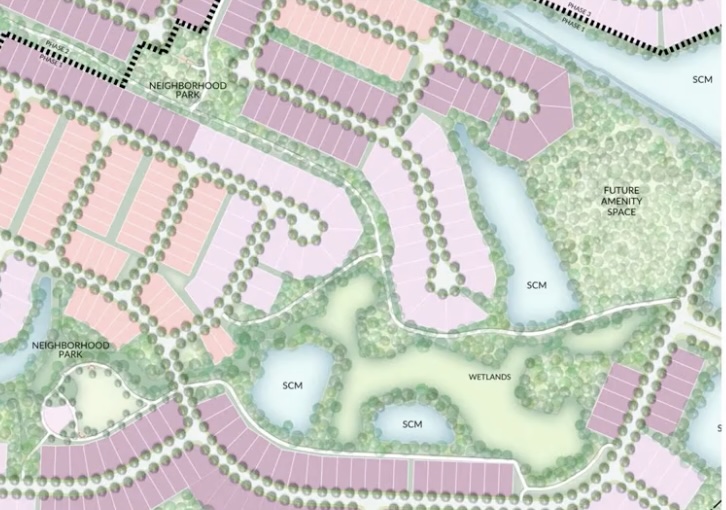
Despite surpassing the open space requirement by 40%, clustering homes away from flood zones and wetlands, and decreasing traffic counts by 54% compared to a conventional neighborhood, the planning board remained apprehensive about infrastructure needs to accommodate more units in an already highly developed area.
READ MORE: More than 1K new homes could be coming to Pender County
ALSO: State GOP dismisses complaint against commissioner appointment in Pender County
“My concern in the county right now is we can’t take much more in density,” board member Brett Keeler said.
He made the motion to recommend commissioners deny the rezoning request, followed by a 3-2 vote, with John Coleman and Ron Satterfield dissenting.
Currently, the parcel is zoned rural agricultural, which would allow 1 unit per acre, to bring in an estimated 344 homes. Though McAdams Homes unit count more than doubles, with 2.3 dwelling units per acre, with its conditional zoning request, the project still comes in less than what could be developed at the highest density there, according to the Pender County 2050 Future Land Use Plan. Between 3 and 6 dwelling units per acre are recommended on the site and could bring up to 2,300 homes, Interim Planning Director Justin Brantley informed the board.
Schaefer said McAdams’ proposal fits in with surrounding properties, too. Lots around the acreage are primarily zoned planned development, allowing up to 6 units per acre. Across Sidbury Road in nearby New Hanover County, the properties are zoned R-15 for 2.5 units per acre by-right.
The project appealed to Satterfield due to conditions the applicant was willing to make: ensuring the project remains for 55-and-up only, which will be placed in covenants on the land deed. Thus, even if the project stalls or doesn’t move forward, the zoning is permanent for an age-restricted project unless someone comes before the board and commissioners again to ask for a change.
This matters since an age-restricted community provides less strain on schools and traffic, in particular.
“With the opportunity to address conditions, we can have this open conversation now,” Satterfield said, noting it allows the board to better direct growth.
Traffic was a high point of discussion during the meeting. Brantley verified the community brings a 50% traffic decrease when compared to building out a conventional 344-lot development under rural agriculture. The conventional neighborhood is poised to bring in 7,771 vehicle trips per day; 536 of them would take place during both morning and evening peak hours.
Traffic diminishes to 3,562 daily trips with a cumulative 448 peak-hour trips under McAdams’ proposal. This is because built-in amenities and organized clubs all take place inside the 55-and-up community, by proxy creating less driving requirements.
“And those aren’t our numbers,” Schaefer said. “Those are numbers we got from NCDOT.”
Brantley noted the traffic impact analysis hasn’t been fully executed yet but will dictate whether the developers will have to make road upgrades. However, he pointed out North Carolina Department of Transportation is continuing its superstreet design in Scotts Hill — a series of dual left U-turns rather than allowing normal intersections. Of course, the Hampstead Bypass also remains under construction.
“This area is in need of major road improvements to help support this growing population,” Brantley said, adding the capacity numbers provided by NCDOT and the Wilmington Urban Area Metropolitan Planning Organization are two years old.
They indicated Sidbury Road was 50% full in 2024, with capacity at 11,000 vehicles daily. U.S. 17 at the Sidbury intersection, located near the New Hanover County line, has almost 50,000 vehicles traveling there daily — over capacity by 7,000 cars currently.
But these numbers don’t take into account developments recently approved or under construction, Brantley added. He listed six projects alone in this region of Pender County bringing in more than 4,500 units, while nearby in New Hanover County another 4,500 are in progress.
Satterfield asked the status of the full TIA and whether there is any guarantee that impacts from the development will be mitigated, whether through additional turn or decelerations lanes or traffic lights.
“Well, NCDOT will tell us what they are and will make requirements or we won’t get a driveway access permit,” Schaefer said.
Planning board member Delva Jordan was not bowled over by using two-year-old numbers: “There are a lot of mitigating circumstances.”
The project is expected to be built out over five years, with a tax revenue estimated to be $4.4 million locally and the tax value of the development at more than $550 million annually.
“And these are conservative estimates,” Schaefer said, noting age-restricted communities often bring four or five times higher tax revenues due to less service demand.
Keeler combated the notion, stating it may cost the county more in the long run to provide more services to more people.
“It also could take an ambulance longer to get to the back of that 400 acres than it is in a neighborhood built with roads, so I don’t know that the extra density is going to impact the services you’re talking about,” she countered.
Satterfield brought up only one access into the development, which also may hinder emergency services. He said though the developers show three potential stub outs connecting to other developments, those projects aren’t online yet.
“They may be constructed before we get there,” Schaefer said. “I can’t say they won’t be any faster than we are.”
Schaefer focused on the neighborhood’s amenities, noting it will lessen the burden on county parks and rec facilities. For instance, walking trails, a fitness facility, pickleball and tennis courts, outdoor lounge and grill areas, a pool and more are on the table. What will be built exactly is dependent on who the contractor will be, though Schaefer anticipates them to be among the top 10 publicly traded national builders for senior living.
She added the amenity package alone will top out around $20 to $25 million and will be built as part of phase one — something Satterfield asked to also be conditioned in the approval. Schaeffer agreed.
“Sometimes we hear developers make promises on this stuff and things change and they get left off,” Satterfield said.
Schaefer added the proposal isn’t expected to generate a significant impact to the school system. The attorney for McAdams stated they referred to the National Education Center for Statistics to pull data, noting around 4.7% of an age-restricted community of 55-plus households may be parents.
“There may be a very limited number of students generated from this neighborhood, but it’s not typical,” Schaefer said.
Keeler asked Brantley, per the board vote, how much weight should be given to the project being 55-and-over and more so how binding it is. He worried developers could change their minds and could come back to ask for only a quarter of the houses to be age-restricted.
Brantley said there is no guarantee that every unit is 55 and up, but that’s the intent of the product. He couldn’t speak to the Fair Housing Act; however, there is a legal exemption, Housing for Older Persons Act, which developers of 55-and-up communities follow for compliance.
Keeler clarified further that homes in the development needed to follow the 80/20 rule, per HOPA: 80% of the development would need to have at least one person in the household aged 55 and up. He worked out the remaining 20% math to equal 186 units being owned by any age group.
Further, he asked if the data on lessening the burden on schools and traffic was made by accounting for 100% of the homes lived in by ages 55 and up, rather than following the 80/20 rule. Schaefer said they followed the federal guidelines.
Still, Keeler pointed to healthcare service needs of an older population. Though he acknowledged the recently opened Scotts Hill Medical Center, as well as a certificate of need that Novant has applied for to bring a standalone emergency department to the Hampstead area, he thought Pender County was stressed in this area.
“That doesn’t take away the fact we still need providers here,” he said.
“Wilmington Health is looking to rapidly expand in the northern part of the area,” Schaefer added. “I do think it will be adequately accounted for.”
County staff recommended approval to the planning board. Among varied reasons, they listed optional housing types as a plus — the development has three lot sizes between 41 and 65 feet — and the age-restricted community would be less of an impact than a conventional neighborhood. It also meets the comprehensive and future land use plans and promotes healthy outcomes for people to age in place, while bolstering connectivity and remaining compatible to nearby developments.
The board recommended commissioners deny the project due to density and infrastructure concerns. The Pender County Board of Commissioners could take up the proposal by mid-October, according to Brantley.
At Port City Daily, we aim to keep locals informed on top-of-mind news facing the tri-county region. To support our work and help us reach more people in 2026, please, consider helping one of two ways: Subscribe here or make a one-time contribution here.
