


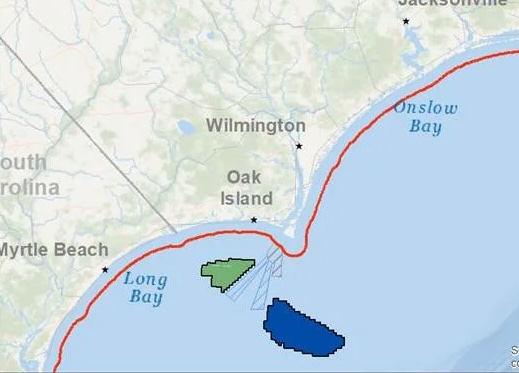
SOUTHEASTERN N.C. — The U.S. government has offered a French energy company a billion dollars to abandon two offshore wind leases along the East Coast, including one in Brunswick County. In a deal to stop the clean energy source from being developed, the Trump administration settled with TotalEnergies to invest in natural gas infrastructure instead in Texas.
TotalEnergies agreed to vacate leases in North Carolina and New York, after paying around $1 billion in fees to obtain them. This year the company will turn its attention toward construction of the 29 Mt Rio Grande Liqueified Natural Gas plant, develop shale gas production and upstream conventional oil in the Gulf.
READ MORE: Offshore wind developers, conservation groups collaborate to protect birds
Once complete, the Trump administration will reimburse “dollar for dollar” the amount spent on the leases: $133 million for Carolina Long Bay and $795 million for the Bight lease in New York, the latter of which was awarded to TotalEnergies’ subsidiary, Attentive Energy LLC.
“Under this innovative agreement driven by President Donald J. Trump’s Energy Dominance Agenda, the American people will no longer pay for ideological subsidies that benefited only the unreliable and costly offshore wind industry,” a press release from the Department of the Interior explained.
Wind is the largest clean renewable source, making up 10% in 2025 and surpassing coal for the first time.
DOI referred to wind farms as “unreliable,” while the president has often called the clean energy source overpriced and the installation of turbines ugly. During the first day of office in his second term, Trump signed an executive order to freeze new federal wind permits. Then in last year’s “Big Beautiful Bill,” he sheared tax credits that made offshore wind production projects viable. He also has tried to use classified national security threats to institute stop-work orders on projects under construction, but these measures have ultimately failed in court.
DOI Secretary Doug Burgum called the TotalEnergies deal a “win-win” for Americans, while Attorney General Pam Bondi said it “prioritizes affordability for hardworking American consumers over the prior administration’s ideological, ineffective energy policies. Americans will benefit from this significant investment in our energy industry, which will also enhance our national security and grid reliability.”
The settlement comes as the Iran war’s disruptions of oil supply continue to escalate. Fuel prices have surged by 60% in the last month, with barrels trading for upward of $100 or so, compared to the low $60s in January this year.
“Furthermore, these investments will contribute to supplying Europe with much-needed LNG from the U.S. and provide gas for U.S. data center development. We believe this is a more efficient use of capital in the United States,” Patrick Pouyanné, chairman of the board and chief executive officer of TotalEnergies, said in a release.
TotalEnergies was founded in 1957 to produce and market oil and biofuels, natural gas, biogas and low-carbon hydrogen, renewables and electricity. Under the Biden administration, the company was poised to install windmill infrastructure in North Carolina, located around 20 miles off the coast of Bald Head Island.
In 2022, Port City Daily reporting indicated some Brunswick County communities opposed the installation of wind turbines in Carolina Long Bay. Officials from Bald Head Island, Ocean Isle Beach and Sunset Beach expressed they would be an “eyesore” to their tourist-centric towns. The turbines’ proposed distance was further out and eliminated such concerns, though wildlife groups also expressed worry over protecting avian populations.
The wind lease in Carolina Long Bay would have generated 1.3 gigawatts of power, enough to supply electricity to 300,000 or more homes, according to the Southeastern Wind Coalition.
In addition to TotalEnergies, Duke Energy Renewables also had a lease agreement in Carolina Long Bay; however, according to reporting last year from WUNC Duke decided it was too expensive to build out currently.
Both wind farm leases were poised to support 37,000 jobs, $3 billion in annual wages, $233 million in tax revenue, and $44 billion in capital investment during construction.
Southeastern Wind Coalition’s president Katharine Kollins spoke against the settlement in a release from the organization. She noted North Carolina would experience an “eight-fold demand” in electricity needs by 2040, with natural gas providing 50% of the energy mix by 2034.
According to the U.S. Department of Energy, wind boasts a lower lifecycle cost and almost 99% lower carbon emissions. Wind leases also are immune to commodity swings unlike liquified natural gas, which is often affected by increased fuel-price volatility, pipeline constraints and basis premiums.
“At a time when electricity demand is surging and grid reliability is under increasing strain, canceling offshore wind projects already under development puts North Carolina’s clean energy economy at risk,” Kollins said in a press release. “We have seen firsthand how offshore wind has bolstered the U.S. grid this winter by providing zero cost fuel during extreme winter weather that caused other fuel prices to spike. Now is the time to be expanding our options, not taking them away.”
The Carolina Long Bay and New York Bight leases were awarded in 2022. Since then, TotalEnergies stated it has invested $12 billion “to accelerate development in oil, LNG, and electricity.”
Recently, the company also signed a letter of intent with lead developer Glenfarne of the Alaska LNG project, to offtake 2 million tons per year of liquefied natural gas over the next two decades. This is subject to the project’s final investment decision.
At Port City Daily, we aim to keep locals informed on top-of-mind news facing the tri-county region. To support our work and help us reach more people in 2026, please, consider helping one of two ways: Subscribe here or make a one-time contribution here.
We appreciate your ongoing support.
