


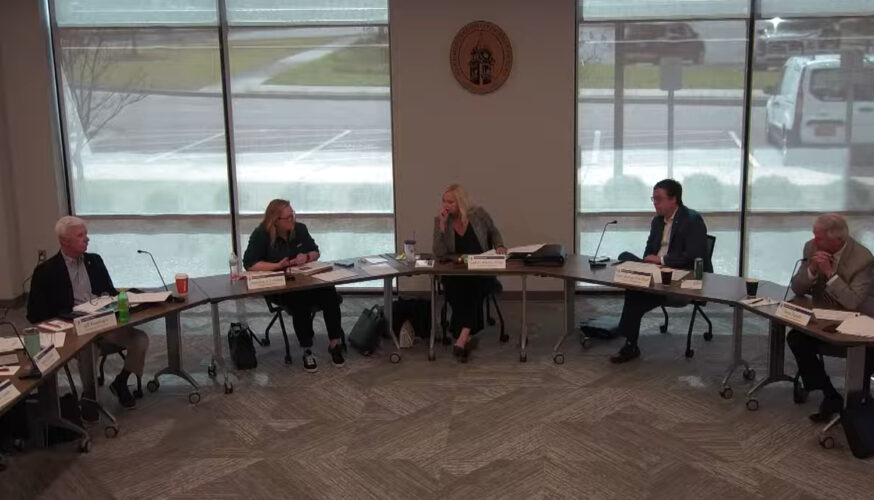
NEW HANOVER COUNTY — New Hanover County commissioners’ tax rate reduction last year, resulting in millions of dollars in service and staff cuts, continues to haunt the board as staff search for ways to fill the $4 million-deficit left in the 2026-2027 budget.
“We are several million dollars off balance based on just the continuation [budget] that we have and the assumed revenues,” County Manager Chris Coudriet said Thursday at the commissioners’ first budget work session of the year.
READ MORE: NHC cuts $36M and 70 people to downsize tax rate, abandons pre-K, food co-op
Later in the meeting, Commissioner Dane Scalise asked Coudriet to elaborate, in which the county manager clarified the deficit is around $4 million, even accounting for a projected 2.5% increase in the county’s property tax base and 1% increase in sales tax.
Thursday was the first budget session of the year and the budget doesn’t have to be balanced until the county manager’s recommendation, required to be presented by June 1.
There are essentially three ways to shore up that funding: cut services, raise the tax rate to bring in more revenue, or find other revenue sources to pull the money from. The county has two unique funds — the $50 million Mental Health and Substance Use Disorder Fund and $300 million Revenue Stabilization Fund — both created from the sale of the New Hanover Regional Medical Center to Novant in 2021. It used both for the current fiscal year budget and is proposing to do so again next year.
Last year, the county commissioners approved a budget 3-2, Democrats Rob Zapple and Stephanie Walker dissenting, to set the tax rate at 30.6 cents — the fifth lowest county rate in the state.
The rate reduction was made possible by a 67% rise in property revaluations on average and was set as close to revenue neutral as commissioners could muster, a goal of the Republican majority to reduce impact to tax bills. A revenue-neutral rate is calculated based on the rate needed to bring in the same amount of money as the prior year’s budgeted amount.
What complicated matters was the commissioners had approved more spending than budgeted in the 2024-2025 year. Essentially, it meant the county needed more than the revenue-neutral rate. The county manager’s recommended budget suggested a tax rate of 35 cents.
Still, the Republican majority — Scalise, LeAnn Pierce and Bill Rivenbark — pushed for a lower rate, resulting in the need for cuts. The county offset the cuts by paying for some items health and human services items from the Mental Health and Substance Use Disorder Fund and balancing its bottom line with the Revenue Stabilization Fund.
Commissioner Scalise called using these funds, plus the county’s fund balance, as an “artificial” lowering of the tax rate — essentially saying the county was using non-recurring funds instead of living within its means. He voted in favor of using the funds anyway.
At Thursday’s meeting, County Manager Coudriet said he does not plan to bring a tax rate forward in his recommended budget for the 2026-2027 fiscal year unless directed to do so by the board majority. He didn’t indicate he’s identified areas to do major cuts either.
Additionally, departments have submitted enhancement requests — increases to their budgets for additional services or staff. These are aside from the inflationary increases that contribute to the need for more revenue than the current fiscal year.
Chief Financial Officer Eric Credle told Port City Daily the total enhancement requests this year were “relatively low” at $3.3 million total among all funds, though only $2.3 million would come from the general fund.
The county shared with Port City Daily some enhancement requests are being assumed into the working budget and are already factored into the $4-million deficit. Port City Daily asked the county what the enhancements were and for the dollar amount they represent; Credle said the enhancements had yet to be finalized, though they would be discussed at the next budget work session in April.
In addition to departmental requests, commissioners Zapple and Walker indicated Thursday they would like to see some budget lines cut last year make a return, including the county’s $3-million annual affordable housing commitment and around $1.6 million in non-county agency funding. Coudriet said he would need the majority of the board to agree to add them back, as he understood them as permanent policy changes.
Though both voted in favor of doing away with both funding priorities last year, Scalise and Chair Pierce did not shut down the idea of bringing both the affordable housing and non-agency commitments, but noted they would prefer to do so at a later date.
“I’d like to get a better read on the totality of what we’re looking at before we start picking off individual priorities,” Scalise said in the meeting.
Regarding the third funding option — pulling from other sources — the county could use its fund balance again. But, after spending $8.1 million from it for the current fiscal year, Coudriet indicated staff were avoiding this option.
County staff have calculated $10 million will be pulled from the Mental Health and Substance Use Disorder Fund for next fiscal year, approximately $1 million in interest earnings and the rest pulled from the corpus, or principal amount. This is similar to the amount pulled last year to cover school nurses and mental health therapists, along with other programs, though county staff warned last year the continued use of the fund’s corpus in this manner would deplete it within a few years.
Additionally, interest earnings from the Revenue Stabilization Fund will also be used, consistent with the $6.6-million budgeted for this fiscal year. The fund’s corpus will remain untouched.
The county’s access to these funds — representing almost $17 million diverted from the general fund — is key to balancing its budget if commissioners want to keep the same tax rate.
The $10 million from the Mental Health and Substance Use Disorder Fund and $6.6 million Revenue Stabilization Fund are already calculated into the $4-million deficit, thus, closing the gap further would require more money to be taken out.
Additionally, Credle noted the county would need to issue debt for small capital items, despite shifting to funding them with cash-on-hand last year, in order to preserve the county’s debt capacity for larger needs and reduce interest payments. In July 2025, the county’s debt capacity for the current fiscal year was a little more than $100 million.
Though the budget session was overall a high-level look, staff did delve into some specific streams including potential increases to stormwater and tipping fees.
Landfill
Operating outside of the general fund, the recycling and solid waste department collects tipping fees for the county’s municipalities, private haulers and residents to dispose of their garbage at the landfill. The fee for run-of-the-mill waste is $52 per ton, inclusive of a $2 state surcharge; the rate has not been increased in three years.
The county has proposed moving to a $61 fee to accommodate decreasing availability of current landfill space plus more customers, the increase of heavy equipment costs by 30% since 2020 and the long-term liability for PFAS contamination gradually shifting to landfills.
The tip fee has been on the decline since fiscal year 2013-2014, when it was $59; by fiscal year 2017-2018 it was $48, where it remained until it was raised to the current rate in fiscal year 2022-2023.
“Why did we reduce it every year and not stay competitive?” Pierce asked, pointing to Brunswick County’s rate of $59 and Pender County’s rate of $78.
Coudriet noted it was a policy decision commissioners made, motivated by taking some cost burden off businesses and customers.
Zapple, who has been a commissioner since 2014, explained their thinking.
“Those years we were reducing the tip fee, rarely, if ever, did any of the private haulers pass that along to the public, which is a real frustration. We were doing our job by pushing that down, and it was not getting passed on,” Zapple said. “However, on the flip side, when we raise it $9 a ton, we’re darn sure they’re going to pass that on.”
However, the fund could not continue to operate at the current rate, Coudriet said, without an increase or cutting services. The department already used $3.8 million in from its fund balance in the current fiscal year.
Zapple noted he would like to see the county ask private companies not to pass on the cost to customers, though he conceded the county didn’t have much control over whether they would. The City of Wilmington makes up around half of the tonnage being dumped and the beach towns another 10%.
The commissioner also noted some communities use pay-per-weight on a household basis, with some families having to pay more for disposing of more trash. Zapple indicated the county may need to explore that model in the future.
Stormwater
Staff did not propose an increase to the county’s stormwater fee, though some commissioners wondered if they should, considering the capital projects in the pipe and looming concerns over stronger storms and higher flooding.
Zapple pointed to the county’s mapping of its stormwater system and outflows into water sources for deficiencies or areas for improvement. The stormwater department has mapped more than 600 miles so far, but is two-thirds of the way through.
“We don’t know what the extent of the problem is,” Zapple said. “We knew we had a problem after Hurricane Florence, which is what kind of brought this up. I think that our fee that we’re charging — $6.14 — is very, very modest for something like a big bang for our buck. We have yet to have a major hurricane, which I am thrilled about, but one day it will come again.”
The county also has 12 capital projects planned, including the $1.5 million Courtney Pines culvert, which will use a portion of the department’s fund balance.
The county also plans to continue its data collection with a Motts Creek watershed study, Pages Creek streambed assessment (grant-funded) and infrastructure condition assessments. Planning studies for Ivy Woods and Rockhill Road watersheds are also on the horizon. Plus, 15 future projects need designing.
As an enhancement request, the department is also looking to convert two contracting positions into two permanent staff.
Despite the work planned, Coudriet said they didn’t anticipate a need for a fee increase.
“We have nothing signaling that it’s too low at this time,” he said.
Coudriet suggested the board was looking for a “deep dive” into the county’s stormwater plan; some commissioners agreed that would be beneficial.
“What I hear out in the community, and since I’ve been an elected official for 12 years, stormwater stormwater, stormwater has been one of the biggest issues that people talk about,” Pierce said.
Still, Scalise initially pushed back, noting no deficiency in the plan had been brought forth, but later agreed a briefing would be beneficial.
Staff agreed to present the current plan at an upcoming meeting; after, commissioners can evaluate whether changes to the plan itself and, thus, the stormwater fee, should be made.
The county’s next budget session will take place in April and further details on enhancements will be discussed. Staff are hosting a Brewing Budget public feedback session on Tuesday, March 17, from 10 a.m. to 11:30 a.m. at the Pine Valley Library.
[Ed. Note: Commissioner Dane Scalise’s quote has been updated to include “picking” rather than “taking” off individual priorities. PCD regrets the error.]
Reach journalist Brenna Flanagan at brenna@localdailymedia.com.
At Port City Daily, we aim to keep locals informed on top-of-mind news facing the tri-county region. To support our work and help us reach more people in 2026, please, consider helping one of two ways: Subscribe here or make a one-time contribution here.
We appreciate your ongoing support.
