


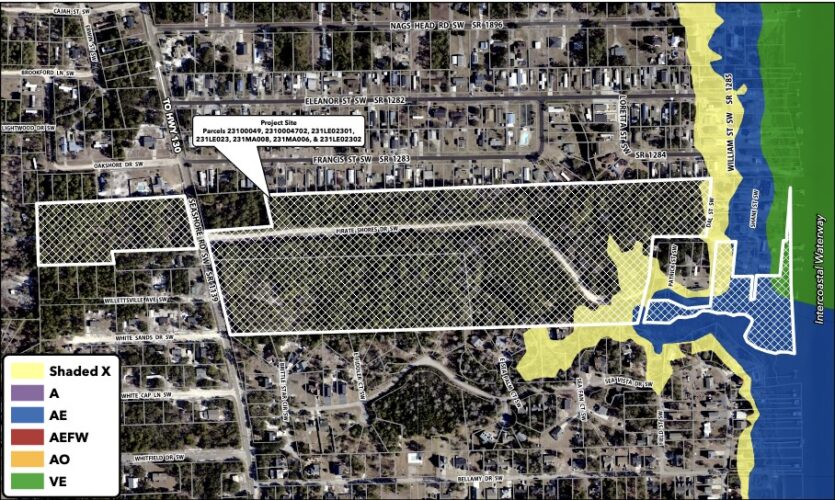
BRUNSWICK COUNTY — A planned development was approved by the planning board in Brunswick County last week that will usher in 168 new homes in Supply.
READ MORE: 140-room hotel cleared by Carolina Beach planning board, council votes in November
The multi-family complex, Bayshore, is planned for 46.64 acres near Seashore Road, by Harbor Town Investments LLC. It will feature 140 single-family lots, 22 semi-attached units and the rest townhomes. The zoning is MR 3200 (high density, multi-family residential), which allows 13.6 dwelling units to be built per acre, but Bayshore will bring an overall density of 3.6, coming in under the threshold.
Sam Franck, with Ward and Smith, represented the applicant and had G3 Engineering and Surveying’s Bruce Robinson and TBM Partners’ Joe Cebina on hand to answer questions as needed.
According to Franck, the property was previously approved to be Saltbox Bay, also from Harborr Town Investments LLC, for 154 single-family homes on 30 acres. But it expired due to no action taken by the developer.
Franck boasted the new development’s density is 75% less than what’s allowed by-right — which would be more than 500 homes under the current zoning.
In addition to the homes, 1.9 of Bayshore’s acres will be reserved for a commercial component. A boat storage facility will be included, with lifts available to residents only, not the public.
Franck and Robinson pointed to its exceptional design elements, with 15.8 acres of open space, above the county’s requirement of 13.9. Some open space will surround the boat storage from nearby properties to provide more of a buffer. There also will be a 250% increase in recreational space — 5.3 acres versus the 2.1 needed.
“Some of it will be pathways built around the ponds and an additional dog park,” Robinson said.
Five ponds will be on the site to help with stormwater runoff, created to suit a 100-year storm event. According to Robinson, most of the water flows from the property to Calabash River and parts to the Intracoastal Waterway. In essence, he said water will not move to existing parcels to the south.
Still, resident Steven Russ, who owns three properties on Pirate Shore Drive, wasn’t convinced.
“If they build 160-something homes, that’s a lot of impervious surface and it’s all downhill,” he said.
Russ also had concerns with the sewer line proposed, as the development will connect to county utilities instead of using septic tanks. Russ wanted to make sure it was secure.
“They proposed to us adding to it but it’s a 2-inch force main and it’s all downhill — and if that check valve fails, it will end up at my house,” he said.
Deputy Planning Director Marc Pages clarified the infrastructure could service around 500 or 600 homes.
Sue Seff questioned how this development could get public utilities, including water, when the surrounding neighbors don’t have it.
“We have water, but that would be awesome if we could hook on to the sewer,” she said.
Franck told the planning board the developer has discussed allowing neighbors hook in as a possibility, but explained it would be a complex situation.
“It will require cooperation from more than one homeowner,” he said. “We remain interested in continuing the conversation to capture scale.”
Victor Simmerly, who lives in the nearby Seaview neighborhood said the homes would be within 30 feet of his own property and was incensed by the project’s changing plans. He was frustrated by little information received ahead of the meeting, noting he also called the planning department about the project but didn’t get a response.
“Every time I looked online or every article I read, it was a different site plan,” he said. “It was constantly in motion and changing. I am sure you will approve this, as you have other developments — I have no doubt in my mind. But as a homeowner next door, it would be nice to get answers to basic questions … This is the first time I’m hearing about public sewer — news to me.”
Simmerly said he wasn’t aware of the developer’s plans about buffers, questioning what he would be seeing when he wakes up daily. Currently, it’s trees, he added.
A 20-foot peripheral buffer will be between the homes and the development, with a 6-foot tall opaque fence installed. Also there will be existing vegetation and supplemental landscaping planned throughout the development to break up the subdivision. A 50-foot buffer will face the voluntary agricultural district abutting an area of the acreage.
“And the map says phase 1 and 2 — do you know what that means?” Simmerly asked, pointing to a diagram he received, but pinpointing little information was included with it.
“Yes, sir, we know what phases mean,” Chair Clif Cheek answered back, while stopping Simmerly. “And that’s your time.”
Phase one will consist of houses in the upland — none will be built on wetlands, Pages told the board. Though townhomes and two single family homes are in flooded or AE zone, they will be constructed as part of phase two of the project. Homes in these areas are to be elevated on stilts.
Franck countered Simmerly’s complaints about multiple site plan, noting varied iterations are part of the planning process and not abnormal: “But each site plan has been better than the one before it.”
He added the developers will respond to any outstanding questions that need more clarity. The group also held a community meeting in August for feedback as part of the process.
Per traffic, Pages said the development will bring in 1,530 weekday trips in a 24-hour period, but no additional turn lanes are warranted near the development, according to North Carolina Department of Transportation’s analysis. The existing central dirt road, Pirate Shore Drive, will be finished and paved by the developer, and an earthen dam will be covered by a bridge.
Engineer Robinson said the traffic impact “is almost a 50% reduction” from what could be expected at full build-out under the allowed zoning. He added a sidewalk will be installed on one street side, with a proposed school bus stop and mailbox kiosk near the front entrance.
“Traffic patterns have been worked to optimize traffic flow throughout the development,” Robinson said, with all roads privately owned.
Russ, a lifelong resident of the area, said during public comment he has watched firsthand the aftereffects of development growth in Brunswick County. He hoped the planning board took the constituents’ considerations seriously.
“I’ve been crawling around down there my whole life,” Russ said. “My dad threw me in the water down there and told me to sink or swim or dig clams. Now, I can’t dig clams down there because it’s permanently closed — for clamming and shellfish — because overdevelopment in Brunswick County. This is only going to add to it.”
Planning board member Jason Gaver praised planning staff and the developers for providing robust information to the board and asked who would put a line in if one wasn’t done from the developers in this case.
Pages answered the homeowners.
“Ladies and gentleman, as much as this frustrates you, what we have is an issue where there is a right — a constitutionally protected right by law,” Gaver said. “A group has come together and purchased this land and by law they can develop it. Unfortunately, we can’t deny it because we don’t like it or want it to happen. If you followed the news at all, you will see two months ago we denied a plan that came before us and guess what? Now, the taxpayers have to pay for a lawsuit.”
Gaver was referring to the 299-unit Sailor’s Haven, denied in July. The developer, Coastal Cornerstone Development, LLC, sued the board in September, saying it met the measures of the county’s UDO, included exceptional design elements and proposed less density than what was allowed — 5.8 units per acre versus 13.6.
In addition to Bayshore also building fewer homes than allowed, Chair Cheek pointed out how these developers also put in exceptional design elements: exceeding open and recreational space, including ponds to a 100-year storm event and providing a commercial use, for example.
The board voted unanimously in approval — Howard Stocks, William Bittenbender, Gaver, and Cheek were the only members out of seven in attendance. Conditions require developers comply with all permitting and the county UDO, conform to approved plans, and update the existing driveway warrant analysis to align with lot counts.
Want to read more from PCD? Subscribe now and then sign up for our morning newsletter, Wilmington Wire, and get the headlines delivered to your inbox every morning.
