


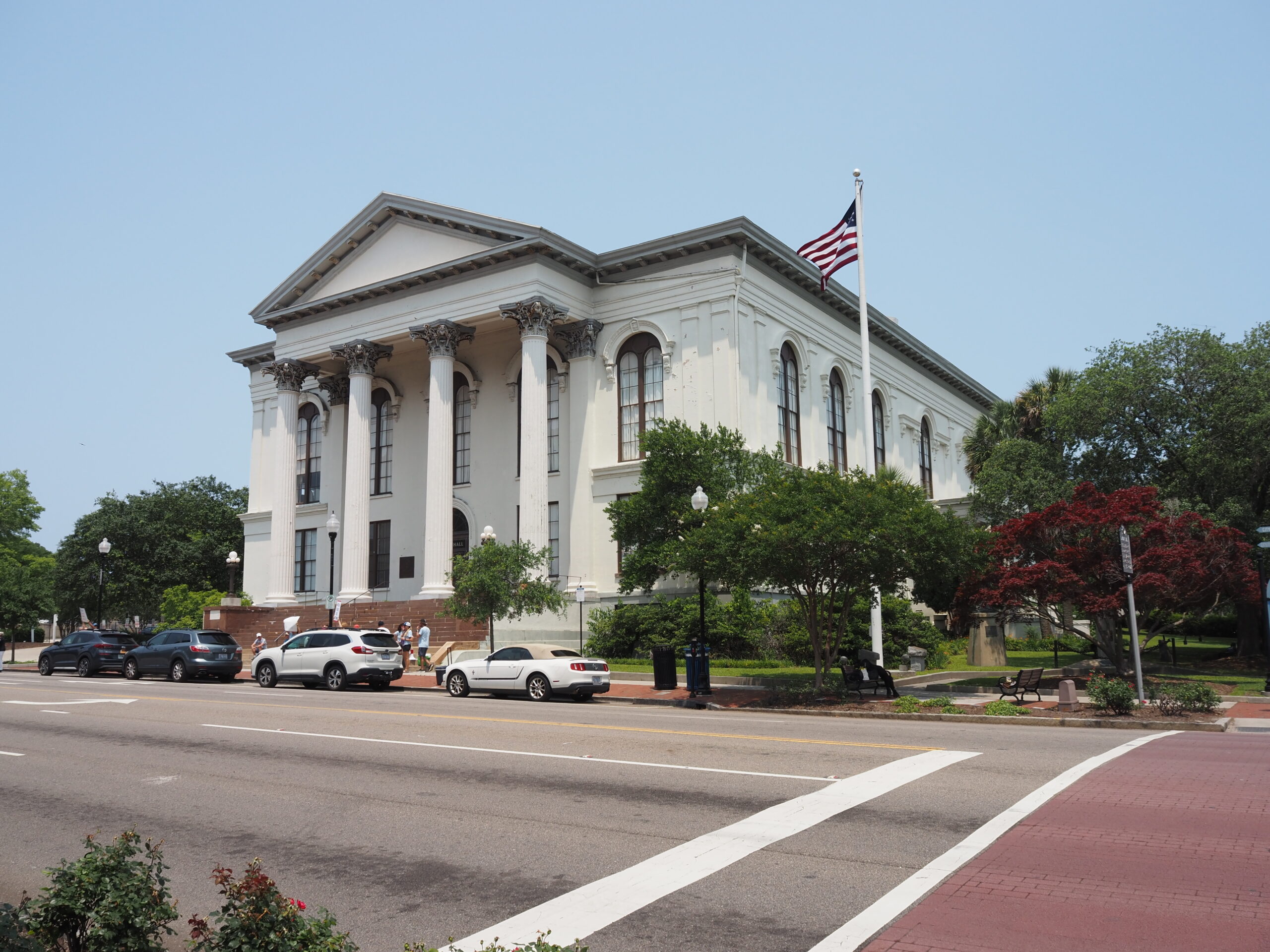
WILMINGTON — After a public camping ordinance to strengthen enforcement on homeless-related issues was tabled at a recent Wilmington City Council meeting, the discussion opened a platform to air issues surrounding homelessness. This included concerns about the city’s collaboration with New Hanover County.
READ MORE: After failing to pass last year, councilman wants to re-approach downtown public camping ordinance
ALSO: County probing new residential treatment center to expand efforts addressing homelessness
The public camping ordinance was discussed for nearly two hours by city council and staff at Wilmington’s Aug. 5 meeting, eventually resulting in it being tabled for further discussion in September. The ordinance would have restricted camping on public city property from 10 p.m to 7 a.m., with the goal to strengthen enforcement efforts.
However, during deliberation council members questioned the county’s participation and the efficacy and status of other initiatives that have been put forth to address an increase in homelessness in the area in the last five years.
For instance, city leaders and staff scrutinized previous joint meetings with the county and the county’s current involvement in the joint Getting Home Street Outreach Program. The latter launched three years ago between the two government entities to help the unhoused population receive services, shelter and potentially housing options.
“I know they started off well, Chief Evangelous can probably tell you, because he’s been looking into that program since he came back in his in his interim capacity, that they’re having some difficulty with the social workers from the county participating actively with them, and the officers can’t do it themselves without the social workers,” City Attorney Meredith Everhart stated.
Upon its launch, Getting Home paired City of Wilmington police officers with New Hanover County social workers to provide a holistic approach to connecting with the unhoused population face-to-face. The city provides officers and salaries, while the county contributes four social workers, a supervisor, and salaries.
Council member Salette Andrews asked WPD Interim Chief Ralph Evangelous if the program was still active, to which it is, though it’s undergoing shifts in operations.
Getting Home
Everhart innocuously dropped a bit of information before the council Tuesday that the county’s social workers were not actively participating in Getting Home, to which Evangelous agreed. He said social workers have moved from a proactive, “boots on the ground” approach to a “caseload” model, leaving WPD officers often without on-site support.
Evangelous added county social workers do come when called upon, but are not “going out to homeless camps.”
Although the county cut 11 social worker positions in June from the FY25-26 budget, County Health Director Jon Campbell told Port City Daily Getting Home is still fully staffed. He said the county’s participation in the program is actively functioning and evolving, with social workers managing their caseload of existing clients, while still accepting new ones, adding the county is fulfilling their duties for the program.
He added that this activity, including thousands of client interactions and a consistent downtown presence, is evidence of their ongoing commitment.
More than 100 people have been placed in permanent housing since Getting Home’s inception. From July 1, 2024, to June 30, 2025, 989 individuals were connected to shelters, with 52 placed in permanent housing. Additionally, the program provided 3,027 transports to service providers and linked 556 clients to medical or mental health services.
“Staff remain actively involved across known areas of need and respond to new encampments and referrals as they arise, Campbell said. “Each day, one team member is designated to respond to urgent or one-time requests, while the remaining staff continue engagement efforts and case coordination throughout the county. Caseloads are not full and team members remain focused on identifying and enrolling new clients who are not yet connected to services.”
Campbell went on to state the Getting Home team “values” its collaboration with the WPD and other local non-profit agencies, which he said are “central to providing coordinated and effective responses to the challenges facing unsheltered individuals.”
Demonstrating the county’s commitment, Campbell cited in an email that out of 5,801 total client interactions in the last fiscal year, 1,122 (20%) occurred in the downtown corridor alone, with social workers maintaining a consistent presence in the area.
Further refuting claims of a breakdown in collaboration, Campbell confirmed the agreement between the city and county for the program is in effect through June 2026. He also noted on July 31, Getting Home social workers met with newly reassigned WPD officers to reaffirm shared priorities and strengthen communication.
WPD spokesperson Lt. Greg Willett confirmed with Port City Daily that officers have been reassigned department-wide, attributing it to a shift in “operational dynamics.” He added “enforcement” for homeless-related issues has always remained in the last three years.
“The primary function of the officers initially assigned to the program was to provide security in the field for our partners at DHHS and to bridge the gap between people who were homeless,” Willett stated. “Once the program entered into a case management phase with DHHS, the presence of DHHS workers in the field was not as necessary, which allowed the personnel to be shifted from WPD’s end.”
Willett also said he was “confident” in all future communications with DHHS and county social workers, noting WPD officers assigned to the outreach program were never the sole point of contact with the unhoused population, as other officers also regularly interact with them.
In the few days following the council meeting, other obtained emails show county staff and WPD were planning a meeting for Aug. 7 to discuss the Getting Home program with the WPD’s homeless unit sergeant, downtown sergeant and Chief Evangelous.
Joint meetings between county and city
Some council members suggested on Tuesday revisiting previous joint meetings between city and county officials from last year.
The “Strategy to Address Unsheltered Homelessness” was created by city and county staff and last presented in 2024 to both the Wilmington City Council and New Hanover County Commissioners following a series of joint meetings. The strategy is based on a housing first approach, with its main goals being to increase the capacity of the Cape Fear Continuum of Care and its service providers, expand housing options, and improve coordination between local governments, nonprofits, and other community partners to better serve the unsheltered population.
Council member David Joyner told Port City Daily in July that county and city staff were supposed to return in 90 days from last fall’s meeting with cost estimates and a concrete action plan for review at a follow-up meeting. It was never scheduled.
“I walked out of the September meeting thinking we’d made real progress, and we said we would schedule another meeting approximately 90 days out,” Joyner said. “Each time I asked if we could get a date on the books I was told to wait until after the commissioners’ 2024 election. After the election, I was informed the meeting would never occur and the County would chart their own course on homelessness policy, apart from the City.”
According to an email thread between county and city staff from January 2025, county chief strategy officer Jennifer Rigby informed city housing and neighborhood services director Rachel Schuler the majority of county commissioners had decided not to hold another joint meeting.
While Schuler said the council “remained committed to a joint partnership,” Rigby stated this decision was made to focus on three priority areas — Continuum of Care capacity building, the Trillium partnership, and the Getting Home program — and should not be interpreted as a lack of commitment to collaboration with the city.
Councilmember Joyner expressed interest in revisiting last year’s previous joint meetings with the county, hoping to resume where they left off.
“We need to get back in the room with our county partners and see if we can get back on track with that plan,” Joyner said. “What the city can do alone, we’ll do alone, but this is a community issue that requires a community response.”
Similarly to Joyner, Andrews said she wants to move forward with the work that has been done, “with or without the county’s involvement.”
“Instead of implementing the plan that we all worked on, we had our staff work on, we put time into and it’s a good plan, we’re back revisiting this,” Andrews said. “It’s clearly not the answer to the problem.”
According to emails obtained by Port City Daily, County Manager Chris Coudriet and Campbell addressed concerns about the framing of the county’s involvement in addressing homelessness, as portrayed at the city council meeting. Campbell maintained communication with WPD has remained consistent.
Following Tuesday’s meeting, commissioner Dane Scalise sent an email to council member Luke Waddell, who brought forth the ordinance:
“I take great exception to your colleagues claiming during your meeting last night that the county has done anything other than make great efforts and investments into attempting to address the issue of homelessness in our community. I applaud you for making the effort to providing law enforcement with a humane and uniform tool in the toolbox.”
Waddell maintained to council on Tuesday the ordinance was an immediate solution, urging his colleagues to vote in favor of the measure.
“I think we can walk and chew gum at the same time, this is not an either-or situation,” Waddell said. “We can take action on the ordinance today and set this meeting and have more conversation with the county, without the county, I don’t care. I’m here.”
He later indicated the political will wasn’t strong enough on the council: “A lot of impassioned speeches and finger pointing and ‘it’s not us, it’s somebody else And I’m used to it at this point, but frankly, it’s weak leadership. I don’t have a whole lot of patience for it anymore.”
The proposed ordinance
It’s the second time in a year Waddell proposed the ordinance after it was defeated in a 2-5 vote in June of 2024 — he and Councilmember Charlie Rivenbark were its only supporters. The measure failed largely due to concerns it would criminalize homelessness and not address the root causes of the issue.
In 2022, Everhart advised the council to also await the outcome of the U.S. Supreme Court case, Grants Pass v. Johnson. The case tested whether cities could ban public camping even when they lacked sufficient shelter space for the unhoused. The Supreme Court has since ruled municipalities are legally able to issue and enforce laws regulating public camping.
President Trump also signed an executive order on July 24 titled “Ending Crime and Disorder on America’s Streets,” which shifts the federal approach to homelessness. The order aims to redirect federal resources away from housing-based programs and instead prioritizes institutionalization and criminalization.
Everhart explained to the council Trump’s executive order tasks federal agencies with evaluating grant programs to ensure municipalities meet specific criteria, including the enforcement of prohibitions on urban camping and loitering. Everhart stated Wilmington has $9.5 million in federal funding — including CDBG and HOME funds — at risk if it does not comply.
In Wilmington, these funds are used for supporting homeless services, creating affordable housing and supporting community development projects. Everhart noted while the city could argue its existing laws meet the criteria, passing the proposed ordinance would strengthen its position. However, she cautioned the executive order is likely to face legal challenges, making the outcome uncertain.
Waddell put forth the ordinance Tuesday after hearing multiple complaints from business owners regarding disruptive behavior, such as aggressive panhandling, public drug use and unhoused individuals camping outdoors.
He showed three videos during the meeting with separate incidents involving the unhoused taking place downtown. One individual followed a family down the street to panhandle, another showed a fist fight. The last incident was of a man being arrested by WPD officers after he locked himself in a young woman’s vehicle and refused to leave.
Andrews asked Evangelous which of the crimes shown in the video the ordinance would address.
“I don’t know that that would address anything, that was probably a felony,” Evangelous replied. “I’m not saying that the ordinance is the fix of all of this, because nothing’s the fix of all this.”
Everhart explained the city already has the authority to address encampments and public camping in most public areas, such as parks and parking decks, so the new rule would largely serve to strengthen existing enforcement.
Waddell’s ordinance to make public camping and sleeping in city-owned surface parking lots a class three misdemeanor is mostly a citation offense and punishable between 10 p.m. and 7 a.m. Other class three misdemeanors in North Carolina include simple assault or battery, shoplifting or larceny under $1,000, and disorderly conduct.
The city and state already have multiple laws that regulate issues related to the unhoused. Everhart explained that while the city already has the authority to enforce against these behaviors, the proposed ordinance would not create a new crime, but rather group them together under one.
Existing city codes already address aggressive panhandling (City Code Sec. 6-16), public urination and defecation (City Code Sec. 6-21), and the obstruction of streets and sidewalks (City Code Sec. 11-13). The city also has an existing ordinance (City Code Sec. 7-5) that explicitly prohibits sleeping or camping in parks overnight.
Interim Chief Evangelous spoke to the council about current enforcement and the impact of the proposed ordinance. While he said the ordinance would “be another tool in the toolbox” for WPD officers, he mentioned enforcement only goes so far to address the root problems of homelessness.
“We all realize we can’t arrest our way out of this problem, we can’t, it’s a mental health, addiction issue that drives most of this,” Evangelous stated. “We’re not reverting to arrests for the first thing. We’re not. We’re trying to help these people going forward.”
However, business owners gathered at the city council’s packed meeting to speak, insisting something needs to be done.
Josh Cranford, co-owner of The Copper Penny and Front Street Brewery, expressed “deep concerns” with the current “trajectory” of downtown Wilmington. A longtime resident, Cranford said he has seen the city grow but also an increase in what he called “vagrancy violence.”
“We’ve got people that are terrified to go downtown,” Cranford stated. “They tell me daily — and these are people that live downtown — ‘I won’t go back. Six o’clock, the sun goes down, we’re not going to mess with it.’ I’ve got families that come through and say, ‘We’re going to choose somewhere else to go.’”
Chap Wallace, owner of Port City Cheesesteak on Front Street, said some people have even declined his job offers, citing the downtown area’s unsafe reputation as the reason.
He mentioned he frequently had to “boot” unhoused people out of his business and is often called on to help area retail stores with young ladies working the front desk who are nervous by the disorderly conduct.
Calling the situation “sad,” Wallace detailed how owners also routinely clean up human feces from the front of their properties. He said a text chain exists among a group of downtown stakeholders.
“I mean, if y’all wanted to, I’ll take your numbers and I’ll put you in the text threads where we’re taking pictures of human feces to anybody in here,” Wallace said to the council.
Tom Harris, owner of Front Street Brewery, also spoke. He was concerned with and said while he wasn’t there to determine the best approach, admitted action was needed.
“I’ll probably take some heat on this but we need some sort of campaign,” Harris said, recognizing people against the ordinance didn’t think a camping ban was the right move. “I would urge them to consider being part of the solution, and if they want, some of the homeless people who are currently downtown to come camp in their yard, invite them. And I’m not being facetious. I’m being honest.”
Chief Evangelous suggested council members join a WPD officer for a ride-along to see what they deal with on a day-to-day basis and view first-hand their interactions with the unhoused. Since the meeting, council member Joyner has requested two ride-alongs: one downtown and another specifically for homeless encampments outside of downtown.
Even with President Trump’s EO, the Supreme Court’s ruling, and business owner complaints, Wilmington City Council remained divided on the no-camping ordinance.
Council’s division
After lengthy discussion Tuesday, Rivenbark motioned to pass Waddell’s proposal. However, Mayor Bill Saffo introduced a substitute motion to table the vote until the first meeting in September, which passed 5-2, Waddell and Rivenbark against.
“I want to make certain that we see both sides of this very clearly as to what it’s going to look like — funding, what the opportunities are,” Saffo said.
Councilmember Waddell responded “enough time has lapsed” on the issue.
Saffo said while he wants to address the issues affecting downtown, he also wants stakeholder input to consider all of the facts before making a decision on the ordinance.
“Just kick it down the road again, that’s exactly what we’re doing, Mayor, we do this way too often,” Rivenbark said to Saffo’s motion. “Those people need help tonight and the police need, as the chief so eloquently said, ‘another tool in their bag.’”
Speaking to the decision to table the ordinance, Mayor Pro-tem Clifford Barnett agreed with a “thorough exam” with stakeholders — business owners, shelters, and faith based groups — to gather all of the facts..
“We’re trying to find all of the nooks and crannies in order to make an educated decision,” Barnett told Port City Daily. “We do hear downtown, we do hear from the citizens of the city.”
Andrews told Port City Daily, from her viewpoint, there should be more services like shelter beds, transitional housing, and permanent supportive housing, to help individuals maintain a living space.
According to Cafe Fear Continuum of Care Director Andrea Stough, the tri-county area currently lacks sufficient shelter and housing to meet the high demand, with many programs already at full capacity. The 2024 PIT count reported a shortage of 113 beds in the region.
She told Port City Daily the strain is further intensified by rising rents and an increased rate of new homelessness — 86% of people entering the homeless services system locally are new to homelessness, an increase from 60% in 2020.
“These are not people that are criminals,” Andrews said at the meeting. “These are not people that are necessarily on drugs. They’re people who need housing, and we need to do something about that. And just putting more people in handcuffs isn’t the solution.”
Outside of law enforcement, the city has been actively funding and supporting programs to address homelessness. In fiscal year 2024-25, the City of Wilmington committed over $2.2 million for homelessness and community development initiatives. This funding includes $900,000 in federal Community Development Block Grant (CDBG) funds, $568,000 in federal HOME Investment Partnership funds, and an additional $779,000 from the city’s general fund.
These allocations are aimed at supporting a housing first strategy, which focuses on moving people into permanent housing, as well as funding nonprofit partners like the Good Shepherd Center who provide critical services like emergency shelter, case management, and new housing unit development.
Councilmember Kevin Spears recalled previous joint meetings with county commissioners where some solutions included a day shelter downtown with access to bathrooms and cooling stations.
“We need to expand our voluntary storage and hygiene services, which reduce clutter and improve conditions in public spaces without criminalizing the people who rely on them,” Spears stated. “And we need to support the Getting Home Street Outreach initiative and other non-police behavioral health response teams who can de-escalate and connect people to care.”
The city council will meet again on Sept. 9 at 6:30 p.m. to reconsider the ordinance.
Have tips or suggestions for Charlie Fossen? Email charlie@localdailymedia.com
Want to read more from PCD? Subscribe now and then sign up for our morning newsletter, Wilmington Wire, and get the headlines delivered to your inbox every morning.
