


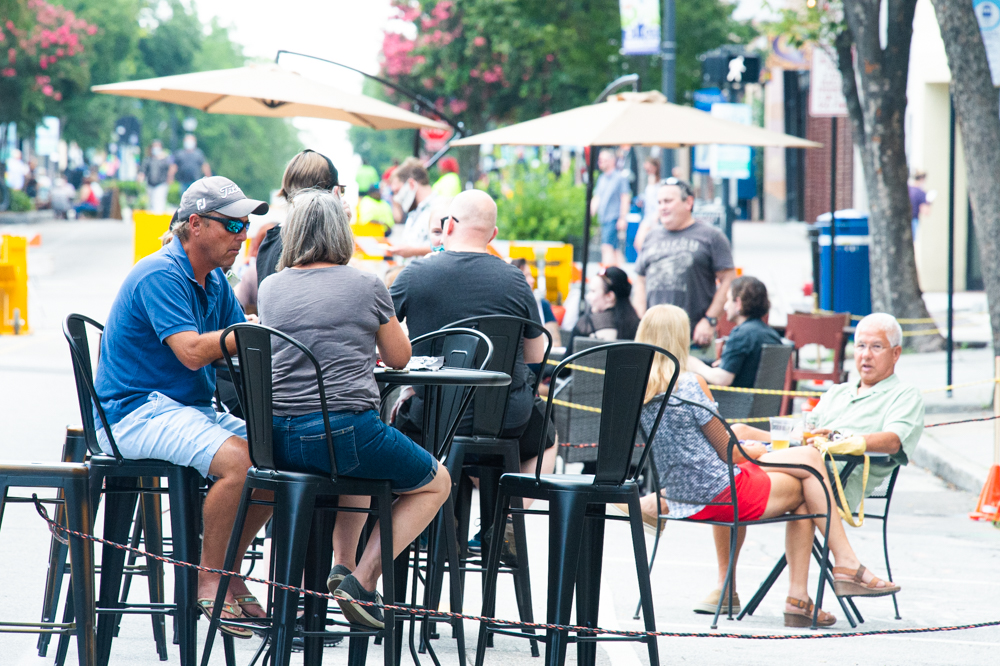
WILMINGTON — The ‘Downtown Alive’ program has been a lifeline for over a dozen downtown Wilmington restaurants. The program is set to sunset on Labor Day but it could be continued through Thanksgiving and possibly expanded to include more businesses — but only if the project can raise at least $125,000.
Downtown restaurants have already pledged to put their own money into an extended, expanded project and the Municipal Service District, which is funded by a special tax on downtown businesses, is also willing to kick in provided some conditions are met.
Related: Wilmington restaurant owners weigh in on ‘Downtown Alive’ program
The Downtown Alive program was initially floated after restaurants were placed under restrictions by Governor Roy Cooper’s executive orders. Those restrictions have since been relaxed slightly, but restaurants are still struggling to make ends meet while operating at 50% capacity.
Initial polling of the idea found it had overwhelming support, both from potential participants and the public. And, while many were surprised by the initial price tag — over $100,000, due in part to barricades needed to address security concerns — the plan won over city council and kicked off in late June.
In a presentation to city council on Tuesday evening, Downtown Business Alliance (DBA) President Terry Espy, who has shepherded the project from inception to implementation, said over a dozen restaurants have been participating in the project.
While there have been logistical hurdles, Espy said the restaurants are not just surviving but — surprisingly — in some cases doing as well as they have in previous Covid-free summers. Most restaurants also reported that their employees had returned from unemployment before the federal $600-per-week support had run out, a key indicator that their employers are doing strong business.
At the same time, Espy noted, this doesn’t make up for the weeks that restaurants were closed. Espy cited one downtown restaurant that spent tens of thousands of dollars keeping the business afloat on top of the lost proceeds from being closed.
Espy also noted that when Downtown Alive was first conceived, many were perhaps too optimistic about the course of Covid-19; most data now suggests the novel coronavirus will stick around, along with executive orders restricting business, into the fall.
So, while Espy said the program has “been a light in our bleakest moments,” businesses have to “face the reality is Covid-19 is not going away.”
Thus, DBA is asking city council to consider extending the program from its current end date of September 7 to Thanksgiving or ‘as long as possible.’ The program would continue to serve its current area and retain its limited hours on Thursday and Friday evening, and throughout the weekend.
DBA is also asking council to consider expanding the program to include ‘parklets’ — essentially, setting up dining areas in the parking spots along streets in a way that protects diners and, importantly, doesn’t require road closures. These could potentially include ‘water-filled barriers.’
Because these installations are difficult to install and remove, the parklet portion of the program would probably run all week, instead of during limited hours of the current program. Details, including how the parklet spaces would be set off and protected, and which blocks would join the program, would be part of future planning and discussion by city staff and, ultimately, city council.
The cost estimate for extending the program through Thanksgiving is $124,745, according to Espy. Expanding the program, either through the parklet concept or with another approach, would require additional funding beyond that.
Restaurants currently in the program have pledged $13,750 of their own money to help defray this cost. The Municipal Service District, which serves downtown businesses, has also offered $20,000 in funding through September — on several potential conditions, including restaurant buy-in. The MSD, which is funded by a special tax on downtown businesses, would consider additional funding in October and November depending on the success of the program. According to city emails, the MSD has a sufficient fund balance to cover the entire cost, while retaining a required minimum balance.
Several council members asked whether the program was benefitting other downtown businesses, noting that there are over 800 downtown businesses and, even with expansion, the Downtown Alive would impact a few dozen.
Espy and DBA member Joan Loch explained that the Downtown Alive campaign included marketing for a variety of businesses, including retail shops that weren’t participating directly. They also noted that while many of the shops lacked the staff to expand onto the street that they would benefit from increased foot-traffic downtown. Espy also noted that many downtown businesses are offices — including real estate and attorneys — which don’t need increased service areas but do benefit from a busier downtown scene.
It’s worth noting that while restaurants have certainly struggled with Cooper’s restrictions, bars have been hit even harder after being shuttered for months despite repeated appeals. Some establishments were able to lobby for exemptions — including breweries and distilleries — and others have found loopholes, like starting to serve food or being classified as bottle shops — most bars face financial ruin. While the Downtown Alive project can’t help bars that can’t open, it’s unclear if city leaders intend to explore alternative ways to help these establishments.
