


WILMINGTON — A recent approval of parking changes in a segment of downtown has fallen short of a warm welcome among the public, though Wilmington officials are defending the move as a well-studied attempt at balancing both business and resident needs in the city’s core.
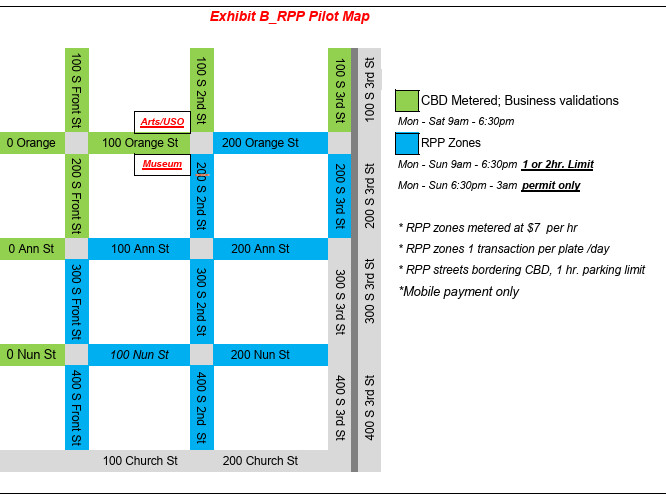
At its Nov. 17 meeting, the Wilmington City Council voted in favor of a temporary parking program to affect multiple blocks in the Chandler’s Wharf area of downtown. The goal is to steer drivers away from residential areas and toward the city’s commercial core.
The historic residential district is currently not metered but allows residents with parking passes to secure a spot; however, starting in January, between 9 a.m. and 6:30 p.m., anyone will be able to park, limited to either one- or two-hour parking duration, at a $7 hourly rate.
Also part of the pilot is a parking validation program for eight blocks abutting the residential area included in the pilot. Instead of paying $3 an hour to park, drivers in these eight blocks can get their parking validated at a participating business for $1.50 an hour.
The pilot raised several questions from council at the Nov. 17 meeting, including from JC Lyle, who asked what the rationale was for the residential rate amount and duration.
“It seems like we don’t want people downtown,” Lyle said, noting there isn’t a lot one can do within an hour.
Chance Dunbar, director of parking services, explained the pilot was developed after more than a year of conversation with city staff and the downtown parking advisory committee.
Dunbar said committee suggested the $7 because it was higher, and thus more likely to deter people, than the regular hourly rate. However, the rate could have just as easily been set at $5, he said, adding the rate amount was a nonissue among stakeholders.
No one on council suggested the rate should be $5 instead, and the vote to approve the pilot was unanimous.
Lyle’s sentiment has been echoed since the city and media picked up on the story, as many have questioned the necessity of the program and how it would impact visitors to downtown. One salient perspective came from Luke Waddell, former city council member.
Waddell wrote on social media the city has had three shootings downtown since June, including one this past weekend.
“Council spent more than a year on a plan to make it more expensive to come downtown. Making it safer to come downtown gets nowhere near that attention,” Waddell wrote. “Downtown needs people. People need to feel safe and welcome. Right now we’re charging them more and protecting them less.”
Port City Daily reached out to each council member for responses to concerns raised.
Andrews and Lyle both told Port City Daily a lot of focus is being put on the $7 rate, which can cause some sticker shock, but ultimately the program as a whole is beneficial.
Doubling down
Late Sunday evening, the city announced a press conference for Monday morning to discuss the parking pilot.
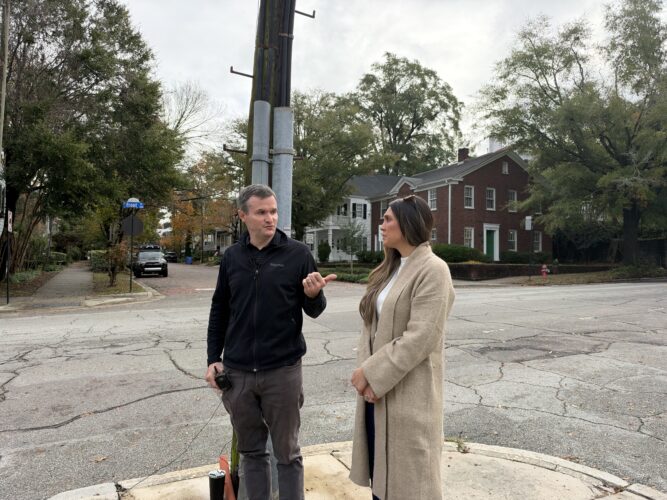
Held at the intersection of Ann and Front streets, where the residential and commercial downtown meet, Dunbar was joined by Wilmington Downtown Inc. CEO Christina Haley, also chair of the city’s parking committee.
Both stressed the pilot is intended to address a “quality of life” issue for downtown residents, while also encouraging business patronage.
Dunbar explained residents had been asking the city to examine changes to parking in the area for years.
The city began its residential parking program in 1996, allowing residents to buy passes to avoid parking meters in 10 blocks.
In 2023, the city added many of the streets that are part of the parking pilot to the residential parking program, though they have various rules. Some streets are open to public parking during the day and turn to permit-only at night; some are permit-only all the time. None of them are currently charging parkers. During the pilot program, all blocks will be open for $7/hour public parking at the same time and close for permit holders at the same time.
Prior to blocks’ admission into the permit program, Dunbar said they were at 110% capacity; after, it was between 50% and 60%. Still, the downtown parking advisory committee has continued discussing ways to improve resident parking in the area where the commercial meets residential.
“We wanted to ultimately reduce the volume of cars cruising for free parking in the residential,” Dunbar said, pointing out the noise and traffic can be a nuisance for homeowners, while continuous searching for a potentially free parking spot increases emissions.
Haley added the two- and one-hour time limits will also promote turnover, allowing residents a greater chance of finding a parking spot during the open hours for public parking.
At the council meeting, Dunbar told council there are 271 spots, all unlined, in the 11 residential blocks. Last year, the city only sold 170 vehicle permits, while distributing 180 visitor permits, issued to guests of residents for 48 hours.
Port City Daily asked the city how many complaints it had received from residents in the 11 blocks. A city spokesperson said they have been minimal since the blocks were admitted into the residential parking program in 2023.
“While resident complaints have slowed, the underlying challenge of balancing limited parking opportunities for residents with the needs of downtown businesses remains,” spokesperson Amy Willis wrote in an email. “The pilot is an opportunity to test a more balanced approach to managing parking demand in this area of downtown.”
To Port City Daily, Lyle acknowledged a $7 rate may be upsetting on the surface, but the spaces in the 11 blocks are necessary for residents, particularly those without driveways. The pilot is an attempt to balance their concerns with visitor attraction and make the rules consistent across the 11 blocks.
Lyle noted the residential side of the pilot is getting all the attention, but the validation program is at its heart.
“It’s not a silver bullet, but it is one element of a broader strategy,” Lyle wrote.
In the pilot’s eight validation blocks, there are about 119 parking spots. Only people parking in these spots are eligible for the discounted $1.50 rate, but any downtown business is able to offer the validation.
Dunbar said businesses can enter the program by calling his office, which will issue the business a code its employees can offer to customers. The mobile payment platform will also notify users if they parked in a spot where the discounted rate is available and tell them to find a business for validation.
Upon being asked if Dunbar or Haley were concerned the pilot program — particularly the $7 rate and confusion over where it applies — would deter people from visiting downtown, Haley said that was why the media was important.
“I think a lot of focus over the past seven days has been on a very small inventory of parking in the south of downtown,” Dunbar said. “The city manages over 5,000 parking spaces throughout downtown … so there are a lot of affordable, very, very convenient parking options throughout.”
The city still offers free first hours in its parking decks on Market and Second streets and through Dec. 26, the decks offer a $5 flat rate on Saturdays. Regular on-street parking remains free after 6:30 p.m. and on Sundays, while on-street parking along N. Third is free after 5 p.m. on weekdays and all day on weekends.
“Focusing exclusively on the $7 rate in a limited residential area overlooks the broader efforts the City has made to improve parking affordability and accessibility,” Andrews wrote in her email.
Additionally, both Lyle and Andrews reiterated the program is a pilot; council and the city manager can make changes throughout the year and choose whether to make any version of the program permanent at the end of next year. Lyle also shared council is scheduled to get an update on the program in May.
Downtown violence
Andrews and Lyle also addressed recent gun violence in the city with Port City Daily, acknowledging business owners’ concerns about how narratives downtown — whether parking changes or issues associated with nightlife — can affect their livelihood.
“Council has a responsibility to address multiple issues simultaneously, and approving a parking management pilot does not diminish our commitment to public safety,” Andrews wrote in an email to Port City Daily.
Haley told Port City Daily downtown businesses have shared concerns about the perception of downtown after two violent incidents earlier in the year. She said some businesses have reported revenue declines of 20% to 30% in the spring and summer, typically their busiest seasons.
“I think what people are asking is: How can we prevent this violence in the first place?” Lyle wrote. “That is not a question that is unique to downtown or unique to Wilmington. Gun violence is a society problem. We can only prevent it with society solutions that address the root problems — for example, investments in education, mental health, poverty reduction, and youth programs. We are not going to interfere with people’s legal gun rights.”
In August, the city had the opportunity to participate in the Responsible Hospitality Institute’s Sociable Cities pilot program. In coordination with Haley at WDI, Wilmington was chosen as one of the pilot’s three cities, intended to improve intercity and state-level collaboration on alcohol regulation, public safety and other areas.
Haley invited the city to participate, though city manager Becky Hawke declined the invitation, as previously reported by Port City Daily.
“It was not a city initiative effort,” a city spokesperson provided in a statement. “Once we were made aware of the opportunity, there were implications for our ordinances, policing models, and zoning. The City wasn’t comfortable engaging, given the limited information we had.”
The city has made staffing its police department a priority. The city budget includes a “living wage” for all city employees, though it was especially designed to recruit and retain WPD officers.
Andrews and Cassidy Santaguida told Port City Daily the Wilmington Police Department already has several initiatives underway to address potential problems downtown.
The WPD’s Downtown Task Force has been conducting targeted operations for several months to address crowding, sidewalk access, disturbances, and other public safety issues, according to Andrews. Officers have also conducted “hundreds of business checks” in addition to regular patrols, she said, while Santaguida said a WPD officer is permanently assigned to these checks and engaging downtown stakeholders.
Santaguida added the task force had a summer action plan conducting high-visibility traffic enforcement from 10 p.m. to midnight on Friday and Saturday nights.
The city’s downtown services team also meets with Wilmington Downtown Inc staff weekly to understand business concerns, she said.
Port City Daily asked the WPD to provide more detail about the targeted operations and business checks, but did not receive it by press.
Lyle pointed out, despite downtown being a “hot topic” these days, it is a gem to the city and remains a safe place to work, live and play.
“Most of the violence happens near bar closing times between people who are involved in an altercation already; people aren’t randomly getting attacked as they go out to dinner or enjoy the nightlife,” she wrote.
Data collected by the WPD shows a correlation between alcohol and crime, Santagiuda said, so she will be calling for the North Carolina General Assembly to review public intoxication laws.
Lyle added another shooting occurred outside of downtown on Saturday that did not get as much coverage.
Both council members acknowledged the city has more work to do.
Andrews shared she would like to build on the city’s efforts by evaluating crime trends and the concentration of alcohol-serving establishments. She would like to see what regulator tools are available to the city under state law, while also strengthening coordination between local enforcement agencies and the ALE, along with the city and downtown business owners.
The council member also raised the idea of improving public safety through environmental design, including lighting, visibility, and the management of public spaces.
Over the next month, Santaguida is scheduling meetings with various stakeholder agencies, including the District Attorney’s Office, the New Hanover County Sheriff’s Office, Alcohol Law Enforcement, and others. She shared she has already done ride alongs with WPD, including one with the Downtown Task Force on a Saturday night/Sunday morning, and will be scheduling another.
Lyle said council is exploring administrative and legislative options that would provide law enforcement, businesses, and council with more tools.
“Stay tuned to our regular meetings!” she wrote.
As for the downtown parking pilot, the $7 rate and validation options will go live Jan. 1, 2027.
At Port City Daily, we aim to keep locals informed on top-of-mind news facing the tri-county region. To support our work and help us reach more people in 2026, please, consider helping one of two ways: Subscribe here or make a one-time contribution here.
We appreciate your ongoing support.
